
 Search Articles


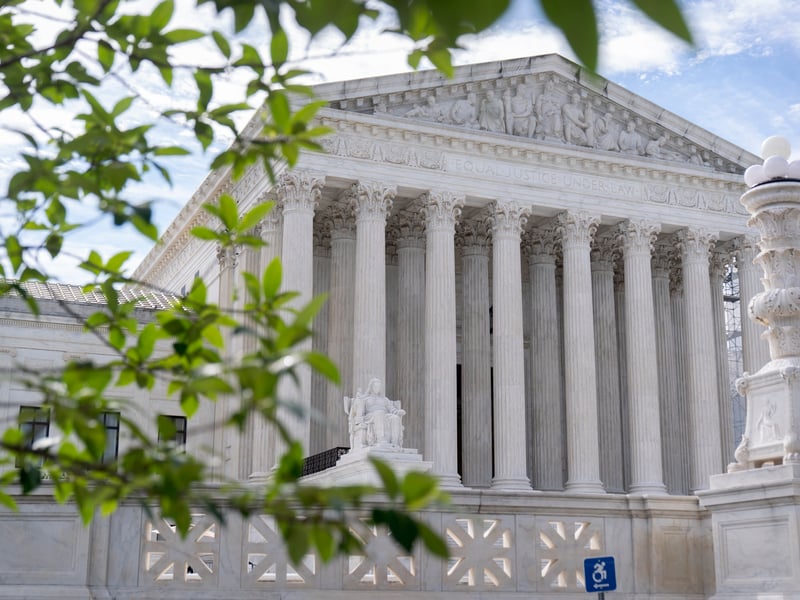
WASHINGTON (CN) — The Supreme Court will confront the future of online speech rights this week in a review of Texas’ age verification law for online porn.
On Wednesday, free speech advocates will try to convince the justices that Texas’ age verification law unlawfully limits adults’ right to online sexual material.
“Pornography is often the canary in the coal mine for free speech,” Vera Eidelman, an attorney with the ACLU’s speech, privacy, and technology project, said in a call with reporters.
In 2023, the Lone Star State enacted House Bill 1181, requiring commercial websites purveying sexual material the state deems harmful to minors to verify the age of every user. The covered websites must also display a warning condemning their content as harmful to health.
Texas says its law stems from a public health crisis caused by readily available hardcore porn. No one disagrees that the state can prevent kids from accessing porn. But free speech advocates warn it could also cover sex-education content or simulated sex scenes in Oscar-winning films.
The law applies to anyone under 18 years old. However, Texas’ age of consent is 17.
“Somewhat incredibly, Texas does permit under its law its older minors to engage in actual sex but not to seek out information about how to engage in that legal activity safely, with information, consensually, and to actually have the tools and information that they deserve and absolutely are constitutionally entitled to navigate their world,” Lee Rowland, the executive director at the National Coalition Against Censorship, said.
To access sexually explicit material under the law, adults must provide digital identification. That puts users at increased risk of leaks and hacks, creating a chilling effect on user access.
Websites and social media platforms are exempt from the law.
Free speech groups and an adult entertainment trade association, the Free Speech Coalition, sued the state, claiming that the law is unconstitutional. A lower court issued a preliminary injunction, but the Fifth Circuit allowed the age verification to go into effect.
The Supreme Court refused an emergency appeal halting verification requirements but took up the case to review this term.
The free speech groups argue that the law burdens adults, forcing them to incur severe privacy and security risks before accessing constitutionally protected speech. No one disputes that Texas can prevent minors from accessing porn, but the groups claim that governments often try to censor the internet under the guise of protecting kids.
“We see these concepts of considering what is harmful to minors as gateways to what can be imposed before people can have access to constitutionally protected speech,” Robert Corn-Revere, chief counsel at FIRE, said.
More than a dozen states have passed laws similar laws, and Texas argued that the websites already use age-verification software to verify the age of content providers. Pornhub and OnlyFans use Yoti, a third-party provider for these checks.
In an amicus brief, Yoti said it has completed over 700 million age checks worldwide using AI-driven facial technology. Just like a bartender, Yoti says its technology includes facial age estimation.
Using the camera on their device, users take a photo of their face that is analyzed by an algorithm.
“To the software model, the new image presented is simply a pattern of pixels, and the pixels are numbers,” Yoti wrote. “Facial age estimation technology has been trained to spot patterns in numbers and pinpoint how people of a particular age appear in those number patterns.”
Disputing advocates’ concerns about chilling free speech, Texas said the First Amendment cannot be leveraged to attack a state law because some adults might not be able to view content they have no constitutional right to view.
“A restriction on videos of ‘teen bondage gangbang[s]’ does not ‘invade[] the area of freedom of expression constitutionally secured to minors,’” the state wrote. “And whether or not such materials can be deemed ‘artistic, informative, or even essential to important parts of career and life,’ petitioners are free to produce, publish, and profit from as much of them as the adult market can bear.”
Violations of Texas’ law carry a $250,000 fine. Texas sued Pornhub for $1.6 million in February. The website suspended its services in Texas after the law was enacted.
 Follow @KelseyReichmann
 Follow @kelseyreichmann.bsky.social
Subscribe to our free newsletters
Our weekly newsletter Closing Arguments offers the latest about ongoing trials, major litigation and rulings in courthouses around the U.S. and the world, while the monthly Under the Lights dishes the legal dirt from Hollywood, sports, Big Tech and the arts.