
 Search Articles


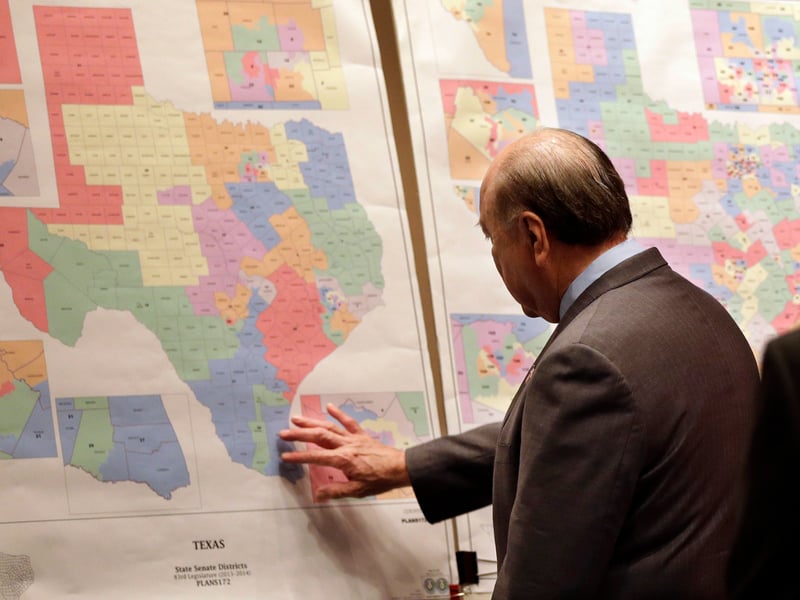
AUSTIN, Texas (CN) — Tensions ran high during a meeting on mid-decade congressional redistricting, as members of the Texas House heard calls from elected officials and everyday citizens imploring them to reject President Donald Trump’s request for more Republican seats in Congress.
Thursday’s public hearing of the House Congressional Redistricting Committee was the first opportunity for Texans to voice their thoughts on Governor Greg Abbott’s request for revised congressional maps. One after another, people overwhelmingly opposed the idea.
Democrats on the committee began the hearing by taking turns highlighting the ways they saw Abbott’s call as improper and in furtherance of Trump, who said he hoped to see five additional Republican seats created.
Representative Jon Rosenthal, a Houston Democrat and the vice chair of the committee, said the goals of mid-decade redistricting were not only politically motivated but also racially motivated. As evidence, he pointed to a U.S. Department of Justice letter sent to Abbott, accusing three Houston-area congressional districts and one in the Dallas-Fort Worth area of being unconstitutional “coalition districts” — where minority groups together make up a majority of the voting population.
“If you look at the four districts in question that the Department of Justice listed in their letter, this process is aimed at removing Black congressional representatives,” Rosenthal said. “Three of those four seats are Black held seats. That is an attempt to racially gerrymander our state.”
The coalition district argument advanced by the Trump DOJ is in part based on a 2024 opinion from the Fifth Circuit Court of Appeals in a case concerning whether minority groups can band together to challenge political maps in court. The opinion’s author said the Voting Rights Act did not allow Blacks and Latinos to file vote dilution claims in court. The Justice Department argued that this decision and others amount to unconstitutional race-based gerrymandering.
However, University of Michigan law professor Ellen Katz told the committee over a video call that if the state were to do what the Justice Department and Trump have asked it to do, it would result in the creation of blatantly illegal, discriminatory maps.
“Dismantling these districts, as the letter instructs, would require Texas to engage in improper considerations of race in violation of both the Voting Rights Act and the 14th Amendment,” Katz explained.
One of the seats at stake, Texas’ 29th Congressional District, currently belongs to Houston Democrat Sylvia Garcia. Attending the meeting in person, Garcia told lawmakers that they should be working to aid the victims of recent floods in the state, not try to break up her district.
“Ripping up the 29th District will silence the voice of this community, and that will be a travesty,” Garcia said. “The Voting Rights Act protects districts like the 29th with common interest, priorities and background. Given this, I urge you to reject this partisan gerrymandering of Texas, reject the map that may come soon from the felon in the White House, and do what Texans want: end this charade and support the families who are grieving.”
Attending alongside Garcia were fellow congressional Democrats Joaquin Castro of San Antonio and Greg Casar of Austin.
Proceedings were momentarily brought to a halt when Isaiah Matin, a candidate for Texas’ 18th Congressional District — which is currently vacant and also targeted in the Justice Department’s letter — was forcibly removed from the committee for refusing to end his fiery, finger-pointing speech, in which he accused Republican members acting on behalf of Trump and against their constitutents.
“You should all be ashamed!” Martin yelled while being carried away. “America will rise up!”
As of Thursday, over 50 proposed maps have been submitted to the state’s redistricting website. The committee’s chairman, Angleton Republican Cody Vasut, said at the start of the hearing that no maps are actively being considered at this time. Rather, this and subsequent meetings serve to allow members of the public to voice how they believe new districts should look. The Texas Senate’s redistricting committee will also be holding public meetings over the next several days.
Governor Abbott’s request for lawmakers to revise the state’s congressional map has put his fellow Republicans in the state house in a complicated position. Many of them voted in favor of the current maps in 2021, during the last redistricting cycle.
In addition, the state argued in a federal case brought by civil rights groups that its current maps were created through a “race blind” process. In response to the Justice Department’s letter, Texas Attorney General Ken Paxton echoed this argument. This contradiction has fueled Texas Democrats who assert their Republican counterparts are doing this to ensure their party retains control of the U.S. House in the 2026 midterm elections.
As the nation looks to see how Texas proceeds on redistricting, California’s Governor Gavin Newsom is weighing whether to have his state redraw maps to increase Democratic seats in the U.S. House. New York’s Governor Kathy Hochul is also reportedly looking to do the same.
Texas Republicans are operating under a tight deadline to deliver on Trump and Abbott’s request for revised congressional maps. Four days into a 30-day special session, they have dozens more hours of public testimony to hear and floor debates that are sure to be lengthy, as Democrats have vowed to drag out the process by any means necessary.
 Follow @KirkMcDanie1
Subscribe to our free newsletters
Our weekly newsletter Closing Arguments offers the latest about ongoing trials, major litigation and rulings in courthouses around the U.S. and the world, while the monthly Under the Lights dishes the legal dirt from Hollywood, sports, Big Tech and the arts.