
 Search Articles


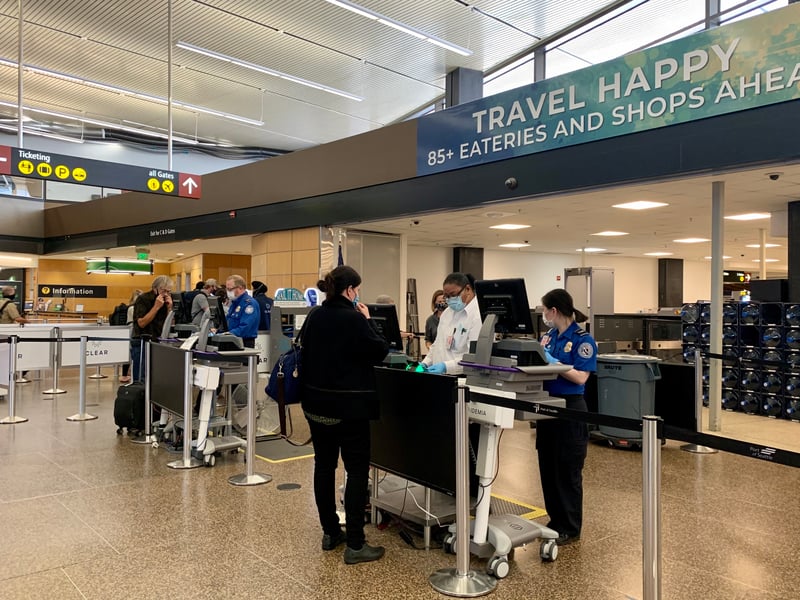
ALEXANDRIA, Va. (CN) — A claim that the government’s searching of cellphones belonging to those on the terrorist watchlist violates their Fourth Amendment right against unreasonable searches and seizure can proceed, a federal judge ruled Monday.
U.S. District Judge Michael Nachmanoff said a Muslim American can continue arguing that his status on the terrorism screening database fails to give the government a reasonable suspicion to search their electronic devices at the airport. The government claimed they wouldn’t add an individual to the watchlist unless they reasonably suspected they engaged in terrorist activities.
“The fact that at the time of nomination, a government agent determined that a TSDB candidate met this standard, however, is a poor fit for the reasonable suspicion standard required to justify a non-routine border search,” the Joe Biden appointee said. “For one, inclusion in the TSDB supports, at best, an inference that reasonable suspicion of national security-related crimes existed at and around the time of nomination — not months or years later.”
Nachmanoff said the claims of Osama Abu Irshaid, the executive director of American Muslims for Palestine, as applied to the Fourth Amendment can proceed, also noting that airport and federal officials have retained an indefinite seizure of his cellphone.
However, the judge dismissed the bulk of the complaint, granting thegovernment’s motion to dismiss the claims of Fifth Amendment and Administrative Procedures Act violations.
The plaintiffs claimed that demanding individuals whose electronic devices are seized provide passwords and threatening continued detention if they do not comply violates the Fifth Amendment’s protection against self-incrimination. Nachmanoff agreed with the government’s argument that the statements must be used in a criminal trial to qualify as a violation.
Gadeir Ibrahim Abbas, deputy litigation director for the Council on American–Islamic Relations, said in a phone interview that the right against self-incrimination is not limited to the right to be free from having illegally obtained evidence used against them in a criminal trial. Abbas pointed to Congressional hearings where people frequently “plead the Fifth” despite not participating in a trial.
“These people are placed on a list that is defined by the government’s belief that these people are suspect terrorists,” Abbas said. “So it’s, of course, focused on collecting information from people to use against those people."
The plaintiffs also claimed procedural due process violations of the Fifth Amendment arising from the government’s deprivation of their protected liberty interest in travel without meaningful process.
Nachmanoff relied on the Fourth Circuit’s analysis in Elhady v. Kable , a case brought by 23 individuals on the watchlist. In that case, the court examined the history of the right to travel, dating back to the Magna Carta. The court found that there is no constitutionally protected interest in being able to travel domestically or internationally without incurring some burdens.
The plaintiffs argued that a lack of constitutionally adequate avenues for redress violated the Administrative Procedures Act but Nachmanoff ruled that the plaintiffs failed to articulate in what manner the government’s actions were arbitrary and capricious.
The Council on American–Islamic Relations brought the lawsuit on behalf of six plaintiffs, including Abu Irshaid. Two of the plaintiffs are of Lebanese descent. The complaint names over 20 federal positions, including the directors of the FBI and the CIA, as defendants, though Nachmanoff dismissed 23 from the complaint Monday, finding that that they were only mentioned as parties without specification as to what their role in the injury was.
“When I first came to the United States almost three decades ago, what appealed to me were the constitutional rights and civil liberties that guarantee humans’ dignity,” Abu Irshaid said in an August press conference. “I’m joining this lawsuit because I have every right to defend my constitutional rights, to defend my civil liberties and to be treated with dignity.”
The plaintiffs each outlined similar experiences where their status on the watchlist resulted in searches of their devices, interrogations and detention.
“None of the plaintiffs in this case have ever been charged or convicted of a violent crime,” the plaintiffs said. “While they detain plaintiffs, the federal agents ask them humiliating questions about their lawful associations, family members, weapon ownership, and — in the case of Dr. Abu Irshaid — advocacy for the rights of Palestinians.”
During a trip from Dulles Airport in Washington, D.C., Abu Irshaid claims an airline agent could not print his boarding pass and only succeeded after a three-hour clearance process. Abu Irshaid said the government has yet to return a phone they confiscated when he returned from Qatar.
California-based plaintiff Mustafa Zeidan said that the government placed him on the no-fly list for his weekly protest calling for an end to Israel’s campaign in Gaza. Zeidan’s placement on the list bars him from traveling to Jordan, where he acts as a part-time caretaker for his mother.
The government created the watchlist after the 9/11 attacks on the World Trade Center. More than one million individuals have been added to the list, and more than 98% of the nominated names have been accepted. The list contains only the identities of the individuals on it and does not provide the reason for their inclusion.
Abbas said the organization plans to appeal the dismissals.
“I refuse to be assumed guilty until proven innocent, and I refuse to be convicted by the security apparatuses without due process,” Abu Irshaid said.
Subscribe to our free newsletters
Our weekly newsletter Closing Arguments offers the latest about ongoing trials, major litigation and rulings in courthouses around the U.S. and the world, while the monthly Under the Lights dishes the legal dirt from Hollywood, sports, Big Tech and the arts.