
 Search Articles


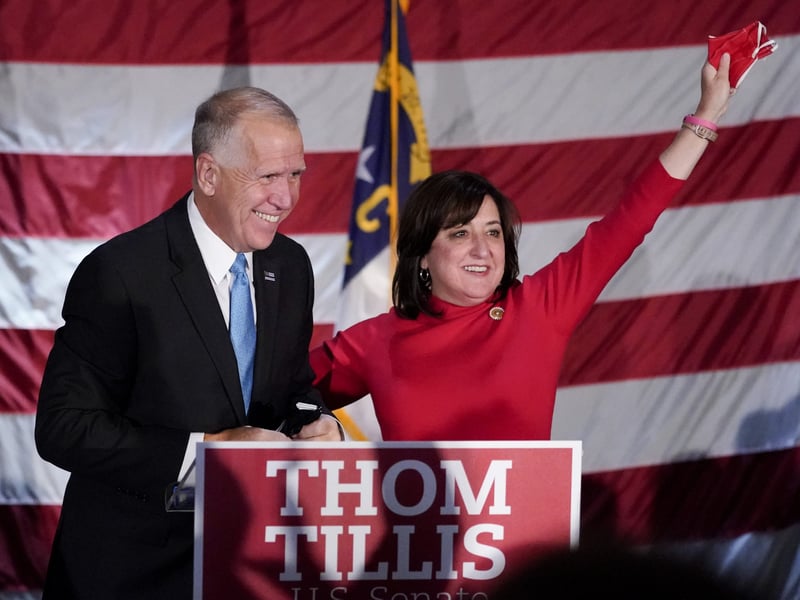
WASHINGTON (CN) — As Congress prepared to leave for its October recess this week, North Carolina Senator Thom Tillis doubled down on his vow to block a nominee for a federal appellate court and again accused the Biden administration of negotiating in bad faith on the judicial vacancy in his home state.
But White House officials are now disputing Tillis’ claims, arguing that he was not only misrepresenting the administration’s approach to the candidate selection process — but that it was the lawmaker himself who had actively refused to cooperate on reaching a consensus.
At issue is Ryan Park’s nomination to fill a vacancy on the Fourth Circuit Court of Appeals. His appointment currently sits before the Senate Judiciary Committee, which was scheduled Thursday to consider his nomination but cancelled the meeting after lawmakers passed a major budget bill Wednesday evening.
Delaying a vote on Park is no major setback for Democrats. It’s likely that his nomination will clear the committee, even if on party lines. But the move highlighted the churning controversy between Tillis and the Biden administration.
Tillis, whose constituents fall under the Fourth Circuit’s jurisdiction, has long complained that the White House ignored input from the Tar Heel State’s Senate delegation when considering candidates for the court vacancy.
During Park’s July confirmation hearing in the Judiciary Committee, the lawmaker said that he and fellow North Carolina Senator Ted Budd supplied four potential nominees but that all were rejected by the administration.
“What is the White House thinking?” Tillis said at the time. The senator, who pointed out that he has often crossed party lines to support President Joe Biden’s court picks, added that he was “ashamed” to be opposing a nominee for his home state.
Budd concurred, telling Courthouse News in July that the administration had “operated in bad faith” in its negotiations with the North Carolina Senators. “We tried to pair them with reasonable candidates, Democrat and Republican, and the White House violated that tradition,” he said.
But a senior White House official told Courthouse News Friday that the North Carolina delegation’s retelling of events was revisionist history, and that the administration had gone above and beyond to seek cooperation with the senators.
According to the official, the administration contacted Tillis and Budd early this year to work out a compromise agreement to fill several vacancies in North Carolina district courts and the Fourth Circuit — but the lawmakers slow-walked the process and repeatedly rejected several White House overtures, insisting on having control over the appellate nominee.
The Tar Heel State senators also insisted on establishing an independent commission to review potential jurists, but the body never examined any of the Biden administration’s candidates, the official said.
Senate Democrats, meanwhile, have argued that they are under no obligation to respect the input of Republican senators on appellate court nominees, thanks to precedent set by the GOP itself.
The Senate has long abided by a tradition known as blue slipping, which allows home state senators to support or oppose White House judicial nominees who would have jurisdiction over their constituents. Lawmakers until recently honored blue slips for both appellate and district court nominees — but the Republican Senate majority under then-President Donald Trump backed away from the process for circuit courts.
Senate Majority Whip Dick Durbin, who chairs the Judiciary Committee, has repeatedly said that by refusing to honor blue slips for appellate nominees he is simply following the standard set by Republicans.
That argument hasn’t stopped Tillis from committing to defeat Park’s nomination on the Senate floor — and to hold up other North Carolina court picks — as a message to the White House. The lawmaker has said that he has gathered enough votes to block the appellate nominee during a floor vote.
And on Wednesday, he reiterated that stance.
“The fact of the matter is, [Park] will not get out of the U.S. Senate,” Tillis told Courthouse News outside the Senate chamber. “I’ve secured the votes. I’ve done the work on a bipartisan basis to secure support on the floor.”
It would take several Democratic defections to torpedo a floor vote on Park, and so far, Tillis has refused to say which lawmakers he courted to break with the majority.
Carl Tobias, chair of the University of Richmond School of Law, said he wasn’t convinced that the North Carolina senator had the bipartisan support he claimed.
“I think he’s bluffing about that,” Tobias told Courthouse News in an interview. “I’m not calling him a liar, but I don’t see it. I don’t think he has those votes.”
If Democrats did break ranks to vote against Park, it wouldn’t be the first time such a thing has happened.
Nevada Senators Catherine Cortez Masto and Jacky Rosen have both publicly said they will not vote for Third Circuit nominee Adeel Mangi, amid a Republican campaign against the prospective jurist that many Democrats have branded as Islamophobic. And Georgia Senator Jon Ossoff in July cast a deciding vote against Southern District of New York nominee Sarah Netburn which prevented her from advancing to the Senate floor.
But so far, no Democratic lawmaker has publicly opposed Park’s nomination.
A senior White House official told Courthouse News that Tillis had informed the administration of his plan to block the nominee, but subsequently met with Park and expressed a willingness to stake out a position of neutrality on his appointment. The White House didn’t hear from the North Carolina senator again before Park’s confirmation hearing was scheduled, the official said.
Tillis has also said that his spat with the White House would similarly doom a slate of nominees to fill U.S. district court vacancies in the Tar Heel State. Speaking with Courthouse News on Wednesday, he suggested that he’d block consideration of those appointments until next year.
“If I can’t negotiate in good faith [with the White House] on the Fourth Circuit, why should I waste my time on the districts?” he said.
Unlike appellate nominees, Tillis could reasonably throw a wrench into the district courts confirmation process by withholding blue slip support.
But the senior White House official suggested the senator was omitting details of his negotiations on U.S. district court vacancies to make it appear as though his refusal to cooperate was the result of a perceived betrayal on the Fourth Circuit nominee.
Tillis had refused to work with the administration on district court nominations for as many as ten months before the appellate seat opened up, the official pointed out, noting that the White House had been in communication with the lawmaker about district court openings as far back as March 2023.
Tobias said the senator’s gambit to gum up district court confirmations was “ridiculous” and would deprive North Carolinians of as many as three federal judges. “You’re just punishing the judges and your constituents,” he said.
He also pushed back on the contention that the Biden administration had been unfair in its negotiations on the Fourth Circuit nominee, agreeing with the Democrats’ argument that the blue slip exception for circuit courts was a problem of the GOP’s own making.
“Sorry folks, you used it in Trump’s time, and now you just have to live with it,” he said. “Biden gave full consideration to the four candidates they sent forward, and he gave them four, and Park was the one Biden picked. What’s the problem?”
A spokesperson for the Judiciary Committee declined to comment on whether Durbin had discussed Park’s nomination with Tillis. The panel delayed an initial vote on the nominee last week while the North Carolina Republican was home responding to a family illness.
 Follow @BenjaminSWeiss
Subscribe to our free newsletters
Our weekly newsletter Closing Arguments offers the latest about ongoing trials, major litigation and rulings in courthouses around the U.S. and the world, while the monthly Under the Lights dishes the legal dirt from Hollywood, sports, Big Tech and the arts.