
 Search Articles


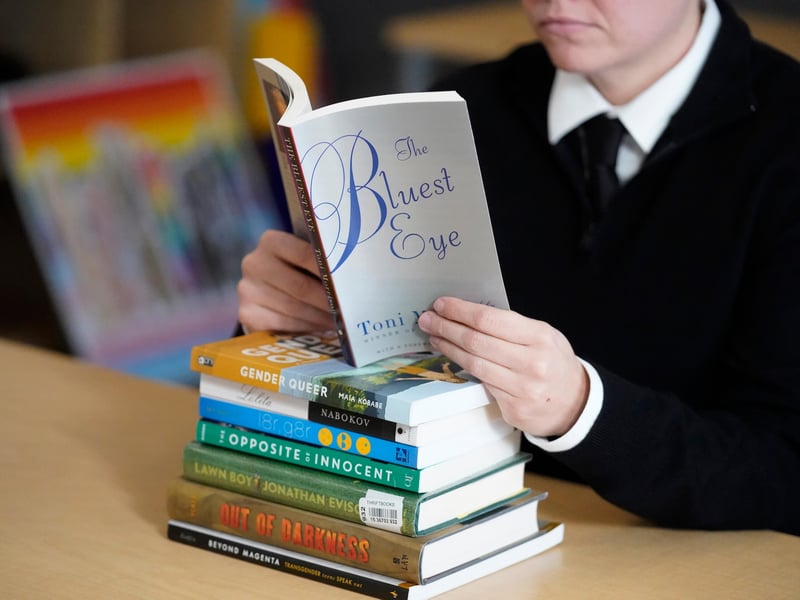
RICHMOND, Va. (CN) — A report presented to a group of Virginia legislators Monday reveals that school boards have removed over 220 books from their schools’ libraries since 2020.
The Joint Legislative Audit and Review Commission survey asked Virginia’s 131 school divisions if they have school library book removal policies and the number of books currently banned. The survey found that almost two-thirds of the participating divisions hadn’t removed any books for content-related purposes.
The survey revealed that a significant portion of the increase in banned books is attributed to a misinterpretation of a 2022 law. Virginia’s Republican Governor Glenn Youngkin signed into law a bill that required divisions to adopt policies aimed at notifying parents if their child is slated to read instructional material containing sexually explicit content and provide alternatives.
According to Josh Brown at the Joint Legislative Audit and Review Commission, divisions cited the law despite it not mentioning library books in its language.
“But in reality, that 2022 law doesn’t necessarily prohibit sexually explicit content, and it certainly doesn’t require, even contemplate, removing a book from a school library if it does include sexually explicit content,” Brown said. “If you read that law, it’s quite clear that isn’t what’s supposed to apply.”
Delegate Marcus Simon, a Democrat, explained that his party feared the law would lead to blanket book bans when it passed.
“When this bill was first passed, I think there was a prediction by some of us made that this is exactly how it would be read,” Simon said. “Isn’t there a danger that once a complaint is made, the path of least resistance for some of these school systems would be, instead of coming up with an alternative assignment for that kid, to remove the book and deprive all kids of the opportunity to read it.”
Regardless of their reasoning, Virginia gives local divisions ultimate control over the contents of a school’s library. According to the survey, 88% of responding divisions reported having a school book removal policy in place. The policies differ, but the majority include a review committee comprised of principals, librarians, teachers, parents and students. The majority also allows the complainant to appeal the review committee’s decision, first to the Superintendent and then to the school board.
Transparency is also an issue that Simon raised. Some divisions reported not maintaining records of book removals. Other divisions reported that review committee meetings are private and not subject to Freedom of Information Act requests.
Delegate Mark Sickles, a Democrat, contrasted the supposed secrecy of some review committee meetings with his time serving on the board of a public library.
“If someone challenged a book, we had a procedure for the public to have input on whether they wanted that removed or not, and a lot of times, we asked for suggestions for alternative books,” Sickles said.
Of the commonwealth’s 131 divisions, only 94 responded, marking a 72% participation rate. Majority Leader for the House of Delegates Charniele Herring appeared frustrated at the lack of responses. Brown said the participation rate is lower than usual and that the data reported is likely only the floor of the potential number of books removed.
“This is probably the floor, and it violates the intent of the legislature, what’s going on in some divisions, and it just is very concerning,” the Democrat said. “Access to literature is important. Parents’ consent to access is very important, too, and so I am concerned about our intent as a legislature not being implemented.”
Divisions that didn’t respond include Culpeper County, Botetourt County, Henrico County and Danville, the majority of which voted for President Donald Trump in the 2024 election.
Hanover County, a rural community just north of the state Capitol, accounts for the most banned books, having removed 125 since 2020. Rockingham County, a rural community in the Shenandoah Valley, ranked second in removals with 57.
“As is reflected in our adopted policy, the school board believes in our libraries providing a wide range of age-appropriate materials. The deselection of these books fulfills the will of the school board, our approved policy, and the accompanying regulations,” Hanover School Board chair Whitney Welsh said in a statement. “We do not have plans to revisit this policy."
When asked, the bulk of divisions that banned books claim they removed books for inappropriate, sexually explicit content. Among the banned books are award-winning novels, such as “Gender Queer: A Memoir” by Maia Kobabe, “Tilt” by Ellen Hopkins and “The Perks of Being a Wallflower” by Stephen Chbosky, which explores themes including queerness and youth suicide.
Toni Morrison’s debut novel, “The Bluest Eye,” which tells the story of a young Black girl growing up and experiencing racism in post-Great Depression Ohio, is banned in four divisions. The novel, which earned Morrison a Nobel Prize for Literature and a Pulitzer Prize, also explores themes including incestual rape.
Other notable removed books include the Hugo award-winning anti-war novel “Slaughterhouse-Five” by Kurt Vonnegut, “Looking for Alaska” by John Green, “The Handmaid’s Tale” by Margaret Atwood, “Water for Elephants” by Sara Gruen and Jay Asher’s “Thirteen Reasons Why.”
“If they are anything like me when I was a teenager growing up, or my kids, you just created a great reading list that kids are going to focus on and read,” Democratic State Senator Jeremy McPike said of the over 220 banned books.
Subscribe to our free newsletters
Our weekly newsletter Closing Arguments offers the latest about ongoing trials, major litigation and rulings in courthouses around the U.S. and the world, while the monthly Under the Lights dishes the legal dirt from Hollywood, sports, Big Tech and the arts.