
 Search Articles


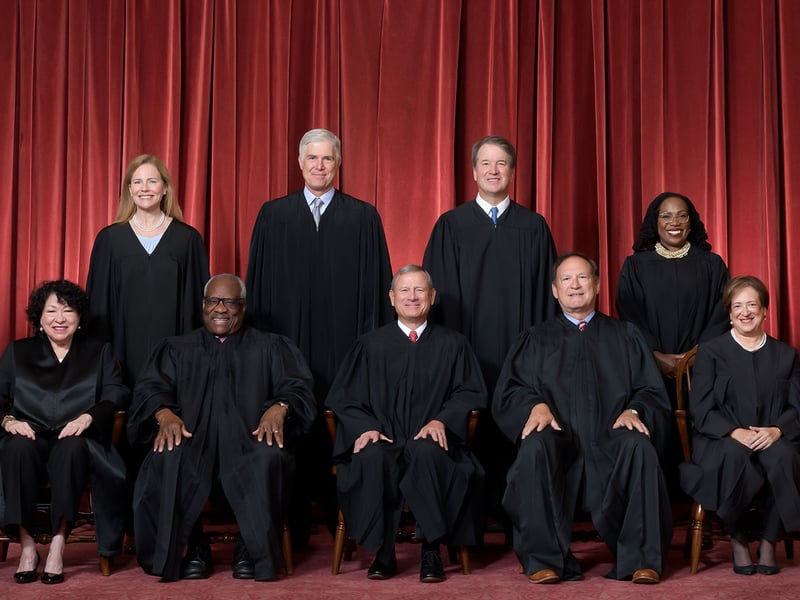
WASHINGTON (CN) — As voters prepare to head to the polls, the justices return to the bench with a docket full of appeals that could help or hurt the next administration’s policy goals.
The court reshaped executive authority in multiple blockbuster cases last term, limiting federal agency power in one while giving immunity to presidents in the other. While only former President Donald Trump can utilize the latter right now, diminished administrative authority will have an impact on both candidates.
Ghost guns
Vice President Kamala Harris wants to build on the Biden administration’s record on gun control, but the justices could reverse those accomplishments before she could push for more.
At risk is a 2022 rule from the Bureau of Alcohol, Tobacco, Firearms and Explosives that required manufacturers to include serial numbers on weapons parts kits and conduct background checks.
Before the rule, 3D-printed guns, their housing elements, called receivers and unfinished frames, or other components allowed manufacturers to sell legal guns without serial numbers — which are typically illegal. Ghost guns, as they’ve come to be called, weren’t covered by gun laws because they were sold disassembled. Without serial numbers and background check restrictions, the weapons became popular with children and criminals.
In just four years, ATF reported an over 1,000% increase in ghost guns submitted by police departments for tracing. The administration said less than 1% of the over 45,000 weapons could be traced back to individual purchasers.
The Biden administration took action by interpreting the Gun Control Act’s definition of firearm to include readily completed weapons parts kits, but gun sellers and manufacturers said the rule was much more expansive.
Cody Wilson, the director of Defense Distributed, a defense contractor serving the general public, said gunmakers were alarmed by the scope of the rule.
“We began to understand how this would affect the industry and how this would affect retail in our space, and we decided we’d probably have to become intervener plaintiffs,” Wilson said.
The administration wanted to target cheap, easily assembled pistol-type kits, but Wilson said the rule extended further into the gun market. He noted rules about so-called 80% receivers, or the unfinished housing for a weapon’s internal parts.
“The real practical outcome for the pendency of the rule in the litigation was companies would have to pick either selling a type of 80% receiver or selling the tools or the fixturing, but not both, as the rule says you can’t do both,” Wilson said.
Until this last term, courts would defer to agencies like ATF to interpret statutes, but Loper Bright Enterprises v. Raimondo did away with precedent so judges could exercise their independent judgment.
The Fifth Circuit used its newfound command to throw out Biden’s ghost gun rule, finding that only complete firearms are covered by the act.
The Supreme Court allowed the rule to be enforced despite the ruling but ordered a full briefing on whether weapons parts kits can be considered firearms under the statute.
The justices will hear arguments in Garland v. Vanderstock on Oct. 8.
Social policies
A potential second Trump administration would also be bound by Loper Bright , but the ruling aligns with Republicans’ policy preferences. Many conservatives criticize bureaucratic overreach, viewing agency action as a substitute for policy that can’t pass Congress.
Trump and Republican lawmakers have called for rollbacks on “progressive social policies” such as diversity, equity and inclusion and climate change. Conservative states and industry groups started on this goal before the term begins, filing dozens of emergency appeals targeting three Biden administration policies that reduce power plant emissions.
The Environmental Protection Agency faces additional headwinds. The justices will weigh in on the agency’s authority to issue permitting requirements under the Clean Water Act, and review impact reporting requirements under the National Environmental Policy Act.
Lisa Heinzerling, a law professor at Georgetown University, said the cases are part of the court’s continuing war on the administrative state. Heinzerling said that while the court will answer statutory questions in both cases, less reliance on agency expertise led challengers to shift their arguments away from the statute’s text.
“The Supreme Court has opened up such amorphous ideas and allowed them to affect agencies’ legal decisions,” Heinzerling said. “That’s what this invites. It invites departure from the text, departure from the purposes [of the statute], and it flies to pro-industry policy points.”
San Francisco v. EPA will be argued on Oct. 16 and Seven County Infrastructure Coalition v. Eagle County, Colorado will be heard in the following months.
The rulings in those cases threaten Harris’ plans to address the climate crisis. The justices’ rulings could also interfere with her anti-discrimination protection proposals for transgender Americans.
Republican legislatures in 26 states have passed bans on gender-affirming care for transgender individuals. The justices will hear the Biden administration’s challenge to Tennessee’s ban on health care for transgender youth.
SB 1 prohibits doctors from prescribing puberty blockers or hormone therapy to treat gender dysphoria. Physicians who violate the law can be fined $25,000 and risk losing their medical license and opening themselves up to civil liability in private lawsuits.
Sasha Buchert, director of the nonbinary and transgender rights project at Lambda Legal, said three transgender children, their parents and a doctor challenged the law’s constitutionality because it discriminates against a protected group.
The Biden administration joined the lawsuit, claiming SB 1 violated equal protection because since a transgender boy cannot receive puberty blockers or estrogen but an adolescent assigned female at birth can, Tennessee’s ban discriminates based on sex.
U.S. Solicitor General Elizabeth Prelogar said SB 1 can’t stand under Bostock v. Clayton County , a 2020 ruling recognizing transgender people as a protected group under Title VII of the Civil Rights Act.
But Tennessee argues that the state has an interest in encouraging minors to appreciate their sex and that Bostock was limited to Title VII.
How the court interprets Bostock in U.S. v. Skrmetti will be consequential for the flood of litigation over LGBTQ rights in the lower courts.
“It has serious consequences for sex discrimination doctrine at large with regard to how courts view these questions and if they’re going to return us to those times of limiting the number of hours that women can work based on ’endurable differences,’ the kind of thing that we witnessed from 50-60 years ago,” Buchert said. “I think that’s the kind of thing this would herald in.”
Protections for children will be a theme in the 2024 term. The justices are set to review the Food and Drug Administration’s ability to prevent companies from marketing flavored vapes likely to attract children to e-cigarette use and Texas’ age verification rule for adult websites.
Election questions
The justices have granted fewer than 30 cases so far, leaving lots of room for additional appeals on the 2024 docket, particularly election-related cases.
The justices already took emergency action to reinstate Arizona’s proof-of-citizenship requirement for state ballots and prevent third-party candidates from being printed on Nevada’s presidential ballot.
Court watchers speculate that fights over mail-in ballot deadlines and dating absentee ballots will make their way to the justices.
Jessica Marsden, director of impact programs and counsel for free and fair elections at Protect Democracy, said the 2022 ruling in Moore v. Harper could play a role in the 2024 elections. In Moore , the justices held that state courts could review state legislatures’ election laws. The court also created an opportunity for federal courts to intervene.
“The size of this loophole is sort of unknown at this point in time, but there are cases percolating that will raise this issue and sort of test the size of that loophole,” Marsden said.
If the Supreme Court is asked to weigh in on any election disputes, Marsden said the justices could affect how voting happens in November, or which ballots get counted.
The 2024 term officially begins on Oct. 7.
 Follow @KelseyReichmann
 Follow @kelseyreichmann.bsky.social
Subscribe to our free newsletters
Our weekly newsletter Closing Arguments offers the latest about ongoing trials, major litigation and rulings in courthouses around the U.S. and the world, while the monthly Under the Lights dishes the legal dirt from Hollywood, sports, Big Tech and the arts.