
 Search Articles


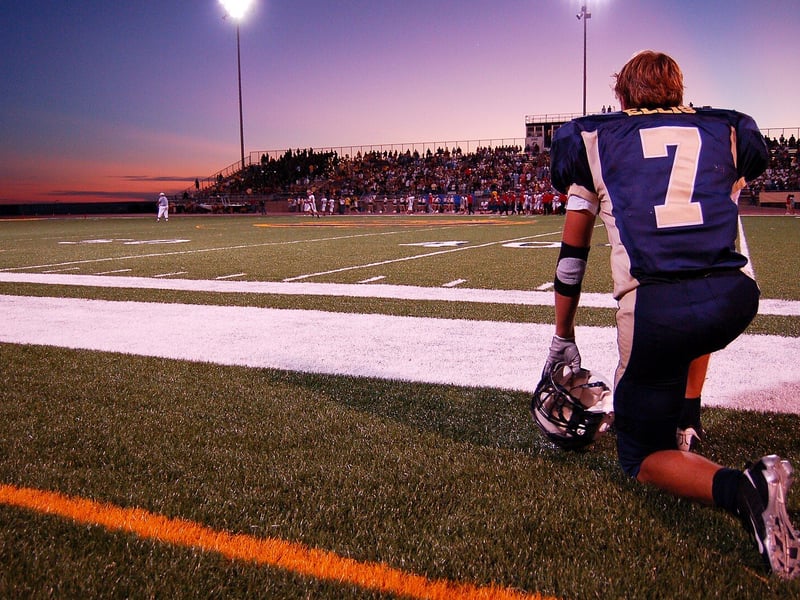
WASHINGTON (CN) — The Supreme Court refused on Monday to put prayers at high school football games back in the spotlight.
Three years ago, the high court ruled in favor of a coach’s mid-field prayers during games in Washington state. A Florida Christian school asked if such conduct could be broadcast over a loudspeaker.
“Nearly a decade ago, a bureaucrat decided that allowing two Christian schools to audibly pray in a stadium would breach the ‘separation of church and state,’” the school wrote. “It may seem like a trifle to some. But for the faithful at Cambridge Christian, and others subjected to religious discrimination by officials high and low, defending the right ‘to live out their faiths in daily life’ is no small matter.”
In 2015, Cambridge Christian School faced University Christian in a championship football game. The latter prayed over the loudspeaker when two Christian schools played in a previous championship game in 2012.
Cambridge Christian made a similar request for the 2015 game, however, the Florida High School Athletic Association, a state-created entity that organizes and regulates a high school athletic league for public and private schools, denied its appeal.
Because the game was hosted at a publicly funded facility and it was a state action, the association said federal law barred it from granting permission for such activity.
The two schools prayed on the field together before the game. Cambridge Christian sued the association in 2016 for prohibiting the loudspeaker prayer.
In the middle of their legal battle, the Florida Legislature created a statutory right for each school participating in championship contests to make brief opening remarks over the loudspeaker that the association may not control, monitor or review.
Under the 2023 law, the association says prayers are now permitted over the loudspeakers. In 2015, when Cambridge Christian’s game took place, the association argued that granting permission for the prayer would have been transforming a special privilege into a right available to every participant in the league. However, the Legislature’s move to shield remarks from the association’s control made the schools’ remarks private speech, negating the association’s establishment clause concerns.
Two lower courts ruled in favor of the association, holding that Cambridge Christian didn’t have standing for its prospective claims and dismissed any retrospective claims based on the association’s government speech. Cambridge Christian asked the Supreme Court to review its case.
“The decision below is egregiously wrong, splits with other circuits and presents issues of utmost importance for religious liberty in this country,” the school wrote. “If the decision stands, it will be virtually impossible to overcome government speech defenses, and the government will again be empowered ’to single out private religious speech for special disfavor.’”
Attorneys representing Cambridge Christian said that despite the denial, their case forced the Florida Legislature to enact greater protections on religious rights.
“While it’s disappointing the Supreme Court chose not to take up the case to reverse the wrongheaded precedent that led to these events, we are gratified that religious liberty protections in Florida are now stronger today than when we began this case,” Jesse Panuccio, an attorney with Boies Schiller, said in a statement.
The justices did not explain their decision to deny certiorari. There were no noted dissents.
 Follow @KelseyReichmann
 Follow @kelseyreichmann.bsky.social
Subscribe to our free newsletters
Our weekly newsletter Closing Arguments offers the latest about ongoing trials, major litigation and rulings in courthouses around the U.S. and the world, while the monthly Under the Lights dishes the legal dirt from Hollywood, sports, Big Tech and the arts.