Search Articles


(CN) — The U.S. Supreme Court reversed a federal appeals court judgment on Monday that enabled the release of a man convicted of the infamous 1979 murder of a 6-year-old boy in New York.
The justices determined the Second Circuit wrongfully nullified the jury verdict convicting Pedro Hernandez, based solely on the state trial judge’s purported failure to instruct the jury in accordance with Missouri v. Seibert.
The 2004 ruling addressed the constitutionality of an interrogation tactic under which police question a suspect in custody without providing a Miranda warning and then, after eliciting a confession, provide a Miranda warning and ask the suspect to repeat the confession. The Supreme Court ruled that the use of the tactic in that case violated federal law.
In his writ of habeas corpus application, Hernandez argued the trial court judge should have instructed the jury to decide whether his confessions made before receiving Miranda warnings tainted his later admissions.
“But Seibert said nothing about jury instructions,” the majority wrote in a collective opinion.
That opinion established nothing about a jury’s determination of a confession’s legality, they added. Seibert concerned a trial court’s ruling on a suppression motion, not a jury’s assessment of whether evidence was illegally obtained.
“We have never applied Seibert in any other procedural context,” the justices wrote.
The justices also said its case law does not support the Second Circuit’s conclusion that Hernandez’s right to due process was violated by the trial judge’s response to a note from the jury.
When jurors asked whether they must disregard Hernandez’s later confessions if they find his initial ones were not voluntary, the trial court judge told them no, despite Hernandez’s objections.
“We have never held that the due process clause, or any other provision of the federal Constitution, requires a trial court to explain to a jury an issue that the jury is not required to decide,” the justices wrote.
Therefore, the Second Circuit exceeded its authority under the Antiterrorism and Effective Death Penalty Act of 1996, which imposes strict limits on federal courts’ power to grant habeas relief to a prisoner convicted in state court, the justices added.
They explained a federal court may grant habeas relief on a claim that a state court has resolved on the merits only if that decision was “contrary to, or involved an unreasonable application of, clearly established federal law.”
Unlike New York law, federal law does not “require that both judge and jury pass upon the admissibility” or voluntariness “of evidence when constitutional grounds are asserted for excluding it,” the justices wrote.
So, Hernandez had no federal right to have the jury evaluate the lawfulness of his confessions after the trial court admitted them, they added.
“The panel’s opinion appears to reflect serious doubt about the reliability of Hernandez’s confessions, but AEDPA does not allow a federal habeas court to disturb a state-court conviction based on such an evaluation of the evidence,” the justices wrote.
However, Justices Sonia Sotomayor, Elena Kagan and Ketanji Brown Jackson disagreed with the others and said they would have denied the state’s petition for review of the Second Circuit’s decision.
The state sought the high court’s intervention after the Second Circuit remanded the case with instructions to order Hernandez’s release unless the state gave him a new trial.
Unlike lower courts, the federal appeals panel found the trial judge’s “no” answer to the jury’s note to be a “manifestly inaccurate" error that warranted habeas relief.
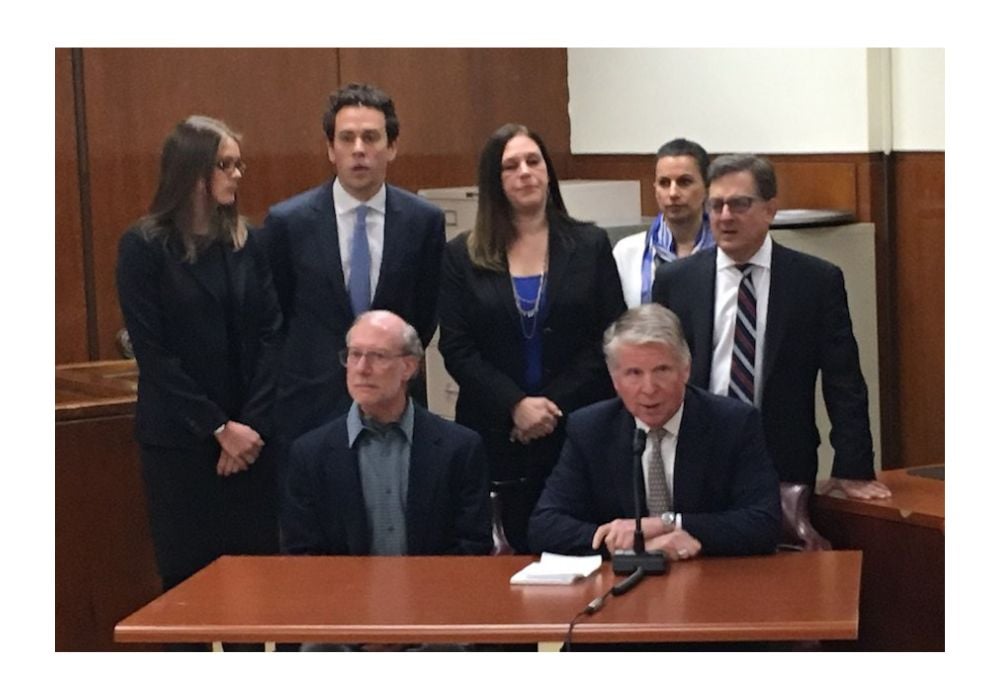
“Today the Supreme Court agreed with the findings of multiple lower courts and upheld the trial conviction of Pedro Hernandez for the horrific murder of Etan Patz, which changed a generation of New Yorkers," Manhattan District Attorney Alvin Bragg said in a press release.
“This office has remained steadfast in its pursuit of justice for Etan and the Patz family and will continue to stand by this important conviction. I thank the prosecutors in my office, especially our appellate attorneys, for their dedication and perseverance,” Bragg added.
In 2016, the jury found Hernandez guilty of kidnapping and felony murder, and he was sentenced to 25 years to life in prison. The first trial against him ended in a hung jury.
On May 25, 1979, 6-year-old Etan Patz left his family’s apartment in lower Manhattan to take a bus to school. Before boarding the bus, he stopped to buy a drink at a bodega where Hernandez, then 18, was working.
Patz never got on the bus and was never seen alive again. Despite a vigorous search, law enforcement could not locate him or find evidence of his fate and spent the following 20 years investigating several suspects until the case went cold.
But in 2012, Hernandez’s brother-in-law reported that Hernandez, who was living in New Jersey at the time, made statements about his involvement in Patz’s disappearance and suspected murder.
While being questioned at the Camden County Prosecutor’s Office before a Miranda warning was administered, Hernandez eventually confessed to strangling Patz and dumping his body in an alley behind the bodega.
After detectives then read Hernandez his Miranda rights, he waived them. Hernandez, who had a low IQ and a history of mental illness, made a second, videotaped confession and also confessed to his wife and daughter.
Hernandez continued for years to confess to Patz’s murder, including to a psychiatrist while in pretrial custody.
Attorneys for Hernandez did not immediately respond to a request for comment.
 Follow @Megwiththenews
Subscribe to our free newsletters
Our weekly newsletter Closing Arguments offers the latest about ongoing trials, major litigation and rulings in courthouses around the U.S. and the world, while the monthly Under the Lights dishes the legal dirt from Hollywood, sports, Big Tech and the arts.
Additional Reads

 Northern Irish unionist ex-leader found guilty of rape June 22, 2026
 Spanish PM's ex-top aide sentenced to 24 years for graft June 22, 2026