
 Search Articles


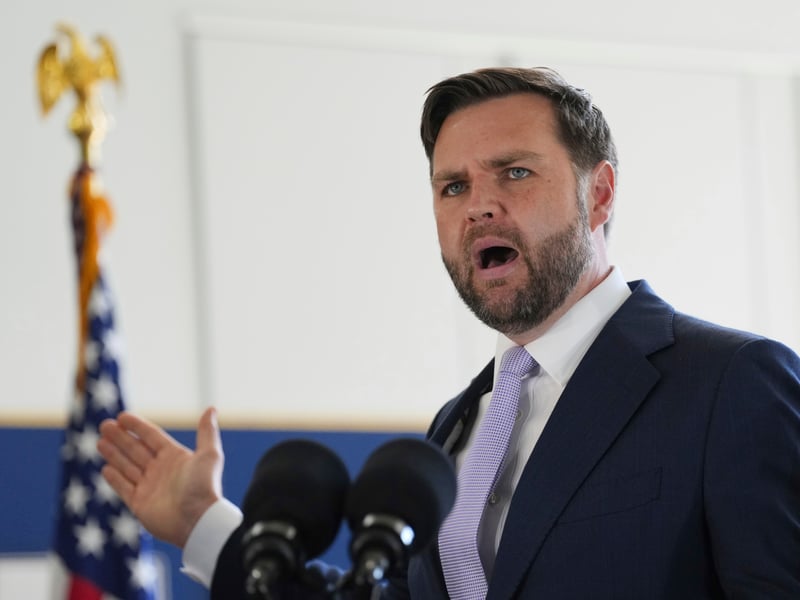
WASHINGTON (CN) — The Supreme Court on Monday agreed to hear an effort by Vice President JD Vance and Republican campaign committees to strike down limits on how much political parties can spend in coordination with federal campaigns.
Then-Senate candidate Vance and the National Republican Senatorial Committee, National Republican Congressional Committee and former Representative from Ohio Steven Chabot, asked the high court to decide whether the government can restrict parties from such spending under the First Amendment.
The challenge targets a 1974 amendment to the Federal Election Campaign Act that places several limits political party committees can receive and spend on advertising in federal elections.
The current limits vary based on voting-age population in each congressional election, but can reach $4 million for Senate races and $127,000 for elections in the House of Representatives.
According to the petitioners, the justices should overturn an en banc Sixth Circuit Court of Appeals decision that upheld the provision on the ground that it was required to under Supreme Court precedent in FEC v. Colorado Republican Federal Campaign Committee, a 5-4 2001 decision commonly referred to as *Colorado II. *
“This court should take up the invitation,” Vance says. “For years, Congress has restricted how much of their own money political party committees can spend in cooperation, or ‘coordination,’ with their candidates to influence federal elections. As Judge [Amul] Thapar recognized, these coordinated party expenditure ‘limits run afoul of modern campaign-finance doctrine and burden parties’ and candidates’ core political rights.’”
Monday’s challenge is the latest opportunity for the conservative-dominated Supreme Court to reshape the nation’s campaign finance laws, which were most notably upended by its 2010 Citizens United v. FEC ruling that opened the door for unlimited independent expenditures by outside groups.
The Colorado II regime, Vance says, has “harmed our political system” by pushing major donors to instead send their funds to super PACs, or political action committees, that are not subject to campaign finance limits. That shift caused a “fall of political parties’ power” in the political sphere, he claims, and has contributed to political polarization across the nation.
The 24-year-old precedent should not foreclose a decision in the Republicans’ favor, Vance argues, as there are two key differences between the cases.
First, Colorado II dealt with a facial challenge to an earlier version of the spending limits, which Congress amended in 2014 to allow unlimited coordinated expenditures for activities like election recounts and similar proceedings.
Second, the Colorado II court “left open the door” to challenges regarding coordinated spending beyond the payment of a candidate’s bills, Vance says, which applies to Monday’s challenge concerning coordinated political advertising.
“Yet if the court thinks Colorado II controls, it should overrule that outdated decision,” Vance wrote. “As the majority below noted, both ‘the law and facts’ have left it behind. And given that stare decisis is at its weakest for ‘decisions that wrongly denied First Amendment rights,’ its is past time to ‘knock down’ this ‘legal last-man-standing.’”
Monday’s challenge stems from Vance and Chabot’s campaigns during the 2022 elections.
Republican Senator from Kentucky Mitch McConnell filed an amicus brief in support of Vance’s arguments, decrying the current campaign finance laws as a “complex, sweeping structure of restrictions” and asserting that the high court’s decision in Colorado II is no longer good law.
“In truth, the challenged coordinated-spending limit’s real function and effect has nothing to do with fighting corruption,” McConnell wrote. “No, its inevitable real-world effect is to restrict the amount and diminish the effectiveness of political speech — ‘the primary object of First Amendment protection.’ And that effect is antithetical to the First Amendment.”
The Trump administration has indicated it would not defend the provision’s constitutionality and supports Vance’s position in the challenge, with Solicitor General John Sauer suggesting the high court appoint outside counsel to defend the law.
“A party performs that function most effectively in cooperation with the candidates themselves,” Sauer wrote. “By restricting that cooperation, the party-expenditure limit severely burdens the rights of parties and candidates alike.”
The Democratic National Committee, the Democratic Senatorial Campaign Committee and Democratic Congressional Campaign Committee together filed to intervene and defend the spending limits, an unopposed request that the high court granted on Monday.
“The Solicitor General’s reversal leaves the 50-year-old limitation on coordinated spending by political parties, and this court’s 24-year-old precedent upholding it, entirely undefended before the court,” the Democrats wrote.
The Supreme Court’s decision to hear the case tees up the first high-profile case for its next term, set to begin in October.
 Follow @Ryan_Knappy
Subscribe to our free newsletters
Our weekly newsletter Closing Arguments offers the latest about ongoing trials, major litigation and rulings in courthouses around the U.S. and the world, while the monthly Under the Lights dishes the legal dirt from Hollywood, sports, Big Tech and the arts.