
 Search Articles


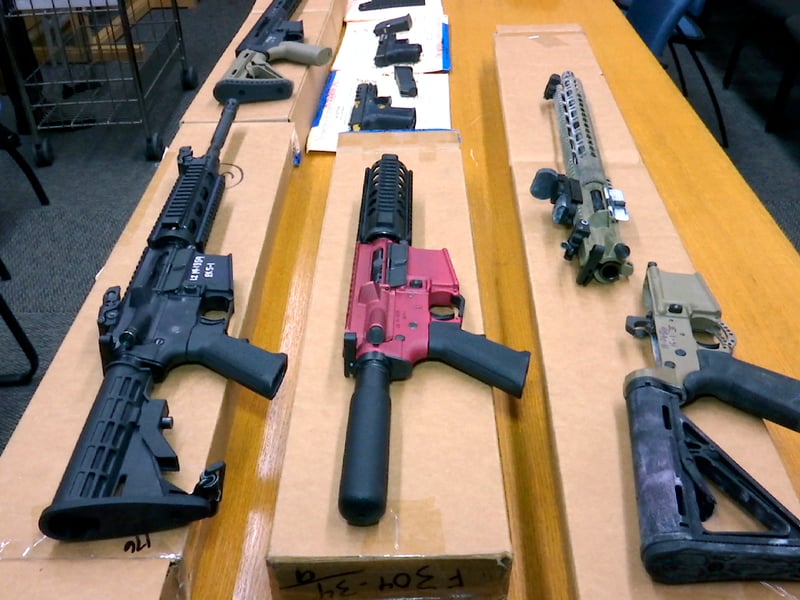
WASHINGTON (CN) — The Biden administration’s crackdown on ghost guns is under fire as the Supreme Court prepares to hear arguments next week over whether the federal government stretched the definition of “firearm” too thin to achieve a policy goal.
In 2022, the Biden administration sought to stem the flood of untraceable weapons in the market by classifying easy-to-assemble gun parts kits as firearms under the Gun Control Act. The edit forces parts kit manufacturers to follow regulations any other weapon is subjected to, including performing background checks and providing serial numbers.
Unlike in the justices’ review of prohibitions on gun ownership for domestic abusers, the Supreme Court will be opening a dictionary — not a history book — to decide the case.
“It comes down to the wording of the provisions from the Gun Control Act of 1968, in which they defined what constitutes a firearm,” Erin Erhardt, litigation counsel at the National Rifle Association, said in an interview. “That is something that is kind of defined by the ATF, but they have to do it within the constructs of what Congress said. So, these questions come down to whether or not the language that Congress used in 1968 covers these things.”
Almost six decades ago, lawmakers defined firearms as weapons that may readily be converted to expel a projectile by the action of an explosive. The Biden administration’s rule says firearms include readily completed weapons parts kits aimed at expelling a projectile by explosive.
The difference between the two will determine whether the Bureau of Alcohol, Tobacco, Firearms and Explosives can keep its rule on the books. Between January 2019 and May 2021, criminal incidents involving a ghost gun rose 408%, according to the Major Cities Chiefs Association, which represents police executives in 70 cities. There was a 240% increase in ghost gun use by people otherwise barred from gun ownership and a 285% increase in use by people under 21.
In 2019, two students at Saugus High School were killed by a 16-year-old with a ghost gun. Frank Blackwell and Bryan Muehlberger, the parents of 14-year-old Dominic Blackwell and 15-year-old Gracie Anne Muehlberger, told the justices that more children would die if the rule wasn’t upheld.
“This court should reject respondents’ efforts to cast aside the reasonable gun-safety measures that ATF enforced in the final rule,” the parents wrote. “It should decline to undermine the Gun Control Act of 1968. And it should spare other parents from the devastating and preventable loss of a child at the barrel of a ghost gun.”
After his daughter’s death, Muehlberger discovered how easily available the weapons were by purchasing a kit online using his deceased child’s name. Muehlberger did not have to verify his name or background and wasn’t questioned for using his credit card, even though the gun was bought in his daughter’s name.
Eric Tirschwell, the executive director at Everytown Law, said ghost guns became popular for teenagers and criminals because they didn’t require these checks.
“They couldn’t otherwise walk into a gun store and buy a pistol, but they could go online and order these gun-building kits,” Tirschwell said in an interview.
The justices are more likely to decide the case based on a brief from professors than the parents, however. Kevin Tobia, a professor of law and philosophy at Georgetown, joined a friend-of-the-court brief with a linguistic analysis of the case.
Tobia and his colleagues broke down the word “firearms” beyond the dictionary definition.
“They should think carefully about what type of term they’re analyzing,” Tobia said in an interview. “Firearm is what linguists would call an artifact kind, a human-made creation, which is different from natural kinds like water.”
Artifact nouns are context sensitive, according to Tobia, giving the word different meanings. To figure out the meaning of firearm in the Gun Control Act, Tobia looked at whether gun parts kits fell within the ordinary meaning of firearm.
Tobia said the scholars concluded that they did.
“If you buy a table from Ikea, it comes to you unassembled,” Tobia said. “We nevertheless are completely comfortable to call that a table, even though it requires some assembly, right? In the same way that a gun parts kit you buy unassembled, doesn’t mean it’s not a firearm. It’s just an unassembled firearm.”
The scholars and linguists conducted a survey to see how an average person would define a firearm. Tobia said the majority of people considered gun parts kits to be firearms. Notably, they also surveyed gunmakers’ websites and found that gun parts kit sellers and their customers also considered gun parts kits to be firearms.
Some gun parts kits can be easily assembled, but others require a little more work. Tobia said having to complete the frame or receiver — the housing of the internal elements — didn’t change that it was a firearm.
“In other contexts, we’re comfortable calling unsharpened pencils that you buy from the store pencils, even though you have to also buy a pencil sharpener and manually sharpen the pencil,” Tobia said.
Cody Wilson, the director of Defense Distributed, a defense contractor serving the general public, saw the law is an attempt to expand government regulations to private people. Defense Distributed is an intervenor plaintiff in the lawsuit against the government.
“A lot of these guns began to be made by private people, and that had never been regulated,” Wilson said in an interview. “So, it was also an attempt to regulate a new channel of activity by private persons, and ATF had to stretch to do that because ATF can only regulate — especially as a federal agency — can only regulate interstate commerce or regulated businesses.”
U.S. Solicitor General Elizabeth Prelogar rejects that characterization, stating that the rule targets gun manufacturers selling parts kits. The government says the question is whether manufacturers can avoid regulations by selling firearms as easy-to-assemble kits or frames and receivers that require a few minutes of work to be made functional.
“Congress adopted the act’s background-check, recordkeeping, and serialization requirements because it was concerned that felons, juveniles, and those seeking guns for criminal purposes could easily acquire them by mail,” Prelogar wrote. “The Fifth Circuit’s reading would re-create the same problem, allowing prohibited persons to bypass the act’s core regulations and obtain firearms that anyone with novice skills and common tools can make functional in a matter of minutes.”
The gun owners challenging the rule say Congress should decide the ongoing policy debate about whether privately made firearms should be regulated. They dispute government data showing an increase in ghost gun use by criminals.
“The evidence suggests that the precursors and weapon parts kits targeted by the rule are favored by hobbyists, while the vast majority of criminals prefer to get firearms that have been professionally manufactured,” the gun owners wrote. “In any event, to the extent there is any basis for a federal regulatory response to these items it is up to Congress, not ATF, to make it.”
Last term, the justices heard a similar appeal on the government’s ban on bump stocks — add-on devices for semi-automatic weapons. The government said bump stocks simulated automatic fire, turning a semiautomatic weapon into a machine gun. The conservative majority disagreed, discarding the ban.
The justices will hear arguments in Garland v. VanDerStok on Tuesday.
 Follow @KelseyReichmann
 Follow @kelseyreichmann.bsky.social
Subscribe to our free newsletters
Our weekly newsletter Closing Arguments offers the latest about ongoing trials, major litigation and rulings in courthouses around the U.S. and the world, while the monthly Under the Lights dishes the legal dirt from Hollywood, sports, Big Tech and the arts.