
 Search Articles


WASHINGTON (CN) — The Supreme Court appeared unlikely Wednesday to give President Donald Trump emergency authority to fire Federal Reserve Board Governor Lisa Cook.
During the two-hour oral arguments, the justices debated the contours of the termination process for the unique entity. But they seemed united against Trump’s arguments that presidents had raw, unreviewable power to fire board members of the independent agency.
“What’s the fear of more process?” Justice Brett Kavanaugh, a Trump appointee, asked U.S. Solicitor General John Sauer.
“Our contention is that there already has been a process,” Sauer responded. “There was a social media post.”
Unlike his attempts to fire members from other regulatory boards, Trump advanced claims of mortgage fraud to justify Cook’s termination. Lenders typically offer lower interest rates for principal-residence mortgages. The administration said Cook claimed properties in both Michigan and Georgia as her principal residence in mortgage agreements.
Trump announced Cook’s firing in a Truth Social post. Cook followed up with a lawsuit, claiming she had been deprived of due process and that the president didn’t have cause to fire her. A lower court ruled Cook could remain on the board during the litigation.
The Supreme Court scheduled a rare oral argument session at Trump’s request to decide the interim fate of Cook’s board seat.
“This whole case is irregular, starting with the Truth Social notice or thinking of it as a notice at all,” Justice Sonia Sotomayor, a Barack Obama appointee, remarked.
Irregular or not, the government claimed the post was sufficient to remove Cook from her seat. Sauer argued Cook wasn’t owed notice or a hearing because Congress did not write specific requirements around terminations when creating the board. He said removals from the Fed only require cause, which is defined by the president and unreviewable by the courts.
Most of the justices seemed skeptical the president’s authority is so broad.
“The outcome of your position is that the president need not provide any notice; the president need not provide any hearing; the president really just has to say, ‘Ms. Cook, you’re fired,’” Justice Elena Kagan, another Obama appointee, said.
Sauer argued Cook hadn’t independently denied Trump’s accusations despite her lawyer submitting filings disputing fraud claims. Justice Ketanji Brown Jackson, a Joe Biden appointee, questioned if Cook was given an opportunity to contest the evidence against her. Sauer responded she was given an opportunity in public.
“In the world?” Jackson asked. “Like, she was supposed to post about it and that was the opportunity to be heard?”
“Yeah,” Sauer said.
The Federal Reserve wields vast authority over the U.S. and international economy. Aside from setting interest rates and managing price inflation, the Fed regulates financial conglomerates, maintains the financial system and provides services such as acting as a lender.
Central bank independence and insulation from presidential control can be traced back to the creation of the Bank of England in 1694. These principles are shared throughout the global financial system, with only 12 nations allowing the removal of central bank board members at the executive’s discretion. Congress protected the Federal Reserve from at-will presidential removal in the Federal Reserve Act of 1913 and in the 1935 Banking Act.
Allowing presidents to have unreviewable removal power over board members, Kavanaugh said, would “weaken — if not shatter — the independence of the Federal Reserve.” He worried Cook’s removal would set off a domino effect through future administrations, suggesting future presidents would find trivial reasons to fire board members who disagree with their policy preferences.
“What goes around comes around,” Kavanaugh remarked, noting Trump’s appointees could be removed under a new Democratic president.
Economists said allowing Trump to fire Cook could destabilize markets and lead to a recession. The government brushed aside such concerns, stating “elite opinions” in the amicus briefs had to be balanced against the concerns of ordinary Americans.
“Obviously, President Trump speaks for ordinary Americans,” Sauer said.
Justice Amy Coney Barrett, a Trump appointee, appeared unconvinced by the government’s assurances on the economy. “There’s a risk, General Sauer. I don’t want to be responsible for quantifying that risk — I’m a judge, not an economist. But if there is a risk, doesn’t that counsel caution on our part.”
Justice Neil Gorsuch, another Trump appointee, tried to probe what the termination process would look like if Trump’s social media post was insufficient. He asked whether a White House meeting would meet the standard.
With no direct precedent to rely on, Cook’s attorney Paul Clement with Clement & Murphy said the justices had the flexibility to set a loose set of guidelines or more exacting requirements. Clement said the former would likely require another review from the justices down the line. The latter, however, could prevent courts from questioning the president’s motivation for such terminations, he said.
“The lower the standard is, the more likely you are to have removals in the future,” Clement said. “And the lower the standard, I think the greater is going to be the judicial temptation to think about pretext. I’m not going to say that there’s no role for a pretext inquiry, but it’s not a happy sort of scenario for the courts to be considering pretext in the context of presidential decision-making.”
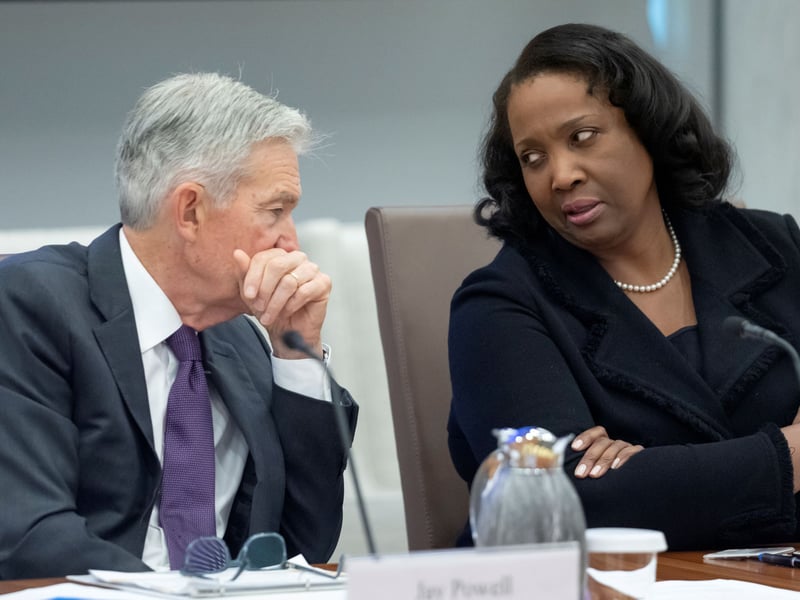
Cook attended Wednesday’s oral argument. Fed Chair Jerome Powell, who warned that the Justice Department had opened a criminal investigation as part of a pressure campaign to lower interest rates and temporarily boost the economy last week, also attended.
 Follow @KelseyReichmann
 Follow @kelseyreichmann.bsky.social
Subscribe to our free newsletters
Our weekly newsletter Closing Arguments offers the latest about ongoing trials, major litigation and rulings in courthouses around the U.S. and the world, while the monthly Under the Lights dishes the legal dirt from Hollywood, sports, Big Tech and the arts.