
 Search Articles


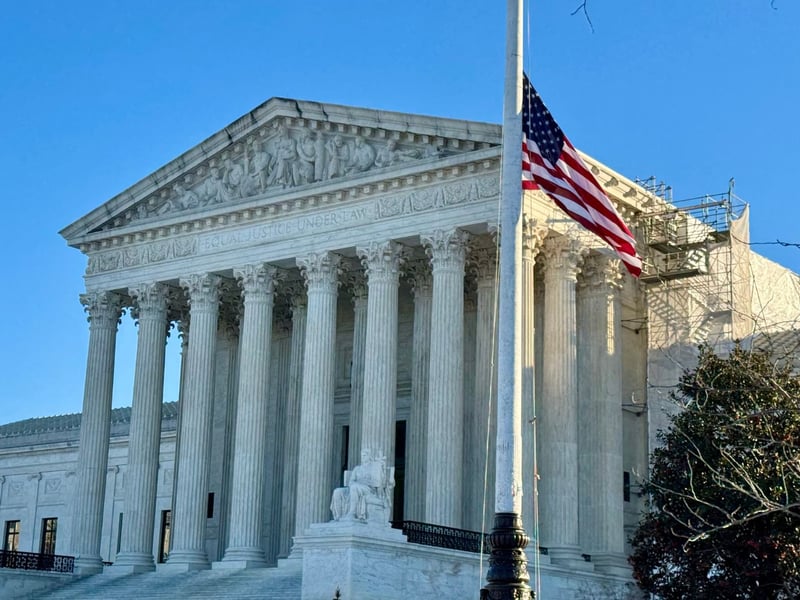
WASHINGTON (CN) — The Supreme Court denied an opportunity Monday to weigh the Second Amendment rights of those convicted of nonviolent felonies.
The opportunity arose through an appeal in Vincent v. Bondi, in which Utah resident Melynda Vincent argued that the prohibition on her possessing a firearm due to her check fraud conviction contradicts recent case law. The 10th Circuit twice ruled against Vincent, holding that neither the Supreme Court’s ruling in NYSRPA v. Bruen nor United States v. Rahimi abrogated the nearly 50-year-old federal statute prohibiting felons from possessing guns.
The high court refused to hear the case despite issuing a grant, vacate and remand order requiring the 10th Circuit to reconsider the appeal in light of Rahimi.
“Fraud is as old as human dealings,” Vincent said in a supplemental brief. “It is proscribed by the Eighth Commandment, and yet there is no evidence of any firearm regulation linked to fraud offenses at the founding or at reconstruction.”
Vincent wrote a fraudulent check for $498.12 at a grocery store in 2008 when she was homeless and fighting drug addiction. She faced up to 30 years in prison and a $1 million fine, but pleaded guilty and was sentenced to probation without imprisonment. Today, she is a social worker in private practice who also runs the Utah Harm Reduction Coalition.
The 10th Circuit held that its 2009 decision in U.S. v. McCane precluded Vincent’s argument that the statute doesn’t apply to nonviolent offenders. In McCane, the appellate court held the felon-in-possession prohibition does not violate the Second Amendment. The 10th Circuit ruled that McCaneis still good law.
Vincent challenged the felon-in-possession prohibition in 2022 after the Supreme Court ruled in Bruen that the government must show gun regulations are historically analogous to policies at the country’s founding.
U.S. Circuit Judge Robert Bacharach rejected the challenge, ruling that Bruen seemed to support criminal background checks for gun purchases and that nothing in the ruling reversed the circuit’s precedent set by the McCane.
“Though Bruencreated a new test for determining the scope of the Second Amendment, the court didn’t appear to question the constitutionality of longstanding prohibitions on possession of firearms by convicted felons,” Bacharach, a Barack Obama appointee, wrote in the 2023 opinion. “In preserving ‘shall-issue’ regimes and related background checks, the court arguably implied that it was constitutional to deny firearm licenses to individuals with felony convictions.”
The Supreme Court threw Vincent a lifeline in 2024 by ordering reconsideration in light of Rahimi. In Rahimi, the high court ruled that firearm bans for those subject to civil domestic violence restraining orders are constitutional. The Supreme Court refined the Bruen test in Rahimi, instructing lower courts to consider analogous cases and general principles from the founding era and modern gun regulations, rather than strict matches.
“Given this remand, we’ve freshly considered the Second Amendment claim and conclude that Rahimi doesn’t undermine the panel’s earlier reasoning or result,” Bacharach wrote in a 2025 opinion.
In a footnote, Bacharach explained the Supreme Court’s instructions didn’t identify any flaws in the appellate court’s previous opinion. Bacharach wrote that “felon dispossession laws are presumptively valid” under both the 2008 Supreme Court case District of Columbia v. Heller and *McCane,*as well as Rahimi.
Vincent argued the 10th Circuit failed to apply the historical analysis the Supreme Court ordered it to consider on remand. The high court did not offer a reason for its denial.
“When it issued its GVR order, the Supreme Court was aware of United States v. McCane and the court’s application of McCane in this case. If McCane remains undisturbed in cases like Ms. Vincent’s, it would prohibit courts in this circuit from applying the historical analysis called for by New York Pistol & Rifle Association v. Bruen and Rahimi,” Vincent wrote. “If the court had intended or accepted that McCane apply as is, without examination or alteration, there would have been no need to GVR for consideration in light of Rahimi.”
The 10th Circuit split from the Sixth Circuit, which found its precedent on the federal statute no longer viable in 2024. The Fourth, Eighth and 11th Circuits have all ruled that Rahimidoesn’t abrogate their earlier precedents upholding the constitutionality of the federal statute.
The denial comes as the high court prepares to hear arguments Monday from a casual weed smoker challenging the federal statute prohibiting those who use controlled substances from owning firearms. Attorneys representing Vincent and the Justice Department did not respond to requests for comment.
Subscribe to our free newsletters
Our weekly newsletter Closing Arguments offers the latest about ongoing trials, major litigation and rulings in courthouses around the U.S. and the world, while the monthly Under the Lights dishes the legal dirt from Hollywood, sports, Big Tech and the arts.