
 Search Articles


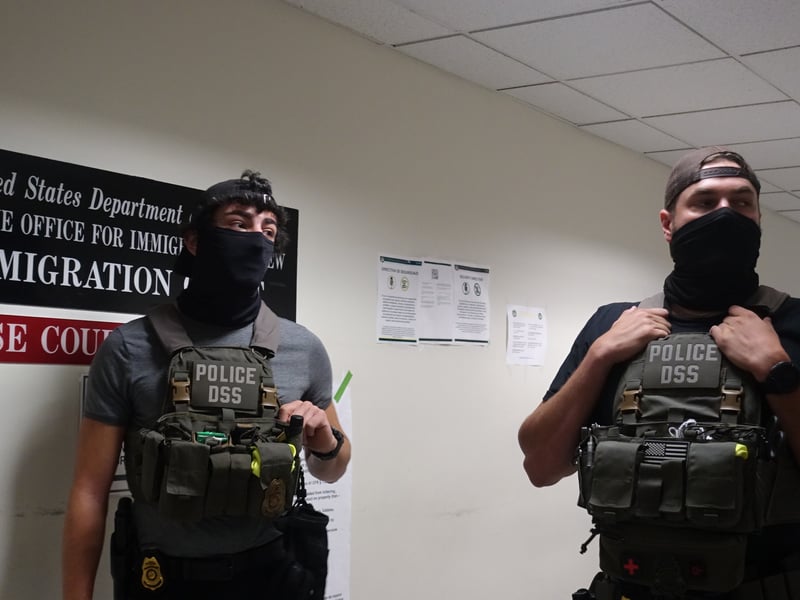
WASHINGTON (CN) — U.S. Immigration and Customs Enforcement can resume sweeping California raids, the Supreme Court ruled on Monday, granting President Donald Trump’s request to continue targeting Latinos, Spanish speakers and certain workers for suspected illegal status.
The unexplained order appeared to fall along ideological lines, with justices Sonia Sotomayor, Elena Kagan and Ketanji Brown Jackson dissenting.
Sotomayor, an Obama appointee, described the ruling as “unconscionably irreconcilable with our nation’s constitutional guarantees.”
“We should not have to live in a country where the government can seize anyone who looks Latino, speaks Spanish, and appears to work a low wage job,” Sotomayor wrote in an opinion joined by her liberal colleagues. “Rather than stand idly by while our constitutional freedoms are lost, I dissent.”
Sotomayor railed against her colleagues’ refusal to explain their ruling, saying lower courts needed guidance moving forward.
“Neither the district court nor the parties will know whether the majority believed the key issue was standing, the merits, or the scope of relief, any one of which could have been the basis for the majority’s order,” she said.
A federal judge halted the administration’s “roving” raids in July, finding that agents likely used racial profiling to arrest immigrants suspected of being in the U.S. illegally and unlawfully detained them without access to an attorney.
Trump pushed the justices to restore these raids, arguing the widespread illegal presence of migrants in areas like Los Angeles called for such considerations.
“Needless to say, no one thinks that speaking Spanish or working in construction always creates reasonable suspicion,” U.S. Solicitor General John Sauer wrote in Trump’s petition. “Nor does anyone suggest those are the only factors federal agents ever consider. But in many situations, such factors — alone or in combination — can heighten the likelihood that someone is unlawfully present in the United States.”
The administration claims California’s Central District harbors 2 million migrants without legal status, giving agents a 1 in 10 chance of arresting a potential deportee among the region’s 20 million residents.
ICE ramped up patrols to meet the administration’s goal of a minimum of 3,000 immigration-enforcement arrests every day. Patrols in California began rounding up people at places like Home Depot and 7-Eleven, based on stereotypes about migrants without legal status.
Officers typically target these individuals based on particularized evidence that the person may be in the country illegally. However, the Trump administration claimed that broadly applicable group characteristics, like speaking Spanish, being Latino or working in certain fields, amounted to adequate suspicion for arrest.
Immigrant advocates said the sweeping patrols had swept up U.S. citizens and warned the justices against endorsing blatant racial profiling.
“Such a theory … would justify an extraordinarily expansive dragnet, placing millions of law-abiding people at imminent risk of detention by federal agents. That kind of regime — anathema to constitutional tradition — is precisely what the government has installed in the Central District,” the five Southern California residents and three advocacy groups who challenged the raids wrote.
Judge Maame E. Frimpong issued an emergency order blocking indiscriminate raids in July. The Joe Biden appointee found that there was a mountain of evidence supporting the plaintiffs’ claims.
The Ninth Circuit upheld the temporary restraining order, finding agents were subjecting Angelenos to detentive stops based on group profiling, not individualized suspicion.
Trump said the plaintiffs’ past injuries did not justify a restraining order barring agents from using factors such as accents or place of employment to target all immigrants without legal status in California. The administration asked the Supreme Court to narrow the order to only the named plaintiffs.
The order chilled immigration enforcement, the administration said, by threatening officers with contempt for doing their job.
“Uncertainty over how the court might later view an agent’s reliance on a mix of factors will ‘likely cause hesitation and delay in the field, which in turn increases the risk of assaults on officers, escalations during volatile encounters, and injuries to both officers and the public, particularly in the already high-risk and unpredictable environment of Los Angeles,’” Sauer wrote.
Justice Brett Kavanaugh, a Trump appointee, claimed that common sense dictated that such factors could constitute at least reasonable suspicion of illegal presence in the country. Kavanaugh said that immigrants who are in the country legally would be quickly released if they got swept up in such stops.
“If the person is a U.S. citizen or otherwise lawfully in the United States, that individual will be free to go after the brief encounter,” Kavanaugh wrote in a solo concurrence. “Only if the person is illegally in the United States may the stop lead to further immigration proceedings.”
Sotomayor balked at Kavanaugh’s characterization of the government’s raids.
“Immigration agents are not conducting ‘brief stops for questioning,’ as the concurrence would like to believe,” Sotomayor wrote. “They are seizing people using firearms, physical violence, and warehouse detentions. Nor are undocumented immigrants the only ones harmed by the government’s conduct. United States citizens are also being seized, taken from their jobs, and prevented from working to support themselves and their families.”
Sotomayor said facts on the ground demonstrated that immigrants in the country legally were not freed as Kavanaugh described.
“The concurrence improperly shifts the burden onto an entire class of citizens to carry enough documentation to prove that they deserve to walk freely,” Sotomayor said. “The Constitution does not permit the creation of such a second-class citizenship status.”
Trump’s immigration crackdown sparked mass protests in Los Angeles in the opening months of his second term. The president federalized California’s National Guard to quell the protests, against the wishes of Governor Gavin Newsom and Los Angeles Mayor Karen Bass.
Over 5,000 National Guard members and Marines were deployed to the city in June. Nearly three months later, only 250 guard members remain in Los Angeles to protect federal agents and buildings.
In August, Trump turned his attention to Washington, D.C., deploying the National Guard and other federal agencies to tackle violent crime. In an unprecedented move, Trump also federalized D.C.’s police force.
 Follow @KelseyReichmann
 Follow @kelseyreichmann.bsky.social
Subscribe to our free newsletters
Our weekly newsletter Closing Arguments offers the latest about ongoing trials, major litigation and rulings in courthouses around the U.S. and the world, while the monthly Under the Lights dishes the legal dirt from Hollywood, sports, Big Tech and the arts.