
 Search Articles


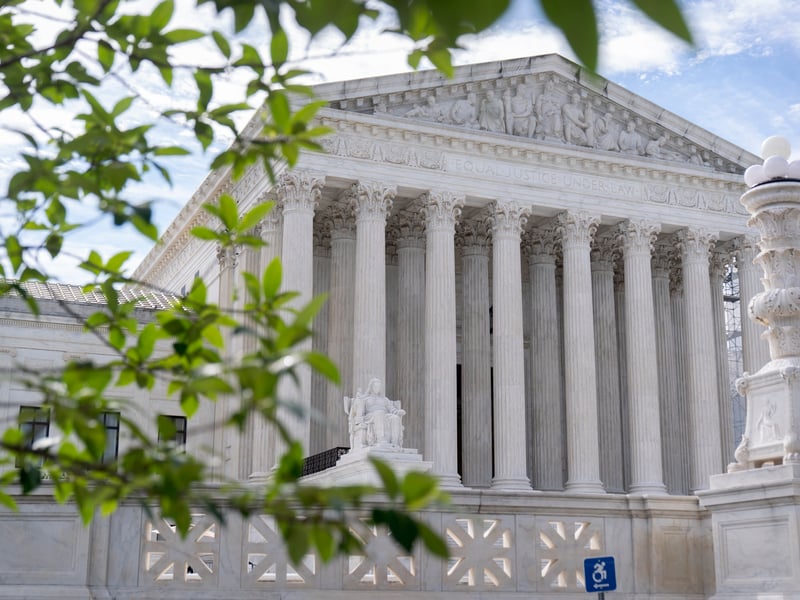
WASHINGTON (CN0 — The Supreme Court on Tuesday ruled against a former high-ranking government official facing prison time for concealing financial records, rejecting his bid to use a ruling favorable to Capitol rioters to delay his sentence.
Eghbal Saffarinia, a former assistant inspector general at the Department of Housing and Urban Development, was sentenced to a year and a day in prison failing to report $80,000 in loans he received from a friend to whom he directed tens of millions of government business during his tenure.
Saffarina asked the Supreme Court for emergency intervention to delay his sentence, arguing that the justices were likely to review his case based on their ruling in a Capitol riot prosecution. In June, the justices narrowed an obstruction charge used to prosecute Jan. 6 defendants, and Saffarina said his charge was similarly overly broad and warned that upholding it would create “extensive mischief.”
“Under the opinion below, the residual phrase ‘proper administration’ now has the broadest possible reach, stretching §1519 to reach obstruction of any routine administrative activity from review of U.S. Postal Service certified mail forms to review of federal job applications,” Saffarina wrote in his emergency application.
Early into his tenure at the department, Saffarina canceled a pending contract to the agency’s current IT service provider. Saffarina encouraged STG Inc. to employ his friend’s company, Orchid Technologies, as a subcontractor to win back the contract.
STG’s contract was canceled the following year. Instead, the department awarded the $17 million contract to a different company partnering with Orchid.
STG filed a complaint, claiming Saffarina steered contracts to his friend’s company. During a subsequent investigation, the FBI discovered that Orchid’s owner loaned Saffarina $80,000 a year after he joined the department.
Under the Ethics in Government Act, high-ranking government officials are required to file annual financial disclosure statements for any liabilities over $10,000 owed to any creditor.
Saffarina failed to disclose the Orchid’s loan in 2014, 2015 and 2016. Another $90,000 loan from a neighbor was also omitted in 2016.
A jury convicted Saffarina on four counts of concealing material factor or making false statements and three counts of falsifying a record or document with the intent to impede, obstruct or influence the investigation or proper administration of a matter within the jurisdiction of a federal department.
Saffarina was released on bail while appealing his conviction. A unanimous D.C. Circuit panel threatened his temporary freedom by rejecting his claims that his conduct fell outside of the obstruction of justice statute.
He believed the D.C. Circuit’s errors would likely be reversed by the Supreme Court, but without the justices’ intervention now he’d serve most of his sentence before his conviction was overturned.
“Serving a sentence for a conviction that might soon be vacated is a harm that cannot be undone,” Saffarina wrote.
On remand, Saffarina claimed his prison sentence would likely be eliminated or at least reduced.
Saffarina asked the court for action on his emergency appeal by Aug. 22 — the scheduled start of his sentence — but the deadline came and passed without any word from the justices. The justices did not explain their decision to deny Saffarina’s application. There were no noted dissents.
 Follow @KelseyReichmann
 Follow @kelseyreichmann.bsky.social
Subscribe to our free newsletters
Our weekly newsletter Closing Arguments offers the latest about ongoing trials, major litigation and rulings in courthouses around the U.S. and the world, while the monthly Under the Lights dishes the legal dirt from Hollywood, sports, Big Tech and the arts.