
 Search Articles


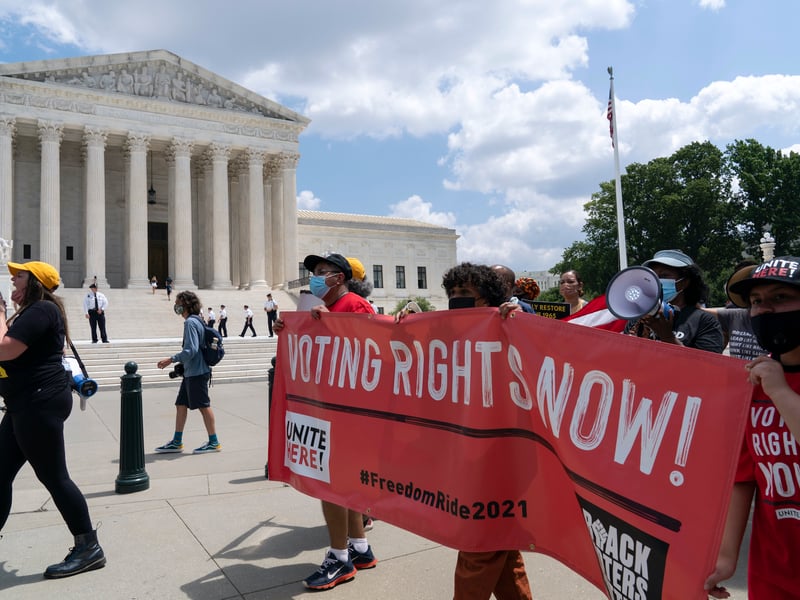
WASHINGTON (CN) — The crowning achievement of the Civil Rights Movement faces extinction at the Supreme Court next week as the justices consider whether a safeguard against racial discrimination is unconstitutional.
The justices will hear oral arguments Wednesday in Louisiana v. Callais , which asks whether adding a second majority-Black district to the state’s voting maps violated the 14th and 15th Amendments. But the high court’s decision stands to ripple across the nation, impacting redistricting nationwide.
“This is about more than lines on a map — it could decide whether millions of Black, Latino and other voters of color still have a voice in our representative democracy,” said Lauren Groh-Wargo, CEO of Fair Fight Action.
For decades, the Roberts court has chipped away at the Voting Rights Act, leaving Section 2, which prohibits discriminatory vote dilution, as one of its last remaining enforceable provisions. Now that too is at risk, setting up the potential for the justices to nullify the landmark law.
“Without the protections of Section 2, there will be very few checks on undoing all that progress that has been made since 1965 and potential backsliding to conditions that we saw prior to the enactment of the Voting Rights Act,” Sophia Lin Lakin, director of the ACLU Voting Rights Project, said.
A watershed ruling in the making
The yearslong battle over Louisiana’s maps dates back to redistricting after the 2020 census. Louisiana’s first set of new maps only included one majority-Black district despite Black voters making up 30% of the adult population in the state.
After a protracted legal battle and federal court ruling, the Legislature drew new maps in 2024 with a second majority-Black district. In response, a group of “non-African American voters” sued the state — so far unsuccessfully — claiming the new maps are unconstitutional.
In March, the Supreme Court heard arguments over whether the Legislature relied too heavily on race when redrawing Louisiana’s maps. Instead of issuing a decision in June, the justices delayed adding an even bigger question to the appeal.
Scheduling reargument is rare — putting Louisiana’s case in the same bucket as blockbusters like Brown v. Board , Roe v. Wade and Citizens United v. Federal Election Commission . The high court raised the stakes of Louisiana’s already consequential case, asking whether the intentional creation of a second majority-Black congressional district — as courts ruled was required by the Voting Rights Act — violates the 14th and 15th Amendments.
The case now puts a familiar tension before the court: Is a solution to discrimination itself discriminatory?
The colorblind Constitution
“The way to stop discrimination on the basis of race is to stop discriminating on the basis of race,” Chief Justice John Roberts famously wrote in 2013.
As Roberts, a George W. Bush appointee, hits 20 years on the bench, that statement has come to be the court’s ethos on race and discrimination.
When the Supreme Court gutted affirmative action in 2023, Roberts wrote, “Eliminating racial discrimination means eliminating all of it.”
Justice Clarence Thomas, a George H.W. Bush appointee, added, “The Constitution’s colorblind rule reflects one of the core principles upon which our nation was founded: that ‘all men are created equal.’”
The justices’ approach to race in Students for Fair Admissions v. Harvard could be reflected in Callais. Thomas previewed these arguments in a dissent to the court’s decision to hear reargument.
“These cases put the court to a choice: It may permit patent racial gerrymandering under the auspices of Section 2 compliance, or it may admit that, as the court has construed the statute, a violation of Section 2 is insufficient to justify a race based remedy,” Thomas wrote.
Congress drew on Reconstruction-era amendments to enact the Voting Rights Act in 1965. The 14th Amendment granted citizenship to all people born in the U.S., and the 15th Amendment prohibited the denial of voting rights to any citizens based on race, color or previous condition of servitude.
In the affirmative action cases, the conservative majority ruled that Harvard’s admissions program violated the equal protection clause of the 14th Amendment. Carolyn Shapiro, founder of the Institute on the Supreme Court at Chicago-Kent College of Law, said that the 15th Amendment offers a stronger argument for considering race.
“The 15th Amendment talks about race and is the only part of the Constitution that expressly talks about race,” Shapiro said. “To my mind, the analysis of when race is appropriately considered under the 15th Amendment — including the originalist analysis — might be different from the colorblind approach that the current court is taking to the 14th Amendment.”
While the conservative justices have embraced the colorblind Constitution, their liberal colleagues have not. Justice Sonia Sotomayor, a Barack Obama appointee, said that her colleagues’ vision of race neutrality in higher education would entrench racial segregation.
“Brown recognized that passive race neutrality was inadequate to achieve the constitutional guarantee of racial equality in a nation where the effects of segregation persist,” Sotomayor wrote in dissent to the affirmative action ruling. “In a society where race continues to matter, there is no constitutional requirement that institutions attempting to remedy their legacies of racial exclusion must operate with a blindfold.”
Justice Ketanji Brown Jackson, a Joe Biden appointee, said that her conservative colleagues declared “colorblindness for all” with a “let-them-eat-cake obliviousness.” She said that the court had put forward an idealistic version of racial equality that does not exist in reality.
“No one benefits from ignorance,” Jackson wrote. “Although formal racelinked legal barriers are gone, race still matters to the lived experiences of all Americans in innumerable ways, and today’s ruling makes things worse, not better. The best that can be said of the majority’s perspective is that it proceeds (ostrich-like) from the hope that preventing consideration of race will end racism.”
Daniel Harawa, director of the Federal Appellate Clinic at New York University, said that while Thomas saw a stigmatizing effort of considering one’s race, Jackson valorized race as part of her story.
“You just have, to my mind, diametrically opposed views of what race actually does and how it operates,” Harawa said. “In some ways, that reflects a broader societal moment.”
The end of an era
While Louisiana defended its second majority-Black district earlier this year, the state has now abandoned that position, stating that there is no safe harbor for racial discrimination.
A group of voters still defends Louisiana’s maps, stating that Section 2 is only relevant where racial discrimination is present. The voters said that a limited consideration of race is necessary to remedy that discrimination.
“Congress ensured that Section 2’s results test is appropriately constrained and requires a remedy only where race is already shaping political decisionmaking,” the voters wrote.
A report from voting advocacy groups found that if the Supreme Court sides with Louisiana, Republicans could secure an additional 19 safe seats in the House of Representatives and cement GOP control for at least a generation.
“We’re watching the GOP advance to the endgame of a decades-long strategy to dismantle the Voting Rights Act and lock in their own power,” said Groh-Wargo, who was involved in the report. “If Section 2 is struck down, the court will be dragging us back to a pre-1965 America where racist maps blocked entire communities from having fair political representation.”
 Follow @KelseyReichmann
 Follow @kelseyreichmann.bsky.social
Subscribe to our free newsletters
Our weekly newsletter Closing Arguments offers the latest about ongoing trials, major litigation and rulings in courthouses around the U.S. and the world, while the monthly Under the Lights dishes the legal dirt from Hollywood, sports, Big Tech and the arts.