
 Search Articles


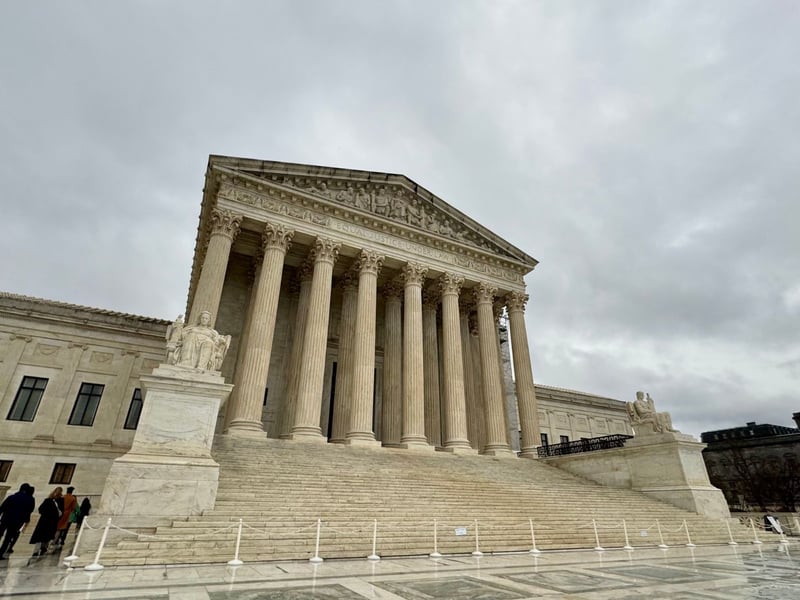
WASHINGTON (CN) —The Supreme Court on Tuesday declined to review cases concerning a juror’s pretrial lies in a death penalty case and the Seventh Amendment’s enforceability against states.
The majority denied review of a Georgia death row inmate’s claim that a juror’s lies during voir dire tainted his trial. Justices Sonia Sotomayor and Elena Kagan, Barack Obama appointees, and Ketanji Brown Jackson, a Joe Biden appointee, dissented in hopes of using the case to address the no-impeachment rule, a rule followed in some form in every state and in the federal system that prevents consideration of juror testimony to undermine a verdict.
A jury sentenced Stacey Humphreys to death in 2007 for the murder and robbery of two real estate agents at a model home. Humphreys, who was out on parole, forced the women to undress and provide their banking information before executing the pair and fleeing to Wisconsin.
During voir dire, the screening process for potential jurors, Lindsey Chancey lied to the court about details concerning her experience with a similar case. Chancey had been a victim of an attempted rape and robbery in her home by a convicted murderer who had escaped from a mental institution. Chancey told the court that she could perform her role impartially, as she explained that her attacker never physically harmed her because she had escaped the building before he entered.
In reality, the convicted murderer did attack Chancey, and according to the other jurors’ posttrial affidavits and testimonies, she had no intention of allowing Humphreys to serve a life sentence. Chancey’s fellow jurors, who all voted for a life sentence without parole during the first two deliberations, claim Chancey intimidated them during deliberations with screaming and cursing. The jury foreperson even requested removal, but the trial court insisted they deliberate further.
Under the no-impeachment rule, the jurors’ posttrial testimonies and affidavits are inadmissible evidence. The minority believed Humphreys’ case presents a worthy exception to the rule.
“This case illustrates another ’extreme’ situation in which the no-impeachment rule likely should have yielded because the juror’s extreme misconduct threatened Humphreys’ Sixth Amendment right to an impartial jury,” Sotomayor wrote. “The ‘usual safeguards’ were plainly insufficient ’to protect the integrity of the process.’
“Voir dire, however, cannot meaningfully screen out an individual like Chancey, who both misleadingly omitted crucial details about her prior assault when questioned and then undertook bad-faith tactics in the jury room by leveraging that experience to coerce her peers,” Sotomayor continued “Chancey’s misconduct appears to have singlehandedly changed the verdict from life without parole to death. That places this case squarely among the ‘gravest and most important,’ cases in which the no-impeachment rule should yield to avoid ‘violating the plainest principles of justice.’”
Humphreys’ attorney Lindsey Mann of Troutman Pepper said it was her firm’s policy not to provide comment to the media.
“Tragically, the court denies review instead, allowing a death sentence tainted by a single juror’s extraordinary misconduct to stand,” Sotomayor wrote. “Because it is at best ‘unclear’ whether the 11th Circuit applied the correct standard of review in declining to adjudicate Humphreys’ claim on the merits, I would vacate and remand the case for further clarification rather than leave Humphreys’ juror misconduct claim caught in a web of procedural barriers.”
The high court also rejected an appeal from the Ninth Circuit concerning a putative class challenge to a California county’s system of administrative penalties and fees related to cannabis abatement, which the challengers argued violated the Eighth Amendment’s ban on excessive fines.
Relying on Supreme Court precedent in the 1916 case Minneapolis & St. Louis R. Co. v. Bombolis , the Ninth Circuit panel found in the citizens’ favor on the Eighth Amendment claim but found their claim that the system violated their Seventh Amendment right to a jury trial was not viable under the court’s selective-incorporation precedent.
Justice Neil Gorsuch, a Donald Trump appointee, agreed with the majority that the present case is not the appropriate vehicle, but did write a short statement advocating for the high court to reconsider Bombolis . The Bombolis decision effectively negated the ability to enforce any of the Bill of Rights amendments against states. Despite this ruling, federal courts routinely act in the contrary.
“Under this court’s contemporary case law, states must respect the First Amendment’s establishment clause, the Second Amendment’s right to bear arms, the Fifth Amendment’s protections against self-incrimination and its takings clause, the Eighth Amendment’s excessive fines clause; the list goes on,” Gorsuch wrote. “On what account should the Seventh Amendment be treated differently?”
Gorsuch said the nation’s founders would have surely expected the right to a trial by jury as a fundamental part of their birthright.
“That Bombolis lingers on the books not only leaves our law misshapen, it subjects ordinary Americans to a two-tiered system of justice,” Gorsuch wrote. “No less than at the founding, civil juries today play a critical role in checking governmental overreach, holding public officials accountable, and ensuring a fair hearing for those who come before our courts."
Attorney Jared McClain of the Institute for Justice, representing the putative class, said in an email that Gorsuch’s statement addressed a significant concern.
“Although a cert petition is always a long shot, Justice Gorsuch’s opinion shows that the civil jury right is an important issue,” McClain wrote. “We will continue to fight in the lower court to make sure that Humboldt [County] respects our clients’ other constitutional rights.”
Subscribe to our free newsletters
Our weekly newsletter Closing Arguments offers the latest about ongoing trials, major litigation and rulings in courthouses around the U.S. and the world, while the monthly Under the Lights dishes the legal dirt from Hollywood, sports, Big Tech and the arts.