
 Search Articles


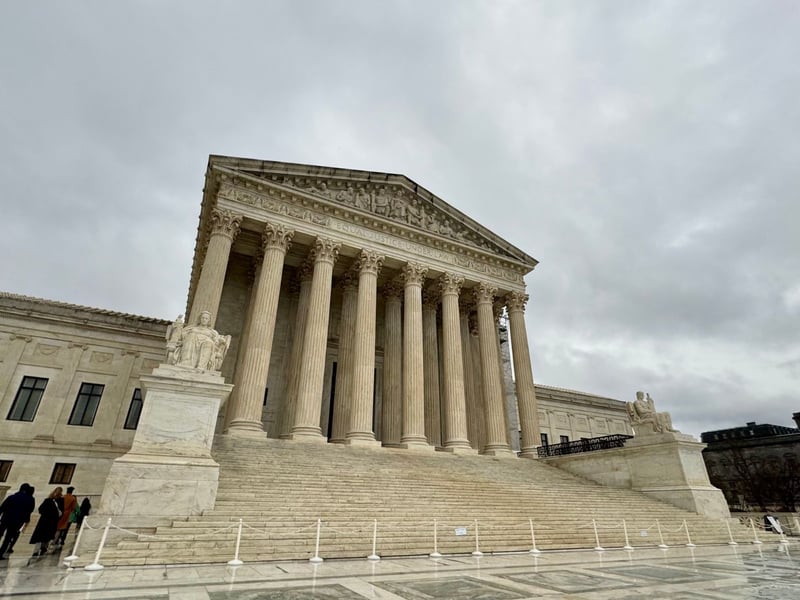
WASHINGTON (CN) — The Supreme Court tried Wednesday to extricate itself from a fiery dispute between two real estate companies seeking a solution to a decadeslong trademark infringement.
“Maybe the best thing is for us to vacate and remand, allow you to try again,” Justice Neil Gorsuch, a Donald Trump appointee, said.
Gorsuch said a Fourth Circuit ruling left a lot to be desired as he and his colleagues struggled to calculate the damages owed to Virginia civil engineering and surveying firm Dewberry Engineers, for trademark infringement by the Georgia real estate company Dewberry Group owned by developer John Dewberry.
The trademark dispute was initially resolved in a confidential settlement agreement in 2007, but the fight resurfaced in 2020 after the Dewberry Group rebranded to Dewberry Capital. Under the settlement, the firm permitted its mark to be used as Dewberry Group but restricted all other uses of “Dewberry.”
Dewberry Engineers said the group’s rebrand and the creation of subbrands like Dewberry Office and Studio Dewberry violated the Lanham Act — the federal law governing trademarks. The engineering firm sued Dewberry Group, but the group does business with affiliates — all of which are owned and controlled by John Dewberry.
The affiliates share the same address as the Dewberry Group and have no employees. The Dewberry Group utilizes the affiliates’ services in exchange for maintaining their financial records.
A lower court found Dewberry Group liable for breaching the 2007 settlement, awarding Dewberry Engineers nearly $43 million in disgorgement profits. However, the court looked to the affiliates’ profits because Dewberry Group’s tax returns showed it had been operating at a loss. The court found all the revenues generated through Dewberry Group were only added to the affiliates’ books. John Dewberry contributed $23 million over the last 30 years to cover the group’s losses.
The Fourth Circuit affirmed, and the Supreme Court agreed to decide if the profits from Dewberry Group’s affiliates — which are considered separate corporate entities — could be taken as a Lanham Act award for the Dewberry Group’s infringement. The court found agreement Wednesday on that narrow question with both Dewberries agreeing that the affiliates’ profits could not be seized.
But the opposing sides’ harmony ended there. The companies disagreed on how the affiliates’ profits could be considered when calculating the award.
Dewberry Group said the affiliates’ structure prevented the court from looking at their profits when calculating the award.
The group urged the justices to reverse the Fourth Circuit’s ruling instead of giving the appeals court a second chance. The group forcefully argued that Dewberry Engineers shouldn’t be able to submit additional theories on remand because they forfeited those arguments by not including them in their briefs.
“This court should enforce its Rule 15 because, otherwise, you’re inviting Respondents and the government to try and throw issues that aren’t in the case and distort the question presented,” Thomas Hungar, an attorney with Gibson Dunn representing the group, said.
Dewberry Engineers said the justices could go further, arguing that the lower court correctly considered the affiliates’ profits to calculate Dewberry Group’s true financial gain. The engineering firm said the justices could decide whether their theory on how to calculate the damages was correct.
“Our point here is that we don’t think the district court — when you look at the record — in fact ignored corporate separateness in using the just-sum provision,” Elbert Lin, an attorney with Hunton Andrews representing Dewberry Engineers, said.
The high court seemed interested in the cleanest escape from the contentious fight. Justice Amy Coney Barrett, a Trump appointee, noted the court only agreed to answer a narrow question that both parties now agree on.
“We would be kind of wading into uncertainty if we spell out all of those theories that the Fourth Circuit never addressed,” Barrett said.
Like Barrett, the majority resisted taking further action, citing problems in the appellate opinion. Barrett noted that the Fourth Circuit “wasn’t the model of clarity.”
“There are many ways to skin the cat,” Gorsuch quipped, noting Dewberry Engineers could sue the affiliates, pierce the corporate veil or try another equitable theory. “But, as I understand it, the Fourth Circuit below did none of those things.”
The government suggested that guidance from the justices would help the lower courts sort through the remainder of the dispute. The Biden administration said clarity was needed to prevent companies from hiding profits to avoid facing trademark infringement liabilities.
“In trademark cases, courts routinely reject deductions where a defendant is attempting to artificially inflate its costs to lower its profits liability,” Nicholas Crown, an assistant to the solicitor general at the Justice Department, said. “We think the outcome should be no different when a defendant tries to deflate its receipts and income, again, to reduce its profits liability.”
 Follow @KelseyReichmann
 Follow @kelseyreichmann.bsky.social
Subscribe to our free newsletters
Our weekly newsletter Closing Arguments offers the latest about ongoing trials, major litigation and rulings in courthouses around the U.S. and the world, while the monthly Under the Lights dishes the legal dirt from Hollywood, sports, Big Tech and the arts.