
 Search Articles


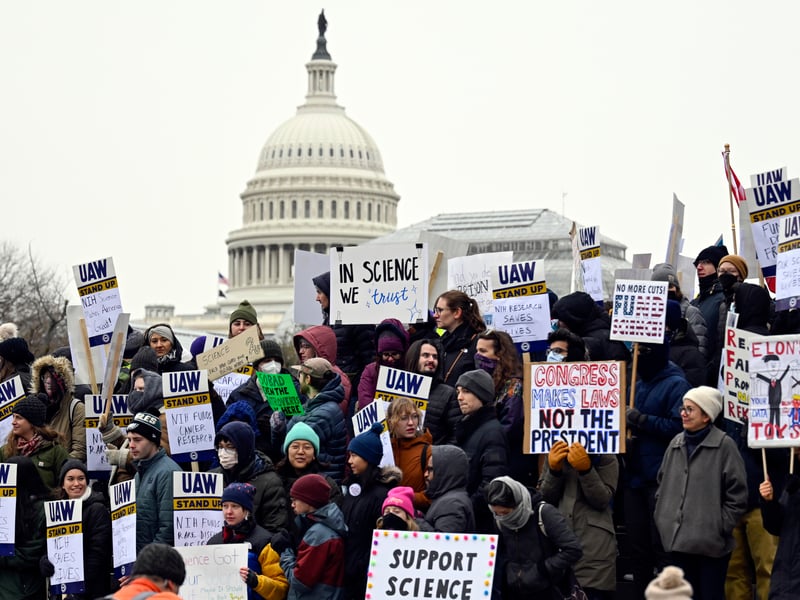
WASHINGTON (CN) — Bowing to President Donald Trump’s wishes, the Supreme Court on Thursday blocked $783 million in grants for health research, reversing a lower court ruling.
Splitting 5-4, the justices said Trump could move forward with the grant cancellations for now. But in a secondary split, the high court indicated the administration’s rationale for the terminations was unlawful.
The majority said that Democratic-led states and private plaintiffs must bring their appeal in the Court of Federal Claims to receive relief.
The Trump administration said it would be irreparably harmed if forced to fund research connected to diversity, equity, inclusion and gender identity. While the loss of funds typically doesn’t meet that standard, the majority reasoned that the grants likely couldn’t be reversed once released.
“The plaintiffs’ contention that they lack the resources to continue their research projects without federal funding is inconsistent with the proposition that they have the resources to make the government whole for money already spent,” the court said in an unsigned statement.
Under the partial win, however, the Supreme Court kept the lower court pause on the administration’s guidance terminating research related to DEI objectives, gender identity or Covid-19.
Chief Justice John Roberts was joined by the three liberal justices in dissent. The George W. Bush appointee said that the administration’s directives and the grant terminations were inseparable.
“If the district court had jurisdiction to vacate the directives, it also had jurisdiction to vacate the ‘resulting grant terminations,’” Roberts wrote.
Justice Amy Coney Barrett, a Trump appointee, was the only justice to vote for the mixed ruling, breaking the tie between her conservative colleagues and Roberts and the liberal justices.
Barrett claimed that the Democratic-states could not end-run the Court of Federal Claims jurisdiction by grouping the grant terminations in with a challenge to the underlying guidance.
“Two-track litigation results from ‘[t]he jurisdictional scheme governing actions against the United States,’ which ‘often requires … plaintiffs to file two actions in different courts to obtain complete relief in connection with one set of facts,’” Barrett wrote in a solo concurrence.
Justice Ketanji Brown Jackson, a Joe Biden appointee, said the order provided a cautionary tale about lawmaking on the emergency docket. Jackson said the ruling neutered judicial review and sent the plaintiffs on a “likely futile, multivenue quest for complete relief” — an outcome neither party asked for.
“Stated simply: With potentially life-saving scientific advancements on the line, the court turns a nearly century-old statute aimed at remedying unreasoned agency decision-making into a gauntlet rather than a refuge,” Jackson wrote in a solo opinion.
Instead of doing whatever they can to uphold the law’s constraints, Jackson said that her colleagues had made vindicating the rule of law as difficult as possible.
“This is Calvinball jurisprudence with a twist,” Jackson wrote. “Calvinball has only one rule: There are no fixed rules. We seem to have two: that one, and this administration always wins.”
Jackson said that her colleagues’ quest to rule for the Trump administration had real consequences for law and the public.
“For the government, the incremental expenditure of money is at stake,” Jackson wrote. “For the plaintiffs and the public, scientific progress itself hangs in the balance — along with the lives that progress saves.”
Trump v. the judiciary
The Supreme Court has endorsed an expansive view of presidential power in recent rulings. In the first six months of Trump’s second term, the administration has submitted dozens of emergency appeals, where the justices granted his requests in nearly every instance.
In contrast, the lower courts have routinely ruled against the president. Here, Trump petitioned the high court for emergency relief after a federal judge restored health science funding tied to DEI and gender identity, and accused the administration of “weaponizing what should not be weaponized.”
Seemingly incensed by the claim, Trump lashed out at the judge for politicizing the judiciary.
“When courts criticize executive-branch officials for ‘their haste to appease the executive’ and dismiss the president’s goal of ‘making America great’ as a ‘guise,’ they impermissibly ‘substitute [their] own policy judgment for that of the agency,’” U.S. Solicitor General John Sauer wrote.
Trump called on the high court to quell “district court defiance,” claiming that there was widespread disobedience of the Supreme Court’s April emergency order on Department of Education v. California , which allowed the administration to cut millions in grant funding for teachers. Trump urged the justices to remind their lower court peers that “the Constitution vests the ‘judicial power’ in ‘one supreme court,’ to which all others are ‘inferior courts.’”
“Our judicial system rests on vertical stare decisis, not a lower-court free-for-all where individual district judges feel free to elevate their own policy judgments over those of the executive branch, and their own legal judgments over those of this court,” Sauer wrote.
Similar to the Education Department grants, Trump slashed National Institutes of Health grants that did not align with his administration’s policies. In February, the Department of Health and Human Services paused all grants supporting diversity, equity and inclusion or gender ideology.
The administration claimed “amorphous equity objectives” were “antithetical to the scientific inquiry.”
In Thursday’s decision, Justice Neil Gorsuch and Brett Kavanaugh, both Trump appointees, chastised the lower court for not following the Supreme Court’s order in the Education Department emergency appeal.
“‘Unless we wish anarchy to prevail within the federal judicial system, a precedent of this court must be followed by the lower federal courts no matter how misguided the judges of those courts may think it to be,’” Gorsuch wrote.
Slashing federal grants
Democrat-led states and private plaintiffs fighting to restore the grants said that their case was meaningfully different from California . The education grants came up to the court on a temporary restraining order, before the challenge could be fully reviewed. In contrast, this appeal has been scrutinized by the lower courts.
Unlike the schools, the NIH grantees also say they lack the resources to keep their programs running without funding. The states said they have already faced irreparable harms that would continue if the grants were cut off again.
“A stay would cause irreversible programmatic harms, such as the loss of data in longitudinal studies, euthanasia of animal test subjects, and spoiled specimens,” the states wrote. “A stay would also impose irremediable operational burdens on the plaintiff states’ institutions by forcing those institutions to lay off highly specialized staff, cut student enrollment, and even withdraw offers of admission to accepted applicants.”
The administration has yet to explain the meaning of the standards used to cut funding, the states said, arguing that the policy was applied unevenly and leaves them with little insight into what programs are at risk.
In one example, the states said that some health programs centered on Black churches were cut, while others were spared.
“Why were some of these studies ‘DEI studies,’ but others not?” the states asked. “Why is a study of opioids’ and stimulants’ effect on the brain a ‘DEI study’? Why does studying the tuberculosis bacterium’s impermeability to pharmaceutical compounds constitute unscientific DEI’? And how is a researcher supposed to comply with NIH’s new policy going forward? It’s anyone’s guess.”
In separate lawsuits, private plaintiffs, including research and advocacy organizations and 16 states, claimed that the terminations were unlawful.
After a hearing, U.S. District Judge William Young restored the grant funding, noting that he had “never seen a record where racial discrimination was so palpable.” The Ronald Reagan appointee challenged claims that DEI studies “support unlawful discrimination,” stating that while the Trump administration might take the “valid government position” to scrutinize affirmative action programs, “that’s not a license to discriminate.”
An appeals court refused to block the ruling, stating that although the government might face irreparable harm in paying unrecoverable grants, its underlying action was unlawful.
Trump pushed the Supreme Court to step in, arguing that the terminations fell within the agency’s authority to shape policy.
“Those decisions reflect quintessential policy judgments on hotly contested issues that should not be subject to judicial second-guessing. It is hardly irrational for agencies to recognize — as members of this court have done — that paeans to ‘diversity’ often conceal invidious racial discrimination,” Sauer wrote, citing the court’s decision to gut affirmative action.
The administration argued that researchers and states had to bring their case in the Court of Federal Claims. Under the Tucker Act, contract claims against the government can not be brought in federal district courts under the Administrative Procedure Act.
“Given the federal government’s sovereign immunity, federal courts generally lack jurisdiction over ‘suits against the United States absent Congress’s express consent,’” Sauer wrote.
 Follow @KelseyReichmann
 Follow @kelseyreichmann.bsky.social
Subscribe to our free newsletters
Our weekly newsletter Closing Arguments offers the latest about ongoing trials, major litigation and rulings in courthouses around the U.S. and the world, while the monthly Under the Lights dishes the legal dirt from Hollywood, sports, Big Tech and the arts.