
 Search Articles


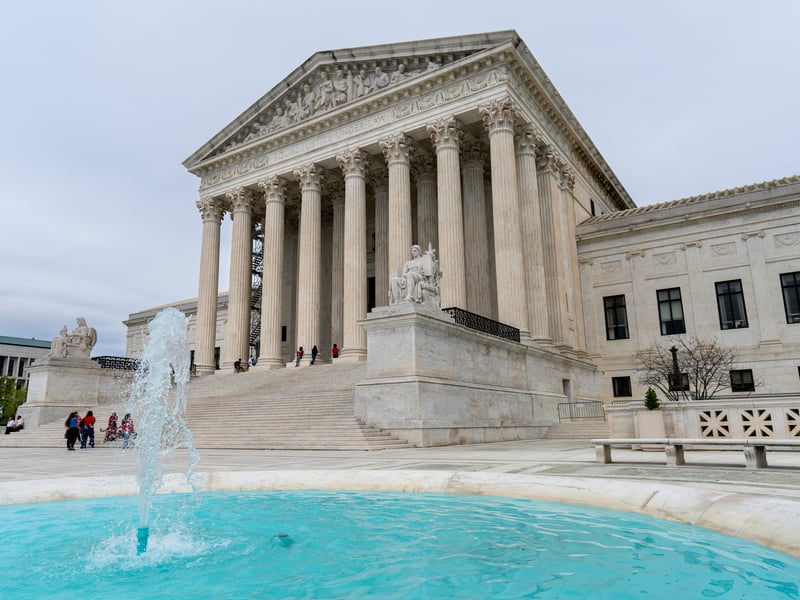
WASHINGTON (CN) — A man who reported misconduct at his job appeared to convince the Supreme Court on Tuesday that his employer should have to face a million-dollar fine for firing him after he filed a whistleblower complaint.
The justices spent close to two hours parsing the Sarbanes-Oxley Act, a 2002 law that protects whistleblowers who report corporate misconduct. The law made filing complaints for fraud a protected activity, but a ruling out of the Second Circuit created confusion on what employees would need to do to utilize these protections.
Trevor Murray brought the case before the court. The financial expert was an employee at the global firm UBS Securities until he filed a complaint against the company for reporting his colleagues’ conduct that he claimed was unethical and illegal.
Murray claims that the head of UBS’s commercial mortgage-backed securities trading desk and a lead trader pressured him to skew his independent research reports. Murray’s reports on the markets would be used by UBS’s customers.
Before he reported his colleagues’ behavior, Murray received positive feedback from his supervisor. After he reported the attempts to influence his reports, however, Murray was fired.
Murray filed a whistleblower complaint with the Department of Labor in 2012, claiming he was fired in violation of federal law. UBS claims it fired Murray as part of a layoff.
A jury found Murray had proved that his complaints were a factor in his termination, awarding him almost $1 million in damages. The jury said UBS had not proved that it would have fired Murray regardless of his complaints.
However, the Second Circuit reversed, finding that Murray should have had to prove that UBS acted with retaliatory intent — a higher burden of proof.
Justice Neil Gorsuch said the appeals court had done something the justices already condemned. The Second Circuit said employees would have to prove their employer had a motive to retaliate, something the high court rejected in the Title VII context.
The Trump appointee saw the high court’s role in the case simply.
“The question is whether there was discrimination, period,” Gorsuch said.
Gorsuch did not want to get into the particulars of the statute, which he saw as complicating the justices’ task.
The majority of the justices seemed to think UBS was the one going beyond the statute, however.
“You’re asking me to read things into a statute that aren’t there,” Gorsuch said.
Not all the justices took Gorsuch’s view that the court should decide the case so narrowly. Justice Elena Kagan characterized Gorsuch’s disposition as “bare bones” and said the court could be forced to have this conversation all over again if they went his direction.
“I don’t think anybody wants to have this conversation all over again,” Gorsuch responded.
Justice Amy Coney Barrett said taking Gorsuch’s approach could leave the door open for lower courts to put more requirements on employees’ burden of proof.
Both Murray and UBS argued their position better fit the high court’s favored legal interpretation — textualism.
“The question in this case is how claims that an employer acted with retaliatory intent are to be proven,” Easha Anand, an attorney with Stanford’s Supreme Court litigation clinic representing Murray, said. “The plain text of the statute answers that question.”
UBS’s attorney, the son of the late Justice Antonin Scalia, said Murray was overreading the statute.
“In Sarbanes-Oxley, Congress employed a phrase, ‘discriminate because of,’ that has long been recognized to require a plaintiff to show discriminatory intent,” Eugene Scalia, an attorney with Gibson Dunn representing UBS, said. “It is this transplanted phrase with its rich soil that decides this case.”
Although there was disagreement over where the court should land exactly, it appeared the majority of the justices were in favor of offering more protections to whistleblowers.
“The court appeared to be skeptical of UBS’ attempt to ignore the plain meaning of the statute,” Stephen Kohn, a whistleblower attorney with Kohn, Kohn & Colapinto, said in an email.
Kohn, who helped draft the provisions used in the statute before the court, said the justices’ ruling in the case will decide if whistleblowers are owed the protections lawmakers intended to give them.
“What hangs in the balance of this case is whether the Sarbanes-Oxley Act can be used to effectively protect corporate whistleblowers, especially those who raise their concerns internally,” Kohn said.
 Follow @KelseyReichmann
 Follow @kelseyreichmann.bsky.social
Subscribe to our free newsletters
Our weekly newsletter Closing Arguments offers the latest about ongoing trials, major litigation and rulings in courthouses around the U.S. and the world, while the monthly Under the Lights dishes the legal dirt from Hollywood, sports, Big Tech and the arts.