
 Search Articles


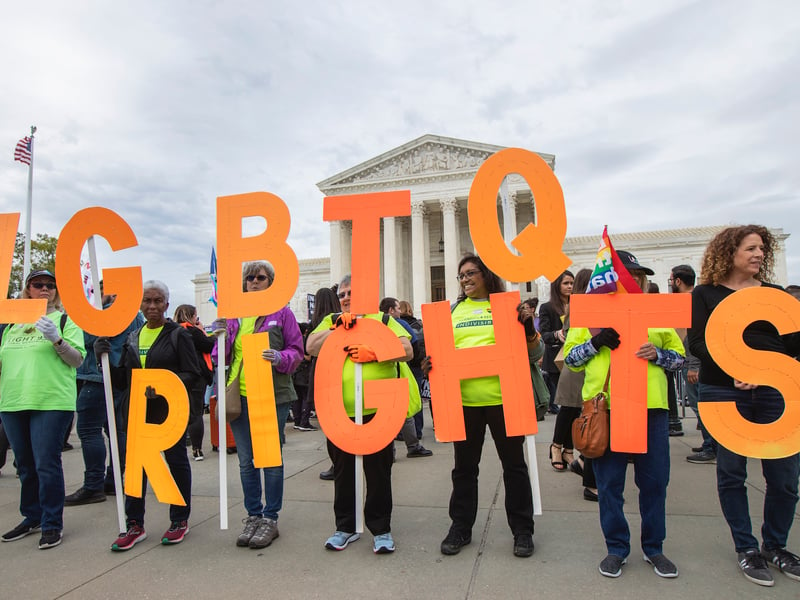
WASHINGTON (CN) — Religious parents secured a Supreme Court win against a Maryland county school board on Friday as the justices ruled in favor of mandatory opt-outs to shelter children from LGBTQ-inclusive storybooks.
In a 6-3 ruling, the court held that the county’s decision to introduce LGBTQ inclusive storybooks without allowing parents to remove their children from the classroom violated the parents’ religious rights.
“We reject this chilling vision of the power of the state to strip away the critical right of parents to guide the religious development of their children,” Justice Samuel Alito, a George W. Bush appointee, wrote for the majority.
Led by Justice Sonia Sotomayor, the three liberal justices dissented, calling the ruling a threat to the essence of public education.
“Exposure to new ideas has always been a vital part of that project, until now,” Sotomayor, a Barack Obama appointee, wrote.
Maryland schools began adding LGBTQ-inclusive books to libraries in 2022, including “Uncle Bobby’s Wedding,” about a young girl whose gay uncle is getting married; “Prince & Knight,” about a prince who wants to marry a knight; and “Love, Violet,” about two girls who give each other Valentine’s Day cards.
The school board initially allowed parents to opt out, giving students alternative lessons during inclusive storybook readings. But the volume of requests made this unworkable and risked stigmatizing students who chose to participate, undermining the policy’s goals.
Three sets of parents asked the justices to find that a Maryland school board violated their religious rights by not offering opt-out policies when LGBTQ-inclusive books were added to classrooms.
Tamer Mahmoud and Enas Barakat, who are Islamic, Chris and Melissa Persak, who are Roman Catholic, and Jeff and Svitlana Roman, who are Roman Catholic and Ukrainian Orthodox, claimed that the board was trying to indoctrinate their children with beliefs contrary to their faith.
The case presented a familiar conflict for the justices, weighing religious freedoms against LGBTQ rights. In 2023, the justices ruled in favor of a Christian web designer who didn’t want to serve gay customers. That case was built on a 2018 dispute involving LGBTQ couples and wedding cakes.
In the dispute about LGBTQ-inclusive books, the justices weighed parents’ religious rights against public schools’ mission to provide an inclusive environment for all students.
The question before the court was whether the parents could obtain a preliminary injunction to keep their children from interacting with LGBTQ storybooks while challenging the school’s policy on the merits. Alito said the preliminary injunction was appropriate because the parents were likely to succeed in their underlying suit.
After a detailed description of the LGBTQ books Montgomery County wanted to include in classrooms, Alito concluded that the upshot of the messaging in the books was “that it is hurtful, perhaps even hateful, to hold the view that gender is inextricably bound with biological sex.”
“These books carry with them ‘a very real threat of undermining’ the religious beliefs that the parents wish to instill in their children,” Alito wrote.
Sotomayor said merely exposing students to the message that LGBTQ people exist did not violate the parents’ rights. Citing the court’s ruling in Kennedy v. Bremerton School District , Sotomayor noted that her colleagues upheld the rights of a football coach praying on the field despite objections about other students’ exposure to objectionable conduct.
“In sum, never, in the context of public schools or elsewhere, has this court held that mere exposure to concepts inconsistent with one’s religious beliefs could give rise to a First Amendment claim,” Sotomayor wrote.
Alito refuted this contention, arguing that it “ignores the messages that the authors plainly meant to convey.”
While the court’s precedents allow government burdens on religious exercise, Alito said the school’s no opt-out policy could not survive scrutiny under the First Amendment. Acceptable burdens must be neutral and generally applicable. Alito said that if the school board allows opt-outs for human sexuality courses, it must also do so for LGBTQ storybooks.
“The board cannot escape its obligation to honor parents’ free exercise rights by deliberately designing its curriculum to make parental opt outs more cumbersome,” Alito wrote.
Sotomayor warned that schools might start censoring their curriculum to avoid litigation now that parents can sue for opt-out rights, giving a subset of parents the right to veto curricular choices. She argued that this would remove authority from democratically elected officials to judges.
“The court, in effect, constitutionalizes a parental veto power over curricular choices long left to the democratic process and local administrators,” Sotomayor wrote. “That decision guts our free exercise precedent and strikes at the core premise of public schools: that children may come together to learn not the teachings of a particular faith, but a range of concepts and views that reflect our entire society.”
LGBTQ advocates worried that the ruling weaponized religion against LGBTQ people. However, because the ruling only concerned the existence of opt-outs, advocates pushed school districts to continue adopting inclusive curricula.
“While parents with religious objections may be able to remove their children from classroom use of these storybooks, they do not get to demand that schools stop these important efforts to reflect our entire society,” Karen Loewy, senior counsel and director of constitutional law practice at Lambda Legal, said in a statement.
However, advocates for religious freedom celebrated the ruling.
“The U.S. Supreme Court today strengthened the rights of parents by ensuring that they have a say when it comes to the education of their children, especially when families’ religious beliefs are at stake,” Kayla Toney, counsel at First Liberty Institute, said in a statement.
 Follow @KelseyReichmann
 Follow @kelseyreichmann.bsky.social
Subscribe to our free newsletters
Our weekly newsletter Closing Arguments offers the latest about ongoing trials, major litigation and rulings in courthouses around the U.S. and the world, while the monthly Under the Lights dishes the legal dirt from Hollywood, sports, Big Tech and the arts.