
 Search Articles


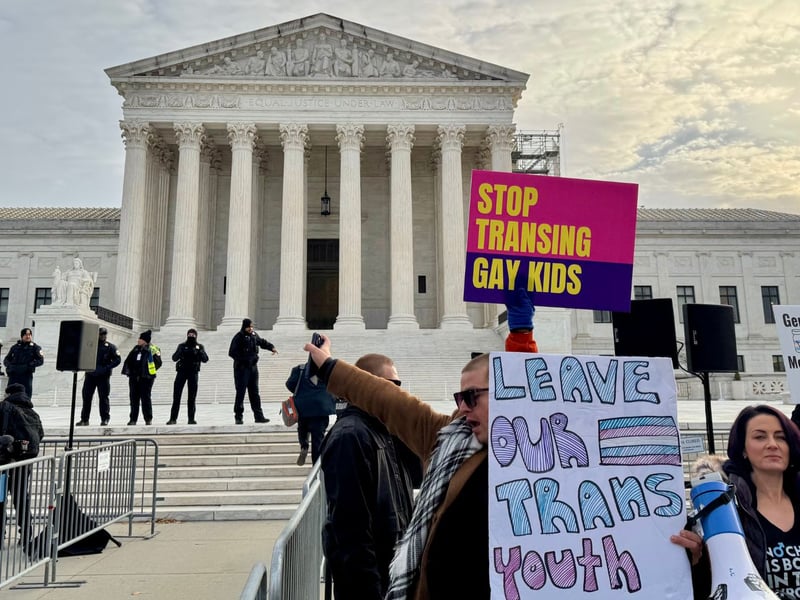
WASHINGTON (CN) — Granting an emergency request, the Supreme Court on Monday ruled California schools must disclose confidential information about students’ gender identity without their consent.
In an apparent 6-3 decision, the court ruled the Golden State’s law likely violated the parents’ rights to guide the religious development of their children. Recognizing parents’ rights to the upbringing and education of their children, the court also granted relief to nonreligious parents who objected to the policy.
“Everyone agrees that children’s safety is the overriding equity,” the majority wrote in an unsigned opinion. “And the injunction here promotes child safety by guaranteeing fit parents a role in some of the most consequential decisions in their children’s lives.”
In cases where suspected abuse may occur should the parents be informed of their child’s transition, the court said California should utilize child-abuse laws.
Justice Sonia Sotomayor, a Barack Obama appointee, would have denied the application, but she did not join a fiery opinion from Justice Elena Kagan, another Obama appointee. Kagan’s dissent, which was joined by Justice Ketanji Brown Jackson, a Joe Biden appointee, chastised the court for acting on a novel legal issue on the emergency docket.
“The court is impatient: It already knows what it thinks, and insists on getting everything over quickly,” Kagan wrote.
Granting relief to the nonreligious parents was particularly egregious, Kagan said, noting that in one other issue — most notably abortion — the conservative justices have rejected the creation of rights through substantive due process.
“Especially given the court’s last venture into the field, today’s decision cannot but induce a strong sense of whiplash,” Kagan wrote, comparing recognizing a parent’s right to make important decisions about her child’s health here with repudiating a woman’s right to make important decisions about her own health in Dobbs v. Jackson Woman’s Health Organization.
Justice Amy Coney Barrett, a Donald Trump appointee, rebutted Kagan’s critique in a separate concurring opinion. She argued Dobbs did not overturn the court’s existing substantive due process precedents, stating that the parents’ right to raise their child has long been recognized by the court.
“California’s nondisclosure policy thus quite obviously excludes parents from highly important decisions about their child’s mental health and is unlikely to satisfy heightened scrutiny,” Barrett wrote. “Our resolution of the parents’ likelihood of success on this claim is dictated by existing law.”
Chief Justice John Roberts, a George W. Bush appointee, and Justice Brett Kavanaugh, another Trump appointee, joined Barrett’s concurrence.
Late last year, a lower court judge ruled that the rights of parents to direct the medical care and religious upbringing of their kids outweighed the state’s responsibility over children in its care.
California said that the judge misunderstood the scope of its law. Known as AB 1955, the law prohibits policies requiring school employees to disclose the sexual orientation or gender identity of students without their consent, unless the disclosure is required by state or federal law.
“Far from categorically forbidding disclosure of information about students’ gender identities to parents, the challenged state laws allow, and even require, disclosure in certain circumstances — in particular, where there is a risk of serious harm to the student,” the state wrote. “And in striking down those laws, the district court relied on dubious legal propositions that far exceed anything previously established by this court.”
The Ninth Circuit agreed with the state, blocking the lower court ruling. The parents turned to the Supreme Court for emergency relief.
“California is requiring public schools to hide children’s expressed transgender status at school from their own parents — including religious parents — and to actively facilitate those children’s ‘social transition’ over their parents’ express objections,” the parents wrote in their emergency appeal.
Last year, the Supreme Court gave Maryland parentsan opt-out whenever LGBTQ+ books were used in classrooms. The California parents argued that the appeals court’s ruling squarely evaded Mahmoud v. Taylor “and strips parents of their core authority with respect to an issue with significant religious and developmental impact: that is, a child’s growth into adulthood.”
However, California argued the parents hadn’t treated the appeal as an emergency in the lower courts. The state warned the justices against early intervention in the case amid ongoing disagreements over Article III standing, the injunction order and the scope of the law.
“For many students, the consequences of compelling the disclosure of confidential information about their gender identity would be irreversible,” the state wrote. “The court of appeals acted responsibly, and equitably, in avoiding that harm before it has the opportunity to consider full briefing and argument.”
A few weeks after the parents filed their emergency appeal, the Trump administration announced an investigation finding the California Department of Education in violation of the Family Educational Rights and Privacy Act. Known as FERPA, the law grants parents the right to access their child’s education records.
The Trump administration claimed that California’s Education Department abused its authority by pressuring school officials to withhold information about students’ gender transitions. U.S. Secretary of Education Linda McMahon said the department will use every available mechanism to hold California accountable.
However, the Education Department’s Student Privacy Policy Office pushed California to voluntarily resolve its FERPA violations by opening up gender support plans and other documentation to parents upon request.
The majority held California’s intrusion on parents’ free exercise rights was greater than in *Mahmoud. *
“The state argues that its policies advance a compelling interest in student safety and privacy,” the court wrote. “But those policies cut out the primary protectors of children’s best interests: their parents.”
Precedent dictates that parents not be shut out of the participation regarding their children’s mental health, the court wrote. The majority said California’s policy likely violated this right by concealing a child’s gender dysphoria from their parents.
“Gender dysphoria is a condition that has an important bearing on a child’s mental health, but when a child exhibits symptoms of gender dysphoria at school, California’s policies conceal that information from parents and facilitate a degree of gender transitioning during school hours,” the court wrote.
Kagan lambasted the court for acting on the parents’ emergency appeal when the court has similar questions waiting on the merits docket. According to Kagan, 40 cases raising related questions are currently percolating.
“The court jumps the line, preempting the Ninth Circuit’s normal (and notably reflective) en banc process,” Kagan wrote. “Why wait for appellate procedures to play out when the court already knows what it wants?”
Despite being short and preliminary, Kagan said no one will read the court’s per curiam opinion as anything less than a conclusive merits judgment.
“If nothing else, this court owes it to a sovereign state to avoid throwing over its policies in a slapdash way, if the court can provide normal procedures,” Kagan wrote. “And throwing over a state’s policy is what the court does today.”
 Follow @KelseyReichmann
 Follow @kelseyreichmann.bsky.social
Subscribe to our free newsletters
Our weekly newsletter Closing Arguments offers the latest about ongoing trials, major litigation and rulings in courthouses around the U.S. and the world, while the monthly Under the Lights dishes the legal dirt from Hollywood, sports, Big Tech and the arts.