
 Search Articles


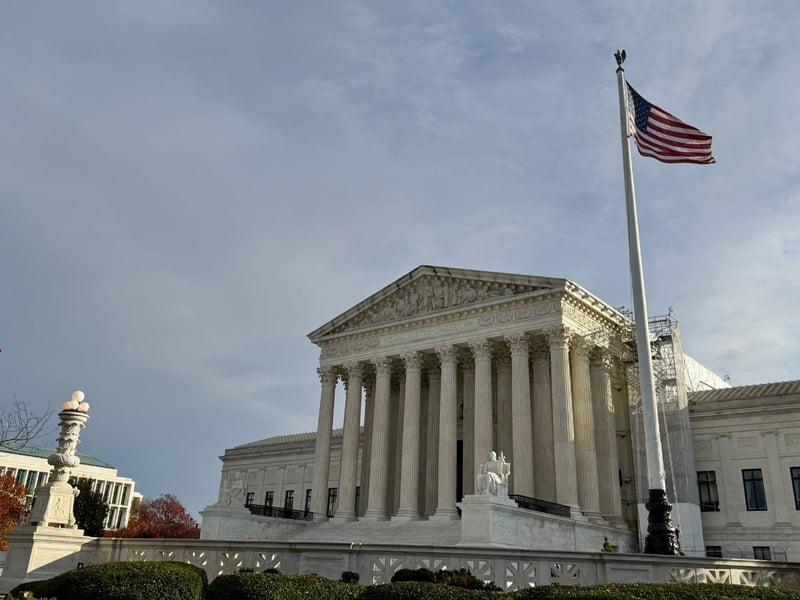
WASHINGTON (CN) — The Supreme Court appeared likely on Wednesday to rule against several prisoners seeking sentence reductions.
For nearly three hours, the high court debated whether the extraordinary and compelling reasons judges consider when offering sentence reductions could include factors like trial errors or changes in the law. Most of the justices were skeptical that Congress authorized such contemplations and worried that doing so would open the floodgates to frivolous claims.
“Congress, for better or for worse, made a determination that those are the limitations that it wanted and even to the extent that a judge thinks that they are unfair, in most cases, I doubt that Congress meant for individual judges to override its own judgment,” Justice Elena Kagan, a Barack Obama appointee, said.
Under the compassionate release provision, courts can modify criminal sentences in certain cases. Before 2018, the Bureau of Prisons had to file a motion as a prerequisite for such consideration, but Congress expanded a federal-sentencing statute in the First Step Act to eliminate that requirement.
Courts have since adopted a broader view of compassionate release factors beyond personal circumstances like old age or illness. Joe Fernandez, who faces two consecutive life sentences, told the justices that errors significantly increasing a defendant’s sentence should be one of these factors.
In 2011, Fernandez was found guilty of murder for hire and firearms charges and sentenced to two terms of life imprisonment for killing two men who owed $6.5 million to a New York drug ring. He maintains his innocence, however, and convinced a judge to reduce his sentence based on extraordinary and compelling circumstances.
That judge said “a certain disquiet remains” over the co-conspirators’ testimony that was used to convict Fernandez. All three of the co-conspirators received lighter sentences for their testimony. Fernandez’s innocence claim and the sentencing disparity constituted extraordinary and compelling circumstances, that court determined, reducing his sentence to time served.
While sympathetic to the disquiet that sometimes judges feel, Justice Sonia Sotomayor, an Obama appointee, said that couldn’t be used as a factor in compassionate release claims.
“It happens to every district court judge,” Sotomayor said. “There’s a case where you really struggle, but can we, in the facts of this case, denote that that is an extraordinary circumstance?”
Justice Neil Gorsuch, a Donald Trump appointee, said that the judge’s own feelings, even if reasonable, have nothing to do with the defendant’s circumstances for compassionate release.
“I thought, in our legal system, the jury’s verdict on the facts is not something a court can impeach unless it’s clearly erroneous,” Gorsuch said.
The court appeared uneasy with allowing judges to consider factors that also fall under the federal habeas statute. Kagan said that habeas claims face harsh limitations and questioned whether inmates might use compassionate release as an end-run around those prohibitions.
Justice Ketanji Brown Jackson, a Joe Biden appointee, stood mostly alone in her support of Fernandez’s arguments. She said that the considerations weren’t mutually exclusive. Instead, Jackson said compassionate release was intended to work as a safety valve.
“The question is safety valve for what?” Kagan asked. “Not every safety valve is a safety valve for everything.”
The Trump administration said Wednesday inserting habeas limits into compassionate release claims would “make some kind of Frankenstein monster that I don’t think is what Congress intended.”
Eric Feigin, deputy solicitor general at the Justice Department, said that compassionate release was intended to be a narrow exception to sentencing finality only to be used in extraordinary circumstances that aren’t addressed by other statutes.
“What you’ve just heard … is a proposal to make it instead an open-ended loophole to challenge the validity of sentences continuously through a potentially endless series of collateral attacks on the criminal judgment,” Feigin said.
Justice Samuel Alito, a George W. Bush appointee, worried that creating an opening for such claims would defeat the unique purpose of compassionate release.
“This isn’t going to be unusual,” Alito stated, noting that most defense attorneys would try to file similar claims. “This is going to be standard.”
Fernandez argued that Congress gave the Sentencing Commission broad authority to provide guidance on issues that the First Step Act didn’t address. But many of the justices were weary that the commission hadn’t said whether legal errors could be considered under compassionate release.
In the second argument of the day, Daniel Rutherford told the court that the commission had weighed in on whether prospective changes in law could be considered as a compassionate release factor.
Rutherford was sentenced to over 30 years in prison for several armed robberies in 2003. One of his firearm charges alone resulted in 25 years of his sentence, but Rutherford argued that under the First Step Act, he would have only received 7 years for the same charge.
The justices were still troubled by Rutherford’s case, however, questioning if the Sentencing Commission had overstepped by weighing in where Congress was silent.
Gorsuch went so far as to suggest that the commission had been “disrespectful” to by overriding Congress’ opinion for their own.
 Follow @KelseyReichmann
 Follow @kelseyreichmann.bsky.social
Subscribe to our free newsletters
Our weekly newsletter Closing Arguments offers the latest about ongoing trials, major litigation and rulings in courthouses around the U.S. and the world, while the monthly Under the Lights dishes the legal dirt from Hollywood, sports, Big Tech and the arts.