
 Search Articles


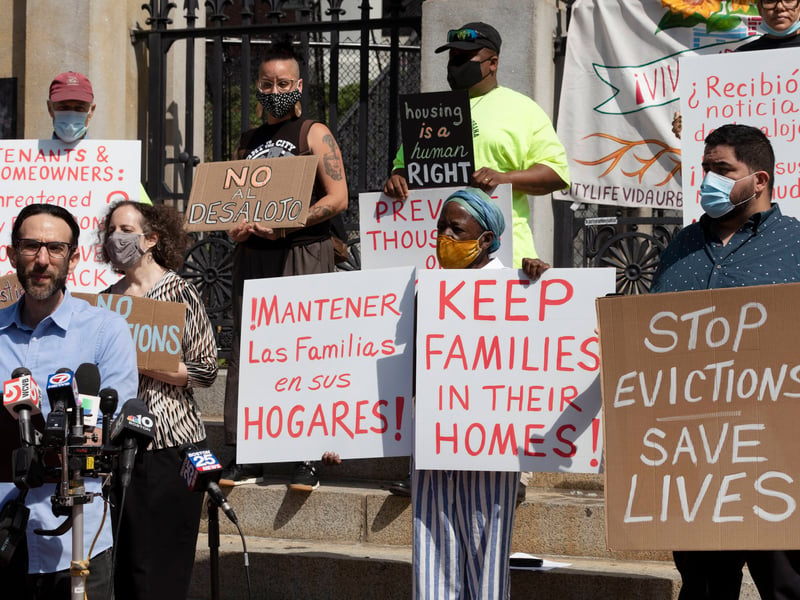
(CN) — The U.S. Supreme Court declined to hear a case that addresses whether eviction moratoriums enacted during the height of the Covid-19 pandemic infringed on the property rights of landlords.
Justices Clarence Thomas and Neil Gorsuch dissent from the petition’s denial in GHP Management Corp. v. City of Los Angeles , arguing in a three-page opinion that the high court should determine whether policies barring landlords from evicting tenants for failure to pay rent represented a physical taking under the Fifth Amendment.
The circuits have split on the issue, the justices observe.
In Darby Development Company Inc. v. United States , the D.C.-based Federal Circuit ruled in a split decision that landlords had sufficiently pleaded a physical takings claim against the Center for Disease Control and Prevention after the agency ordered a nationwide moratorium on residential evictions.
In the opinion, U.S. Circuit Judge Sharon Prost, a George W. Bush appointee, rejected arguments that the agency was acting outside the normal scope of its duties when it issued the order.
The global pandemic was an abnormal event, and it prompted the CDC to issue an abnormal order, Prost wrote. But the agency was still acting within the normal scope of its duties — preventing the interstate spread of communicable diseases.
The Eight Circuit reached a similar conclusion in Heights Apartments LLC v. Tim Walz , which challenged eviction moratoriums in Minnesota, but later affirmed that sovereign immunity protected the state and its governor from claims related to the order.
Meanwhile, in GHP Management Corp. , the Ninth Circuit wrote in an unpublished opinion that a statute that “merely adjusts the relationship between landlord and tenant,” including the terms of the eviction, does not constitute a physical taking.
The Ninth Circuit cited the U.S. Supreme Court’s 1992 decision in Yee v. Escondido , which states “the government effects a physical taking only when it requires the landowner to submit to the physical occupation of his land” by a third party.
In this case, the landlords voluntarily opened their property to occupation by tenants and they were not compelled to rent the properties in perpetuity, the circuit found.
GHP Management Corp. and 13 other apartment building owners argued in a petition for writ of certiorari that the Ninth Circuit has routinely misinterpreted Yee , which addressed a local ordinance that controlled rent in mobile home communities, not evictions.
Thomas writes in Monday’s dissent that the circuit split stemmed from confusion about how to reconcile the precedents in Yee and Cedar Point Nursery v. Hassid , a 2021 decision that found a law requiring agricultural employers to allow labor organizers onto their property constituted a physical taking.
“Because ‘[w]e created this confusion,’ we have an obligation to fix it,” writes Thomas, a George H.W. Bush appointee. “That obligation is particularly strong here, as there is good reason to think that the Ninth Circuit erred.”
Under the logic of Cedar Point , Thomas argues an eviction moratorium would plainly seem to interfere with one of the most fundamental rights of landlords — the right to exclude.
The issue was also “important and recurring,” according to Thomas.
“Given the sheer number of landlords and tenants, any eviction moratorium statute stands to affect countless parties,” Thomas writes. “And, the end of the Covid–19 pandemic has not diminished the importance of this issue. Municipalities continue to enact eviction moratoria in the wake of other emergencies.”
It was better to clarify the case law now, “rather than in the heat of the next national emergency,” he writes.
 Follow @SteveGarrisonPC
Subscribe to our free newsletters
Our weekly newsletter Closing Arguments offers the latest about ongoing trials, major litigation and rulings in courthouses around the U.S. and the world, while the monthly Under the Lights dishes the legal dirt from Hollywood, sports, Big Tech and the arts.