
 Search Articles


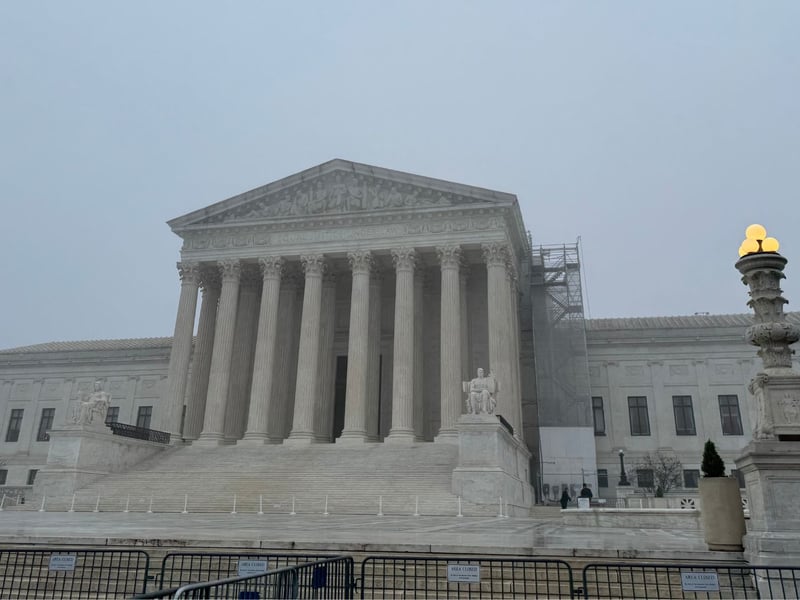
WASHINGTON (CN) — The Supreme Court on Monday declined to review a prisoner’s petition to examine whether a biased jury at trial wrongfully resulted in a first-degree murder conviction and death sentence.
Missouri resident Lance Shockley, seeking a new trial sparked by a deadly drunk-driving incident and a police investigator’s murder, asked the high court to resolve an appellate circuit split after the Eighth Circuit Court of Appeals denied him a “certificate of appealability” even though one judge voted to grant it. The single vote would have been enough to earn an appeal in some circuits.
Justice Sonia Sotomayor, a Barack Obama appointee, wrote a dissent, joined by Justice Ketanji Brown Jackson. Sotomayor said she would have granted the petition, noting that Shockley’s appeal could have proceeded in the Third, Fourth, Seventh and Ninth circuits.
“Allowing a panel of judges to deny a certificate of appealability over a dissenting vote has significant consequences,” Sotomayor wrote.
She noted that briefing is significantly limited at that stage and oral arguments are presumptively denied, forcing a defendant to argue for the certificate rather than their claims’ merit. Further, a lawyer is only appointed if the certificate is granted, making it harder for poor litigants to earn an appeal.
“Allowing an appeal whenever one judge votes to grant a certificate also reflects the substantive standard that governs habeas appeals,” Sotomayor wrote. “When one or more jurists believes a claim has sufficient merit to proceed, that itself ‘might be thought to indicate that reasonable minds could differ … on the resolution’ of the relevant claim.”
Sotomayor pointed to her dissent in the 2023 Johnson v. Vandergriff, another prisoner petition challenging the Eighth Circuit’s decision to deny a certificate of appealability.
In that case, Missouri resident Johnny Johnson challenged his death sentence after a psychiatrist diagnosed him with severe mental illness and found he was not competent to stand trial. The Supreme Court declined to stay his execution.
On Nov. 26, 2004, Shockley wrecked a pick-up truck he was driving with Jeffrey Bayless, his sister-in-law’s fiancé. Shockley asked a couple for help at a nearby house; she called 911 while he called his wife.
When police arrived, they found Bayless slumped in the passenger seat with bottles of alcohol. Shockley’s wife, her sister and the neighbor couple were there, but Shockley wasn’t. No one told police he was the driver, and he later denied involvement. Bayless died at the scene.
Four months later, Highway Patrol Sergeant Carl DeWayne Graham Jr., the lead investigator, questioned the neighbor again, falsely telling her that Shockley had confessed to being the driver. She said Shockley told her the same thing.
The next day, someone shot and killed Graham after he pulled into his driveway. Police later arrested Shockley for fleeing the scene of the accident but ultimately also charged him with first-degree murder. He was convicted and later sentenced to death by a trial judge after a jury failed to agree on a sentence.
Shockley’s attorney appealed after finding that the jury foreman had written a novel with himself as the main character, “chronicling the protagonist’s brutal and graphic revenge murder of a defendant who killed the protagonist’s wife in a drunken-driving accident."
The foreman was removed before the jury debated the sentence. Though Shockley’s attorneys requested a new trial on the grounds of jury bias, they declined to question any of the jurors. The judge denied the request for a new trial.
Shockley hired new attorneys, who found that the foreman gave copies of the book to several jurors and court officials, including the judge. He filed for post-conviction relief, arguing that the lack of questioning was a breach of his rights.
The Missouri Supreme Court rejected that claim, though one judge dissented. A federal judge then denied his request for post-conviction relief and denied his permission to appeal.
A three-judge panel of the Eighth Circuit Court of Appeals also refused to grant Shockley a certificate of appealability in a 2-1 decision, which was upheld by the full Eighth Circuit, with two judges dissenting.
“This case exemplifies the problems with the Eighth Circuit’s contrary approach,” Sotomayor said. “The Court of Appeals plainly erred when, over multiple dissents, it treated as not even debatable the district court’s denial of relief on Shockley’s ineffective-assistance claim. Had the court instead followed the approach taken in the Third, Fourth, Seventh and Ninth Circuits that error would have been avoided.”
 Follow @Ryan_Knappy
Subscribe to our free newsletters
Our weekly newsletter Closing Arguments offers the latest about ongoing trials, major litigation and rulings in courthouses around the U.S. and the world, while the monthly Under the Lights dishes the legal dirt from Hollywood, sports, Big Tech and the arts.