
 Search Articles


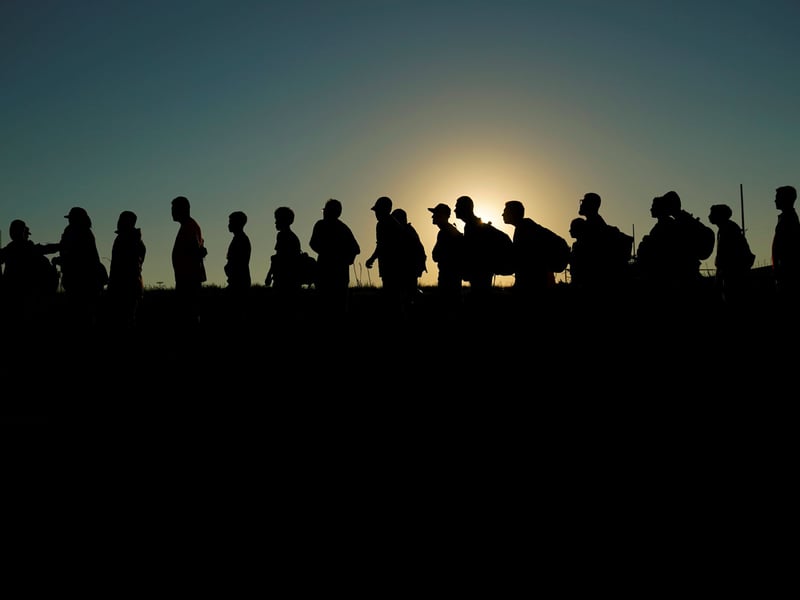
WASHINGTON (CN) — The Supreme Court agreed on Monday to reassess an abandoned immigration policy turning back asylum-seekers at ports of entry along the U.S. southern border.
President Donald Trump asked the justices to review a Ninth Circuit decision declaring the hurdle unlawful. The practice, which the government calls “metering,” was rescinded by the Biden administration, but the current White House wants to keep its options open as its immigration crackdown expands.
“The Constitution entrusts the power to manage the border to the political branches, not the judiciary,” U.S. Solicitor General John Sauer wrote. Citing connections to active policies, Sauer said that “the decision below improperly ‘undercuts Congress’ authority’ to set asylum policy. It also ‘severely intrude[s] on the executive branch’s prerogative to manage our country’s borders.’”
A nonprofit immigrant rights organization, Al Otro Lado, and 13 asylum-seekers who filed the lawsuit at the center of the dispute in 2017 said they stand behind the Ninth Circuit’s ruling and will defend it before the high court.
“The government’s turnback policy was an illegal scheme to circumvent these requirements by physically blocking asylum-seekers arriving at ports of entry and preventing them from crossing the border to seek protection,” attorneys for Al Otro Lado and the asylum-seekers said in a statement. “Vulnerable families, children and adults fleeing persecution were stranded in perilous conditions where they faced violent assault, kidnapping and death.”
Under the Immigration and Nationality Act, anyone who is physically present in the United States — whether or not at a designated port of entry — can seek asylum if they have a well-founded fear of persecution in their home country.
During an influx of Haitian asylum-seekers at Southern California’s San Ysidro port of entry in 2016, the Obama administration began ordering border agents to turn away newly arriving migrants. Two years later, the Department of Homeland Security formalized the policy, giving all southern border ports “metering guidance.”
Under the 2018 policy, border agents identified likely asylum-seekers and physically prevented them from stepping onto U.S. soil. The first Trump administration implemented an additional roadblock in 2019, making migrants who traveled through one or more countries on their way to the U.S. ineligible for asylum if they did not previously seek protection in at least one transit country.
A lower court certified a class for the asylum-seekers who had arrived prior to Trump’s transit rule and issued an injunction that reopened claims that had been denied based on the 2019 policy. That class allowed the case to continue after the Biden administration rescinded the metering policy in 2021. The transit rule was later rescinded in 2023.
In 2022, the lower court issued a permanent injunction barring the government from applying the asylum prohibitions to that class, and said its members were entitled to seek asylum under prior policy guidance.
To decide whether the remedy should be upheld, the Ninth Circuit reviewed the lawfulness of the metering policy. The panel sided with the asylum-seekers, rejecting the government’s arguments that migrants who were turned away from ports of entry were not unlawfully denied asylum under the metering policy because they were not physically present in the U.S.
The Trump administration urged the Supreme Court to reverse, arguing that other policies, like the Biden-era CBP One app — allowing migrants to make asylum appointments — would be threatened.
“Under the logic of the decision below, [Customs and Border Patrol] was not allowed to prevent the entry of an alien who came to the border without an appointment,” Sauer wrote. “Such an alien could claim, after all, that he has arrived ‘in the United States’ and that the government accordingly must inspect him and process his asylum application — effectively allowing him to jump the queue.”
The asylum-seekers opposed the government’s petition, stating that the appeals court’s ruling only applied to a subset of migrants.
“Although the current administration’s border policies face pending legal challenges, none of the plaintiffs’ claims in those cases turn on the question presented by the petition here,” wrote Kelsi Brown Corkran, an attorney with the Institute for Constitutional Advocacy and Protection at Georgetown Law. “The court’s resolution of the question presented would thus amount to little more than an advisory opinion.”
The Justice Department declined to comment on the Supreme Court’s decision to hear its appeal. The White House referred questions about the revival of the metering policy to the Department of Homeland Security, which did not answer questions about whether the Trump administration would revive the policy.
“As our attorneys have already made abundantly clear, the Trump administration has advanced the clear meaning of federal law and basic common sense in this case since day one,” Assistant Secretary Tricia McLaughlin said in an email that included a link to the government’s petition. “We look forward to presenting our case to the Supreme Court.”
 Follow @KelseyReichmann
 Follow @kelseyreichmann.bsky.social
Subscribe to our free newsletters
Our weekly newsletter Closing Arguments offers the latest about ongoing trials, major litigation and rulings in courthouses around the U.S. and the world, while the monthly Under the Lights dishes the legal dirt from Hollywood, sports, Big Tech and the arts.