
 Search Articles


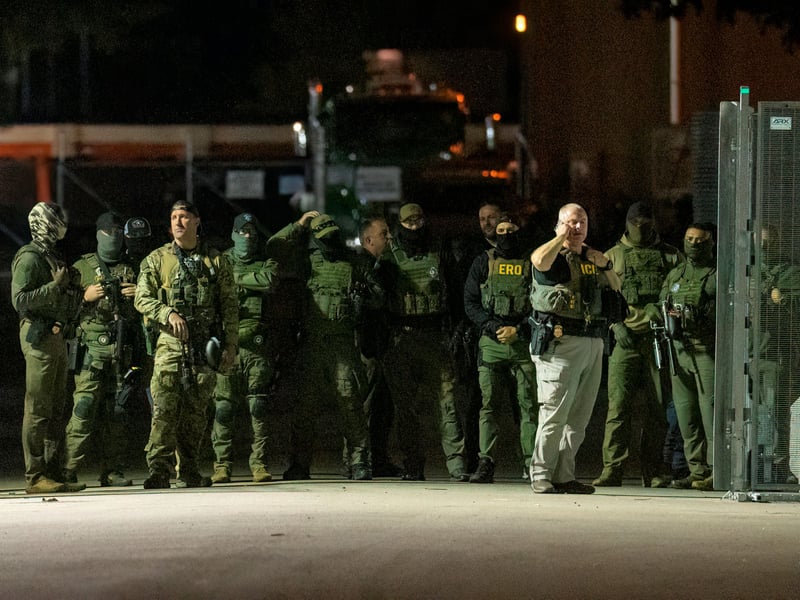
WASHINGTON (CN) — The Supreme Court rejected President Donald Trump’s rhetoric about rebellion in the Windy City on Tuesday, barring the deployment of National Guard troops to the Chicago area against the wishes of local officials.
The justices’ ruling marks the first opportunity for the Supreme Court to weigh in on Trump’s use of military force against protesters. Two lower courts were unpersuaded by the administration’s framing of opposition to immigration policies as a violent rebellion, leading Trump to call for emergency relief from the Supreme Court.
After an unusually long deliberation, the justices denied Trump’s request in an apparent 6-3 order.
“The government has not carried its burden to show that [Title 10] permits the president to federalize the guard in the exercise of inherent authority to protect federal personnel and property in Illinois,” the majority explained, referring to the authority the government cited to deploy guard troops.
Justice Samuel Alito, a George W. Bush appointee, wrote a lengthy dissent claiming that the majority had ruled on questions that neither party put before the court. Alito, joined by Justice Clarence Thomas, a George H.W. Bush appointee, also lambasted the lower court’s fact-finding, arguing that the government had adequately shown it couldn’t enforce immigration policy without the help of national guard troops.
“Whatever one may think about the current administration’s enforcement of the immigration laws or the way ICE has conducted its operations, the protection of federal officers from potentially lethal attacks should not be thwarted,” Alito wrote.
Justice Neil Gorsuch, a Trump appointee, penned a separate dissent, expressing concern with the high court’s intervention in the appeal at an interlocutory posture. Gorsuch said he agreed with parts of Alito’s dissent, but reserved his thoughts on broader questions about when the president could deploy the military domestically.
“I believe the declarations federal law enforcement officials submitted below support the grant of a stay for substantially the reasons given in … Justice Alito’s opinion,” Gorsuch wrote. “But I would hazard no opinion beyond that, leaving instead all the weighty questions outlined above for another case where they are properly preserved and can receive the full airing they so clearly deserve.”
Abigail Jackson, a White House spokesperson, said that nothing in the ruling detracted from the administration’s core agenda.
“The president promised the American people he would work tirelessly to enforce our immigration laws and protect federal personnel from violent rioters,” Jackson said in a statement. “He activated the National Guard to protect federal law enforcement officers, and to ensure rioters did not destroy federal buildings and property. Nothing in today’s ruling detracts from that core agenda. The administration will continue working day in and day out to safeguard the American public.
ICE in Illinois
In September, the Department of Homeland Security announced “Operation Midway Blitz,” an effort to ramp up immigration-related arrests in and around Chicago, Illinois. A suburban immigration processing facility in Broadview has become the epicenter of the operation, leading to standoffs between protesters and Immigration and Customs Enforcement officers in Illinois.
Viral videos have shown officers pointing guns at protesters and deploying smoke grenades and tear gas. One video shows an officer throwing Democratic congressional candidate Kat Abughazaleh to the ground. Another shows an officer firing projectiles from close range at a Presbyterian minister, who then collapses.
Some protesters have been arrested, but few have been charged and even fewer have been indicted by federal grand juries.
Elsewhere in the state, federal law enforcement raided a Chicago apartment building. After rappelling from a Black Hawk helicopter, armed agents reportedly swarmed the building, kicking down doors and forcing men, women and children out of their homes. Residents of the building, who included Venezuelan migrants and U.S. citizens, were zip-tied and made to wait outside for hours while federal agents took several dozen people into custody.
Broadview, Chicago and Illinois State Police have responded to demonstrations, working with federal officials to ensure public safety. State officials say local police departments remain committed to working with federal officers.
In early October, the Chicago Police Department responded to a shooting by a Customs and Border Patrol agent who claimed that a woman had rammed his vehicle. After the collision, the agent got out of his vehicle and shot the woman five times.
State officials said city police officers helped federal agents transport the woman to the hospital and preserve the crime scene. Chicago police officers also stood between protesters and federal agents as public outrage over the shooting drew demonstrators to the area.
According to state police, ICE’s Chicago field office director praised the unified response and coordination with federal and state officials. However, officials say they received a threat to federalize the National Guard on the same day.
Illinois Governor JB Pritzker rejected the intervention, arguing that there was no public safety need or emergency. Defense Secretary Pete Hegseth issued a memorandum federalizing hundreds of National Guard personnel anyway.
Title 10
The administration invoked a rarely used statute known as Title 10, allowing the president to federalize the National Guard. Title 10 can only be utilized when the country faces foreign invasion, the U.S. government faces rebellion, or the president is unable to execute laws with regular resources.
In a rare move, the justices asked for additional briefing on Trump’s initial appeal. The justices want to know whether “regular forces” refers to the U.S. military — not federal officials as Trump suggests.
In Tuesday’s order, the majority said that regular forces did refer to the U.S. military, noting that Title 10 would only apply where the military could legally execute the law. The military can only be deployed domestically, the court said, in exceptional circumstances under the Posse Comitatus Act.
“So before the president can federalize the guard under [Title 10], he likely must have statutory or constitutional authority to execute the laws with the regular military and must be ‘unable’ with those forces to perform that function,” the majority wrote. “At this preliminary stage, the government has failed to identify a source of authority that would allow the military to execute the laws in Illinois.”
This determination was the source of the dissenting justices’ disagreement with the majority. Alito said that it would be puzzling if the Posse Comitatus Act stood in the way of Trump’s deployment of guard troops under Title 10.
“Does the court mean to suggest that the Posse Comitatus Act somehow limited a president’s inherent constitutional authority?” Alito wrote. “That is certainly not Congress’s view.”
Justice Brett Kavanaugh, a Trump appointee, agreed with the court’s decision to deny Trump’s application but disagreed with the majority’s reasoning. Kavanaugh said the court should not have addressed whether protecting federal personnel and property could be considered executing the law under Title 10.
“Suppose also that the mob is threatening to storm the courthouse and attack the federal judges, prosecutors, and other personnel inside, and to damage or burn down the building, thereby preventing the execution of federal law,” Kavanaugh wrote, arguing that the majority’s reasoning would prevent the deployment of guard troops in that scenario.
Trump claimed that protests in Illinois fit that bill, stating that the demonstrations constituted a “rebellion or danger of rebellion.” Illinois sued the administration after Trump ignored state and local officials’ repeated objections to the use of troops against protesters.
Two lower courts determined there is no active rebellion in Chicago, with an appeals court stating, “political opposition is not rebellion.” A unanimous panel on the Seventh Circuit also rejected claims that protest activity in Illinois hampered federal officers from executing federal immigration laws.
U.S. Solicitor General John Sauer urged the justices to take immediate action, claiming that the continued prohibition on the deployment of federal troops increased the risk that officers would be seriously harmed by what he called “violent anti-ICE agitators.”
Claiming that judges can’t review the president’s opinion, the Justice Department says it doesn’t matter if courts disagree with the White House’s assessment. Under an 1827 Supreme Court ruling known as Martin v. Mott , the administration claims that only the president can determine whether there’s a rebellion or invasion.
“A federal district court lacks not only the authority but also the competence to wrest control of the military chain of command from the commander in chief,” Sauer wrote.
Illinois urged the justices to reject Trump’s appeal, stating that his arguments rested on mischaracterizations of the factual record.
“The state seeks to protect its sovereignty, retain control over local policing, and protect the basic structure of American federalism from unprecedented intrusion,” Jane Elinor Notz, the state’s solicitor general, wrote.
 Follow @KelseyReichmann
 Follow @kelseyreichmann.bsky.social
Subscribe to our free newsletters
Our weekly newsletter Closing Arguments offers the latest about ongoing trials, major litigation and rulings in courthouses around the U.S. and the world, while the monthly Under the Lights dishes the legal dirt from Hollywood, sports, Big Tech and the arts.