
 Search Articles


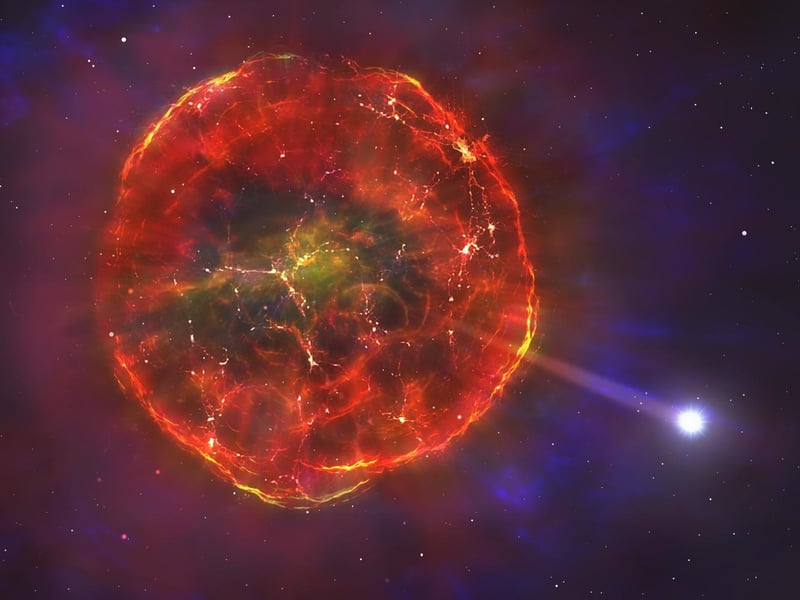
(CN) — Water could have appeared in the universe shortly after the cosmic dawn, far earlier than previously believed, according to research published Monday in Nature Astronomy.
Scientists Daniel Whalen, Muhammad Latif, and Christopher Jessop used sophisticated computer simulations to show that water molecules formed abundantly following the universe’s first supernova explosions, suggesting a key building block for life could have been present just 100 to 200 million years after the Big Bang.
Latif, an astrophysicist at the United Arab Emirates University, Al-Ain, emphasized their research’s broader implications.
“Life in the universe could have originated much earlier than previously thought. Potentially, Jupiter- or even Earth-size rocky planets could have formed within a few hundred million years after the Big Bang, and conditions would be favorable for the existence of life. We believe this could be a paradigm shift in our understanding of the origin of life in the universe,” he said.
Whalen is a professor and Jessop a doctoral student at Portsmouth University’s Institute of Cosmology and Gravitation in the United Kingdom.
Their findings dramatically push back the timeline for water’s cosmic appearance. Previous studies suggested water couldn’t have formed in significant quantities until at least 1 billion years after the Big Bang. This belief stemmed from the understanding that oxygen, essential for water molecules, was synthesized in the cores of the first stars.
This research team modeled two types of primordial stellar explosions to determine whether post-explosion conditions could produce water molecules. Their simulations revealed that water became particularly concentrated in dense cloud cores contaminated by metals from the explosions.
“We were pleasantly surprised that water was able to form at such early times in such harsh environments. Also, to our surprise the water was mainly concentrated in the dense clumps which could be potential sites for planet formation,” Latif said in an interview with Courthouse News.
The smaller supernova produced about one-millionth of a solar mass of water after 90 million years, while the larger explosion generated roughly one-thousandth of a solar mass of water in just 3 million years.
These dense, dusty cores enriched with water may have been the birthing grounds for the first planets in the universe, raising the possibility that planets with water also might have formed billions of years earlier than previously thought.
“Our simulations show that water was probably a key constituent of the first galaxies,” the researchers wrote. This finding challenges previous assumptions about when water became prevalent in cosmic structures.
“Although we found that water already exists in gas clouds, the radiation from subsequent star formation can destroy it. The presence of cosmic dust can absorb the radiation and protect the water from getting destroyed. This is something we are going to explore in detail in the upcoming studies,” Latif said.
Detecting this primordial water directly presents significant challenges for current technology. The researchers note that the most advanced water detection has been observed with the Atacama Large Millimeter Array. The water in their simulations formed at limits that strain current observational capabilities.
However, they suggest that future instruments like the Square Kilometer Array or Next Generation Very Large Array might be able to detect earlier water formation.
 Follow @JeremyYurow
Subscribe to our free newsletters
Our weekly newsletter Closing Arguments offers the latest about ongoing trials, major litigation and rulings in courthouses around the U.S. and the world, while the monthly Under the Lights dishes the legal dirt from Hollywood, sports, Big Tech and the arts.