
 Search Articles


(CN) — Massive stars in the young universe filled galaxies with dust as they met their demise, according to a scientific theory that researchers say is bolstered by a study published Wednesday.
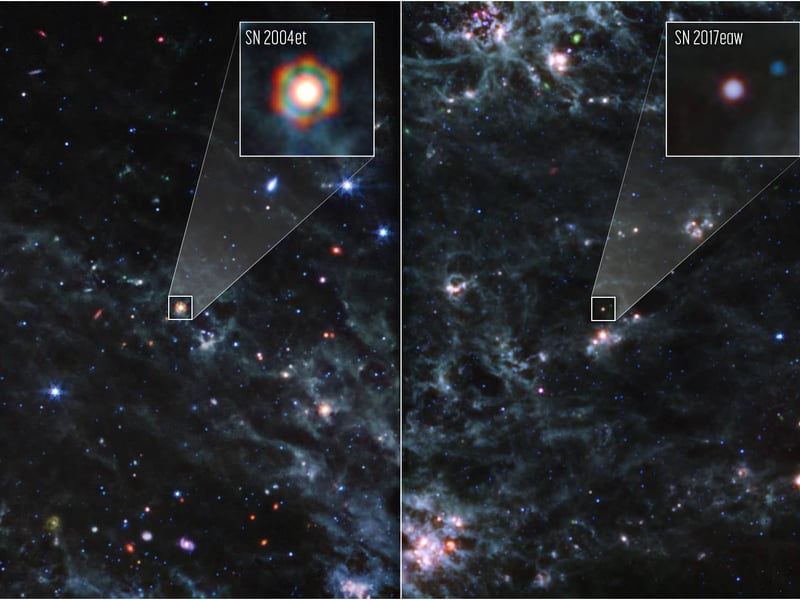
Using the James Webb Space Telescope, a team of scientists identified large amounts of space dust in the material ejected from two supernovae in a distant galaxy, detailing the results in the Monthly Notices of The Royal Astronomical Society.
Space dust is released by aging stars in their death throes. It serves as the building block for many larger structures in the universe — including the planet we’re standing on — but scientists still aren’t sure where all the dust they can observe in distant galaxies comes from.
As looking light years into space also means looking light years back in time, we see many far-flung galaxies as they appeared millions or even billions of years ago: full of dust. Yet they were too young for long-lived, medium-mass stars like Earth’s sun already to have formed, died and released dust into the interstellar medium.
Rather, the new observations suggest, early galaxies appear to have gotten their dust from the explosive deaths of short-lived, massive stars. Scientists observed the two supernovae in question, known as SN 2004et and SN 2017eaw, in the spiral galaxy NGC 6946 located some 22 million light years from Earth. Scientists have estimated that in life, both stars were about 15 times more massive than the sun.
“Direct evidence of this phenomenon has been slim up to this point, with our capabilities only allowing us to study the dust population in one relatively nearby supernova to date — Supernova 1987A, 170,000 light-years away from Earth,” said the study’s lead author Melissa Shahbandeh, an astrophysicist with Johns Hopkins University, in a prepared statement.
It was the Webb telescope’s infrared cameras, which can detect objects in infrared light that are typically obscured in the visible spectrum, that facilitated the study of SN 2004et and SN 2017eaw.
“Supernova explosions have been sought for decades as a possible source of dust in the universe, providing the seeds of galaxies, stars, and planetary systems,” the study abstract states. “SN 1987A offers one of the most promising examples of significant SN dust formation, but until the [Webb telescope], instruments have traditionally lacked the sensitivity at both late times and longer wavelengths to detect analogous dust reservoirs.”
The dramatic demises of SN 2004et and SN 2017eaw were not isolated incidents. In the so-called “Fireworks Galaxy,” NGC 6946, scientists have recorded 10 supernovae over the last century of observation — 10 times the amount marked in the Milky Way during the same time period, despite NGC 6946 only having about half as many stars.
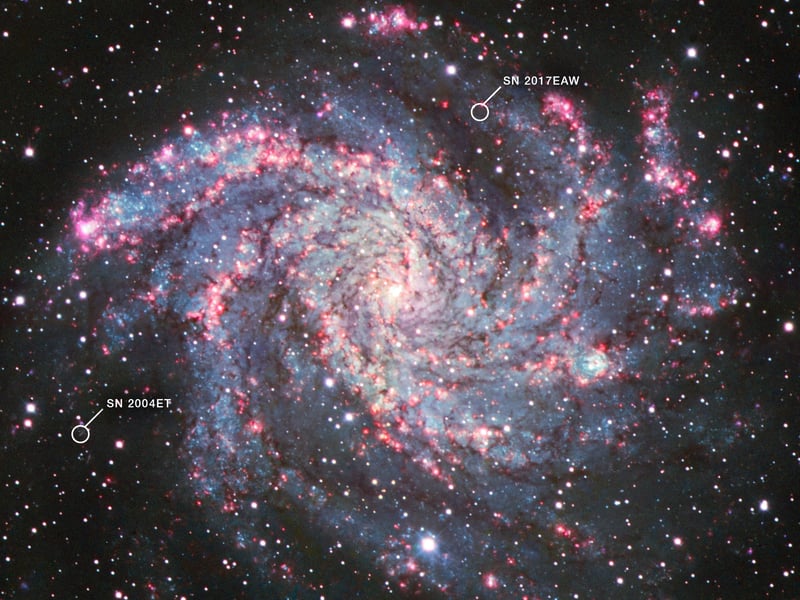
Such a high rate of massive stellar turnover could help explain how NGC 6946 became so dusty. In SN 2004et alone, the researchers detected over 5,000 Earth masses worth of dust.
“Regardless of the best fit or heating mechanism adopted, the inferred dust mass for SN 2004et is the second highest (next to SN 1987A) mid-infrared inferred dust mass in extragalactic supernovae thus far, promoting the prospect of supernovae as potential significant sources of dust in the universe.”
The dust scientists detected in SN 2004et may not be all the material the stellar explosion generated. Dust cools as it speeds away from supernovae, making it more difficult to detect. Further observations with the James Webb Space Telescope’s infrared imaging devices could reveal further dust masses, providing data not just on the source of dust in young galaxies, but about the stars that generated it.
“There’s a growing excitement to understand what this dust also implies about the core of the star that exploded,” Space Telescope Science Institute program lead Ori Fox said in a prepared statement. “After looking at these particular findings, I think our fellow researchers are going to be thinking of innovative ways to work with these dusty supernovae in the future.”
 Follow @djbyrnes1
Subscribe to our free newsletters
Our weekly newsletter Closing Arguments offers the latest about ongoing trials, major litigation and rulings in courthouses around the U.S. and the world, while the monthly Under the Lights dishes the legal dirt from Hollywood, sports, Big Tech and the arts.