
 Search Articles


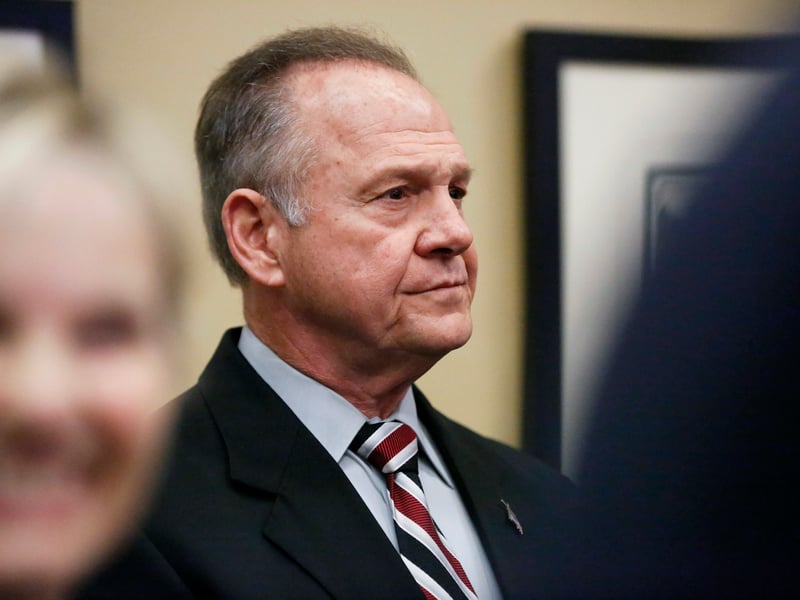
ATLANTA (CN) — An attorney for a Democratic-aligned super PAC asked an 11th Circuit panel on Wednesday to overturn an Alabama federal judge’s refusal to grant a new trial after a jury awarded Republican Roy Moore $8.2 million in damages and found he was defamed in a TV ad recounting sexual misconduct accusations made against him during his failed 2017 U.S. Senate campaign.
The Senate Majority PAC (SMP) has argued that the gist of the advertisement, which implied Moore solicited sex from a 14-year-old girl at a shopping mall, was substantially true and drew on a “firestorm” of news stories about Moore’s inappropriate behavior. The ad, which SMP helped air on Alabama television stations 533 times over 10 days, showcased a series of quotes about the sexual misconduct allegations against Moore.
The ad began: “What do people who know Roy Moore say?” It continued with the statements: “Moore was actually banned from the Gadsden Mall… for soliciting sex from young girls” and “One he approached was 14 and working as Santa’s helper.”
Moore, a Republican and former chief justice of the Alabama Supreme Court, lost the 2017 Senate race to Democrat Doug Jones after nine women came forward to accuse him of improper conduct when they were teenagers in the 1970s and 1980s.
An attorney for the SMP told a panel of the 11th Circuit that Moore’s defense of the jury award hinges on “a single pronoun” and is “an extensive exercise in missing the forest for the trees.”
U.S. District Judge Corey Maze upheldthe jury’s award in 2023 and refused to grant SMP a new trial on the 2019 lawsuit, ruling the ad “conveyed a message that a reasonable juror could find was not supported by any published report.” Maze found the two juxtaposed quotes implied Moore solicited sex from Wendy Miller, a young girl working as Santa’s helper at the mall, and was banned from the mall for that encounter and others.
“When SMP published the shopping mall ad, no woman had alleged that Moore asked her to have sex while at the Gadsden Mall… Wendy Miller told the media that, when she was 14, Moore told her that she looked pretty, and when she was 16, he asked her out on a date. Moore never asked Miller for sex,” Maze wrote.
Arguing on behalf of SMP on Wednesday, attorney Abha Khanna of the Elias Law Group said her client did not intend to imply Moore solicited sex from Miller and asked the panel to reverse Maze’s decision.
“Moore’s entire case rises and falls on SMP’s use of the pronoun ‘one’ to purportedly link Miller to the previous slide in their ad regarding the mall ban,” Khanna said. “Basically, Moore says you should’ve said ‘Moore approached one young girl’ instead of ‘one he approached.’ That’s not where the line is when it comes to the very demanding actual malice standard.”
Jeffrey Wittenbrink, a Baton Rouge, Louisiana-based attorney representing Moore, told the panel the way the ad was put together is “independent evidence of actual malice” on its own.
“It’s impossible for the average person not to come to the conclusion that Wendy Miller was one of the girls he approached,” Wittenbrink said. “No person who speaks English — no person viewing that ad can conclude anything other than what it says, which is that he solicited Wendy Miller for sex.”
U.S. Circuit Judge Elizabeth Branch appeared to side with Moore on that point. The judge noted that Miller testified at trial that Moore did not solicit sex from her.
“Here, the false statement is that Moore solicited sex with Ms. Miller. The pleaded truth is that he only told [her] she was pretty. How is that not materially false?” the Donald Trump appointee asked Khanna.
Khanna said Moore failed to show her client acted with actual malice and argued Moore was “credibly accused” of soliciting sexual acts from a 14-year-old girl, even if that girl was not Miller. Moore disputed “the literal falsity of the implication,” not the gist of the ad, the attorney said.
“The gist of the ad is the repeated pattern of sexually predatory behavior toward teenage girls,” Khanna said. “That is what is accurately reported in the ad and that is the implication of the ad.”
Branch also questioned the SMP’s research process, pointing out that the portion of the ad related to soliciting sex from Miller was not fact-checked.
But Khanna insisted her client engaged in an “extensive line-by-line, statement-by-statement” fact-check.
“Even if the court does not believe the fact-checking was sufficient, the existence of that fact-checking document… demonstrates SMP’s subjective intent to ground each and every statement in the public reporting,” Khanna said. “That kind of fact-checking is totally antithetical to any kind of reckless disregard for the truth.”
Branch was joined on the panel by Senior U.S. Circuit Judge Frank Hull, a Bill Clinton appointee, and U.S. Circuit Judge Jill Pryor, an appointee of Barack Obama. The panel did not indicate when it would reach a decision in the appeal.
The 11th Circuit last year upheld the dismissal of Moore’s defamation claims against Guy Cecil, the former chairman of Democratic super PAC Priorities USA, over tweets, a press release and a digital ad.
 Follow @KaylaGoggin_CNS
Subscribe to our free newsletters
Our weekly newsletter Closing Arguments offers the latest about ongoing trials, major litigation and rulings in courthouses around the U.S. and the world, while the monthly Under the Lights dishes the legal dirt from Hollywood, sports, Big Tech and the arts.