
 Search Articles


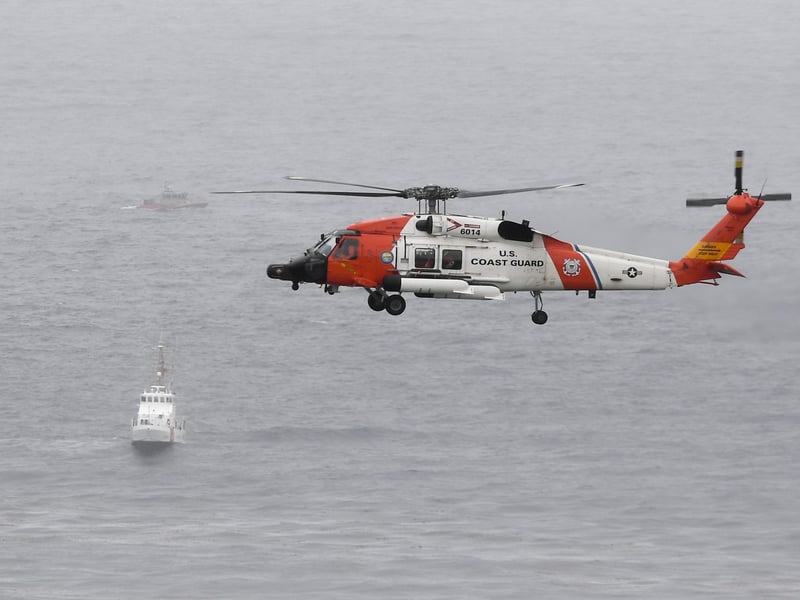
EUGENE, Ore. (CN) — The U.S. Coast Guard must keep a rescue helicopter on the Oregon coast for now, a federal judge ruled on Monday.
The statute at issue prohibits the Coast Guard from closing or reducing operations at air facilities without notice, warning or public comment opportunities and congressional review.
Lincoln County, Oregon, and the Newport Fishermen’s Wives nonprofit accuse the Coast Guard of blatantly violating that requirement since it stopped deploying a rescue helicopter to the Newport Air Facility in May. In October, the Coast Guard extended the suspension of rescue helicopter operations indefinitely and reassigned Newport’s rescue helicopter to San Diego.
“Certainly the harm is palpable,” said Eric J. Brickenstein, attorney representing the plaintiffs. “This is a life-and-death situation, full stop.”
While there are rescue helicopters stationed down the coast in North Bend, the increased distance adds an estimated 30 minutes to response times, the plaintiffs argued. The coastal waters of Oregon present challenging sea conditions with large swells, high winds and cold waters.
U.S. District Judge Ann Aiken issued a temporary restraining order Nov. 24, calling for the Coast Guard to return the rescue helicopter to the Newport Air Facility.
The state joined the lawsuit, arguing that the Coast Guard’s relocation of the rescue helicopter constitutes a final agency action that is subject to review under the Administrative Procedure Act.
“The question is, were any of the notice requirements … triggered?” posited Oregon Justice Department Attorney Brian Marshall. “The answer to that question is yes.”
In an effort to dodge the claims, Susanne Luse with the U.S. Attorney’s Office noted that 85% of Coast Guard rescue operations in Oregon are achieved through the use of small boats rather than by helicopter, as evidenced by deposition from Captain Kent Reinhold. But the judge was unmoved.
“I’m not sure why we’re listening to this if your argument is going to be that small boats do a better job when the statute outlines what we’re supposed to be doing here. This has not been helpful,” said Aiken, a Bill Clinton appointee. “This is not new information to me.”
Luse argued that moving the helicopter to North Bend during less busy times of the year is a routine operation, and one that allows the Coast Guard to better manage its resources for training. She also argued that the plaintiffs hadn’t shown they have been irreparably harmed.
“Nowhere are there any facts that indicate that there was a call made to the Coast Guard and they didn’t respond,” Luse said. She explained that the helicopter had been called to California for a rescue mission. “There’s a chessboard, unfortunately, with resources.”
Again, the judge shot down the federal government’s argument.
“It’s not a chessboard of assets," Aiken said. “It’s a statute that has to be followed.”
In 2013, Congress passed the Coble Act, which prohibited the Coast Guard from closing the Newport Air Facility after it had proposed doing so. Then, in 2016, Congress enacted a statute that requires the Coast Guard to submit a proposal to Congress before closing or significantly reducing personnel and use of any of its air facilities.
After Aiken issued the first temporary restraining order, Oregon’s senators announced that the acting Coast Guard leader had committed to keeping the rescue helicopter at the Newport Air Facility.
Based on that news, Aiken remarked that she was surprised the parties hadn’t stipulated an agreement ahead of the hearing.
“I’m sort of stunned we’re where we are, and I’m hearing what I’m hearing,” Aiken said.
Aiken extended the temporary restraining order and indicated a written order would be issued soon.
Subscribe to our free newsletters
Our weekly newsletter Closing Arguments offers the latest about ongoing trials, major litigation and rulings in courthouses around the U.S. and the world, while the monthly Under the Lights dishes the legal dirt from Hollywood, sports, Big Tech and the arts.