
 Search Articles


WASHINGTON (CN) — According to an animal protection organization, the U.S. Department of Agriculture went from issuing 63 fines for Animal Welfare Act violations between April 2023 and June 2024 to issuing only five since then.
In their report published Wednesday, the Animal Welfare Institute attributes this steep decline in Animal Welfare Act violation fines to a Supreme Court ruling that requires jury trials for some federal agency enforcement actions.
The USDA Animal and Plant Health Inspection Service is responsible for regulating the use of warm-blooded animals in laboratories, by breeders, dealers and exhibitors, but the institute says the fines have dropped dramatically, while official warnings rose from 66% of all actions taken to 91%.
“Together, these data suggest that the Jarkesy decision had a chilling effect on the issuance of fines by USDA-APHIS and led to an increase in official warnings issued in lieu of more effective enforcement actions,” the institute said.
The Supreme Court ruled in June 2024’s Securities and Exchange Commission v. Jarkesy that the Seventh Amendment right to a jury trial applies to assessments of fines by the SEC for securities fraud.
Since then, the institute says, the USDA and other federal agencies have scaled back the issuance of financial penalties, adopting the view that the ruling applies to all agencies that seek civil penalties before administrative law judges.
“USDA continues to assess its authorities in light of the decision,” a USDA spokesperson said in an email. “USDA is continuously looking for opportunities to improve regulatory compliance and believes that regulatory correspondence, such as an official warning, can be a useful tool to encourage compliance and deter future noncompliance.”
Courts or Congress?
The Supreme Court has yet to hear a case that would resolve whether the Jarkesy ruling applies to the Animal Welfare Act.
Delcianna Winders, Director of the Vermont Law and Graduate School’s Animal Law and Policy Institute, thinks that that the ruling wouldn’t apply, as Jarkesy concerned a fraud crime that would entitle someone to a jury trial at the nation’s founding.
“Animal welfare violations, of course, did not exist at the time of our founding, and they’re kind of the epitome of a public right, something that was created to protect the public interest,” Winders said in an interview.
Animal Welfare Act fines, Winders says, are administrative fines that fall into the public rights exception, which are historically resolved by executive or legislative acts rather than in a court. A North Carolina federal court ruled in August that Jarkesy does not apply to fines levied through the Horse Protection Act.
Congress is considering several bipartisan measures that would strengthen the USDA’s authority to enforce the Animal Welfare Act.
Lawmakers reintroduced Goldie’s Act, named for an emancipated golden retriever found at an Iowa puppy mill, which would require the USDA to conduct more frequent inspections, provide lifesaving intervention for suffering animals, issue penalties for violations and communicate with local law enforcement to address cruelty and neglect.
Animal welfare advocates say the 775,000 warm-blooded animals used for research, testing, and teaching are particularly at risk of abuse if the USDA continues its hesitant approach to issuing fines, as the Animal Welfare Act does not authorize the agency to revoke licenses of facilities or initiate criminal proceedings, unlike it can with breeders and exhibitors.
Winders said that if the federal government will not properly regulate testing facilities, it should cease providing federal funding.
“If we’re not going to adequately regulate it, then taxpayers shouldn’t be spending billions of dollars on it every year,” Winders said.
USDA shortages
Animal rights advocates say that the decision is resulting in less enforcement from an agency that was already lacking in curbing abuse.
“The USDA consistently fails the animals that it is statutorily charged with protecting and now that it is largely failing to use one of the most important tools in its tool belt, civil penalties, we’re seeing them now starting to rely even more on official warnings,” People for the Ethical Treatment of Animals general counsel Brittany Peet, who works in the Captive Animal Law Enforcement division, said in an interview.
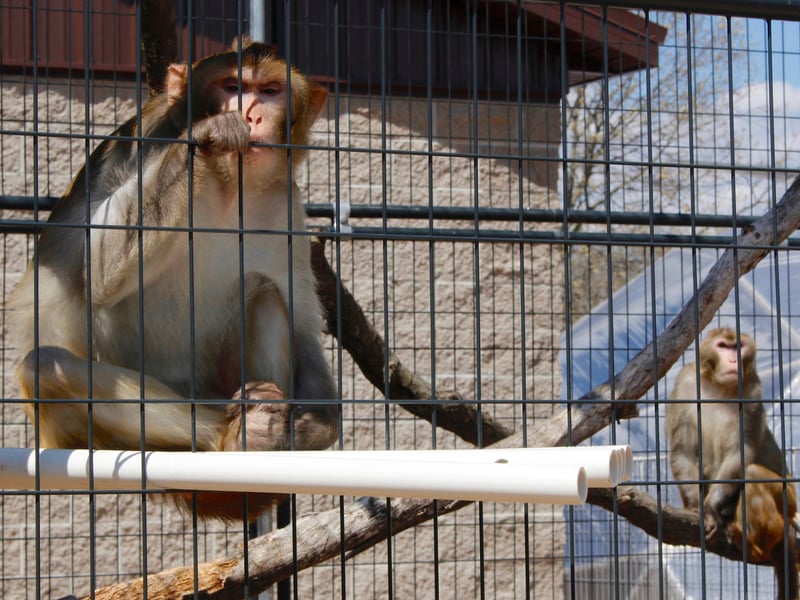
Official warnings are not considered final agency action, and data from the Animal Welfare and Horse Protection Actions database shows that some facilities have received numerous warnings without consequences — like Alpha Genesis Inc., which received its third official warning since 2014 in 2024 for the preventable death of 22 monkeys.
“Facilities get warning after warning after warning in perpetuity, and they don’t do better, so it doesn’t seem to be compelling them,” Animal Welfare Institute’s Animals in Laboratories Director Dr. Joanna Makowska said in an interview.
Peet said the lack of action is leaving regulated entities emboldened to abuse their animals. The advocates stated that even when the USDA issued fines, they often failed to have a significant impact on the wallets of well-funded research facilities.
“Many deaths, animals without water, animals escaping, mutilating each other, all of that would result in a few $1,000 fines,” Makowska said of an analysis done on fines issued to the National Primate Research Center. “They are allowed to fine $10,000 per violation. So they’re hugely, hugely reduced."
Advocates say that the USDA — which is currently not deploying inspectors due to the federal government shutdown — is chronically understaffed with only around 70 inspectors tasked with overseeing an ever-increasing number of licensees and registrants.
“We would need way more money for inspections to have more inspectors,” Makowska said. “They can’t possibly do a good job, and it’s not because they’re not trying necessarily."
Winders argues that the USDA is not the appropriate agency and that there is a need for an agency devoted to overseeing animal rights violations.
“The U.S. Department of Agriculture is an agency whose focus is on promoting American agriculture and providing services to farmers, and that sometimes is in direct tension with ensuring animal welfare,” Winders said. “We should be thinking about an Animal Protection Agency, an agency that doesn’t have these conflicting mandates.”
Subscribe to our free newsletters
Our weekly newsletter Closing Arguments offers the latest about ongoing trials, major litigation and rulings in courthouses around the U.S. and the world, while the monthly Under the Lights dishes the legal dirt from Hollywood, sports, Big Tech and the arts.