
 Search Articles


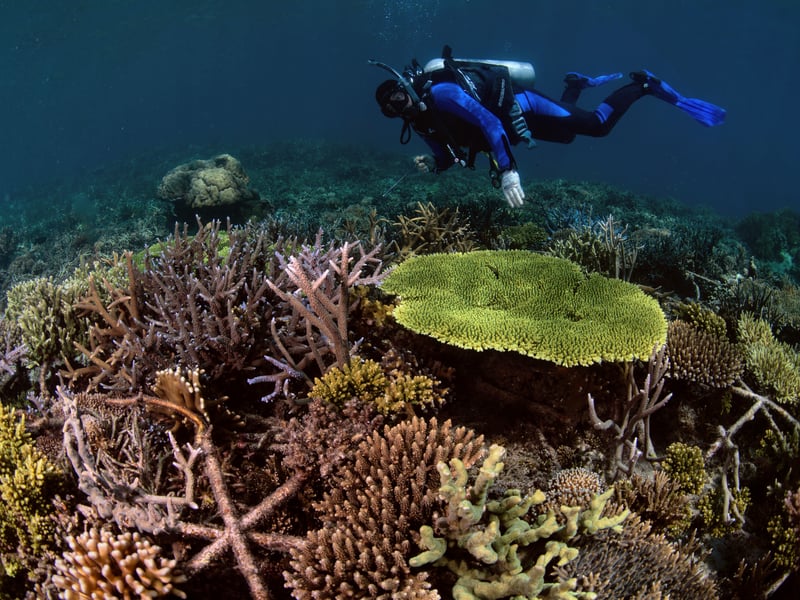
(CN) — Coral reefs provide shelter for fish, food for people, livelihoods for people who fish, and protection from storms and erosion for coastal residents, but all over the world coral are under assault from pollution, warming waters, and blast fishing.
But according to a study published in Current Biology on Friday, transplanting coral fragments can restore damaged coral reefs and revive their important roles in local ecosystems.
Researchers focused their study on coral reefs in South Sulawesi, a province in Indonesia that has been damaged by decades of blast fishing, where explosives are used to stun or kill large numbers of fish. The blasts turn the coral in the water into rubble, which hampers the survival of young coral.
The study describes how the researchers built a series of interconnected sand-coated hexagonal steel structures they nicknamed “reef stars” to consolidate the loose rubble from blown-up coral, which acted as a structure to which they could attach fragments of healthy coral.
Corals add calcium carbonate to reefs. Measurements of the overall amount of calcium carbonate they emit can indicate if they’re growing or not. When the researchers measured the coral four years later they found that not only had the coral cover, average colony size, and the carbonate production rate tripled, but the coral was also similar to other healthy reefs.
“The speed of recovery that we saw was incredible,” Ines Lange, a faculty member and research fellow at the University of Exeter, and the lead author of the study, said in a press release. “We did not expect a full recovery of reef framework production after only four years.”
The research on restoring reefs will continue into the future, Ines added.
A big question will be whether the restored reefs will keep growing and be able to protect coastlines from storms and rising sea levels, especially in East and Southeast Asia where 71% of the global coastal population lives within 10 meters above sea level.
“Coral reefs serve as natural breakwaters by reducing wave energy reaching the coast by up to 97%, a service that is threatened by ongoing and projected future reef decline. One desired outcome of reef restoration should therefore be to support vertical reef framework accretion in order to enhance coastal protection,” the authors of the study write.
Another challenge is record high surface water temperatures, which lead to widespread bleaching, leaving corals stripped of nutrients, and death of coral in the Caribbean and the Eastern Tropical Pacific.
“Heat waves like this will become common events in coming decades and current projections predict high-frequency severe bleaching by 2040–2050, threatening the long term success of reef restoration, especially when transplanting thermally sensitive coral taxa,” the authors of the study write.
There is some evidence that coral tolerance to higher heat could be increasing naturally, but it’s unclear if the natural process will be too slow for rapidly increasing temperatures caused by climate change.
“Whether this thermal tolerance increase can keep pace with ocean warming will depend on global action on reducing carbon emissions,” the authors of the study write.
But the researchers hope that their study shows that large scale reef restoration can offer some options to revive ecosystems that are important for both marine life and people.
“We hope that this positive example of reef restoration will encourage governments, industries and NGOs to invest in large-scale restoration efforts in collaboration with local communities. We want to emphasize that projects should be well planned, take into account local challenges and environmental conditions and are based on well-defined and measurable goals so the success and challenges can be tracked through time,” Ines wrote in an email.
Subscribe to our free newsletters
Our weekly newsletter Closing Arguments offers the latest about ongoing trials, major litigation and rulings in courthouses around the U.S. and the world, while the monthly Under the Lights dishes the legal dirt from Hollywood, sports, Big Tech and the arts.