
 Search Articles


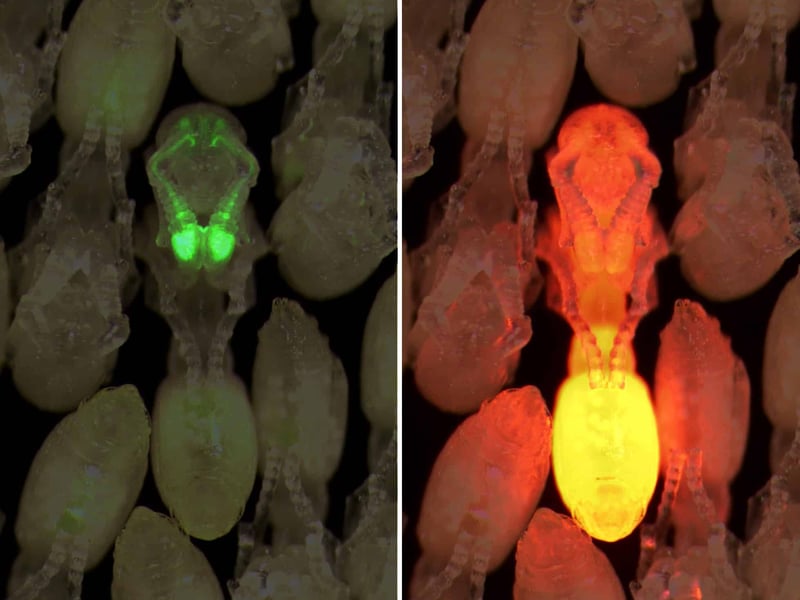
(CN) — For creatures as tiny and generally defenseless as ants, communication between members of a colony is essential for survival. It has long been known that ants use pheromones to communicate, but now new research indicates that the insects possess a fine-tuned sensory hub in their brains that helps them avoid danger.
In a study published Wednesday in the journal Cell, researchers with The Rockefeller University document alarm pheromones released by ants influence entire colonies and how this panic response is interpreted in their brains.
“Ants use different compounds as trail pheromones, recruitment pheromones, policing pheromones, nestmate recognition cues, and the alarm pheromones we studied here. By implementing modern neurogenetic tools in ants, we can now study how this entire chemical language is perceived and processed in the insect brain,” corresponding author Daniel Kronauer said in an email.
When exposed to this alarm pheromone, the clonal raider ants used in the study immediately begin their panic behaviors, fleeing the nest and even transporting eggs and larvae away from the perceived danger.
The team of researchers generated the first transgenic ants by genetically encoding them with a protein known as GCaMP, which binds to calcium ions to become a fluorescent indicator of brain activity. Researchers used high-speed imaging on these ants to scan their brains as reactions to the alarm pheromones occurred.
“We imaged a brain region called the antennal lobe, which processes olfactory information," lead author Taylor Hart, also of The Rockefeller University, said. “We identified the sub-compartments of the antennal lobe that reliably became active when the ant smelled alarm pheromones. These brain regions are directly connected to the specific type of sensory neuron that the ants use to smell these pheromones.”
Through the imaging, Hart and the rest of the team were able to detect how glomeruli — structures in the brain’s olfactory bulb that receive olfactory information — in the ants’ brains responded to the alarm pheromone.
“We detected very small regions that responded very strongly when the ant was stimulated with alarm pheromones," Hart said. “These responses occurred on the inside of the brain, in an area that most previous experiments were not able to see.”
Although only a small section of the ants’ brains lit up when exposed to danger signals, the ants were still engaged in swift and complex response behaviors.
According to the study, “this sparse encoding logic could simplify the neuronal computation required to respond to molecules indicative of danger, despite the complex olfactory environment of an ant colony.”
This response was unlike other social insects such as honeybees and other carpenter ant species, which prior studies have indicated rely on a broader pattern of brain activity to coordinate behavior. This unexpectedly smaller hub of brain activity leaves researchers wondering if other behavioral responses are similarly structured.
To research this, Hart and Kronauer say that these new transgenic ants could be the key for more detailed future studies.
“We are interested in how the ant brain processes other types of pheromones beyond alarm pheromones,” Hart said. “We also know that in ant colonies, tasks are divided between different subsets of individuals, for example some individuals focus on nursing the brood while other individuals go outside the nest to forage. We are curious to see how the brains of these individuals differ. Do nurses and foragers perceive some types of pheromones differently? If so, that’s one possible way you could get this division of labor that we know is happening inside each colony, and we might be able to see this happening in the ant’s sensory system using our brain imaging methods.”
Subscribe to our free newsletters
Our weekly newsletter Closing Arguments offers the latest about ongoing trials, major litigation and rulings in courthouses around the U.S. and the world, while the monthly Under the Lights dishes the legal dirt from Hollywood, sports, Big Tech and the arts.