
 Search Articles


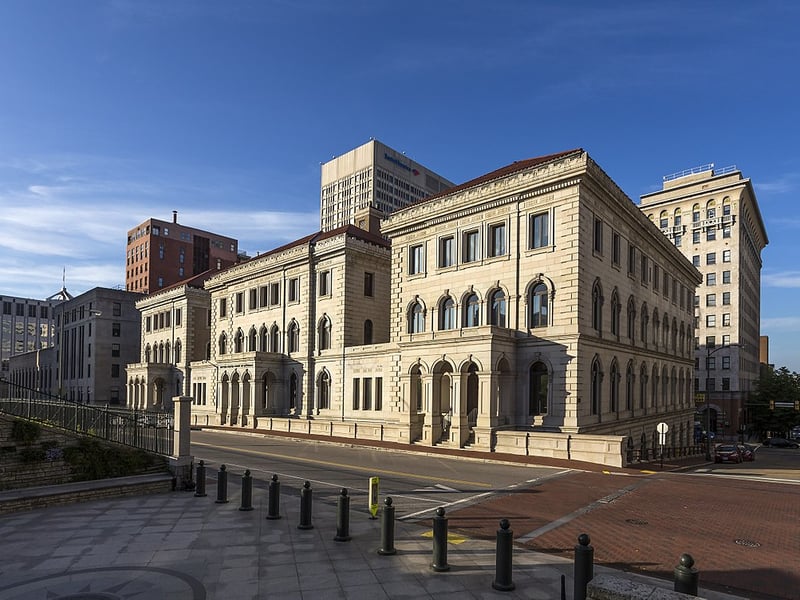
RICHMOND, Va. (CN) — A student argued before a Fourth Circuit panel Tuesday that her case against a sheriff’s department should be allowed to proceed because a lower court should not have used an interview recording to dismiss her case.
Dyanie Bermeo, a 23-year-old student from Charlotte, says that she was sexually assaulted during a traffic stop in Abington, Virginia, in September 2020. She reported the incident to local law enforcement the next day, and then said that the Washington County Sheriff’s Office coerced her into recanting her report and arrested her for falsely reporting a crime with the intent to mislead law enforcement. The Washington County Sheriff’s Office then published a Facebook post about her arrest, including her photo, name, university and the name of her neighborhood in Charlotte.
Bermeo, who was tried twice and acquitted the second time, argued in her complaint filed in 2022 that the Washington County Sheriff Blake Andis and several of the sheriff’s office employees violated her constitutional and civil rights. Andis and detective Brad Roop told Bermeo that they obtained video from a house near the stop and that there was no car behind her. They told Bermeo that she was digging herself into “a deeper hole” and they did not want to “embarrass” her, and Roop said, “We need you to tell us the truth … no stop happened here.”
She made a noise indicating agreement, and responded “I don’t know,” when asked why she would make up a story. Law enforcement used that to prosecute her for falsely reporting a crime.
A lower court improperly dismissed her claims, Bermeo said, by factoring in evidence outside of the parties’ pleadings — an audio recording of the interview — in a motion to dismiss. The judge also prematurely resolved important factual disputes, she said.
“This case is not about a suspect’s confession, it’s about a victim’s recantation that was extracted through deception and pressure,” Melissa Hordichuk, counsel for Bermeo, said Tuesday. “And the district court relied in error on its own interpretation of an audio recording that the defendants submitted outside of the pleading, and in doing so, it effectively performed a summary judgment fact-finding at the pleading stage.”
Bermeo insists the recording did not contradict her story. She argued her case should not have been dismissed because she sufficiently claimed that the officers took deliberate advantage of her psychological vulnerability from sexual trauma.
The defendants counter that the lower court properly included the recording, which they say “blatantly contradicts” Bermeo’s claim that she was coerced into confessing. The cops also claim Bermeo agreed that the lower court could consider the audio recording at the motion to dismiss stage and did not object to it.
However, Nathan Schnetzler, attorney for the law enforcement defendants, struggled to define what exactly in the recording contradicted Bermeo’s claims.
“What is it? Where is the contradiction in the audio?” U.S. Circuit Judge James Wynn Jr., a Barack Obama appointee, pushed Schnetzler to answer.
“There’s a lot of things not in that recording. And every time she says something here, the standard is not that it must be supported by the recording or audio. It needs to be contradicted by it,” Wynn said.
Schnetzler, who asked for the dismissal to be upheld, said that if the lower court judge erred making a conclusion dependent on the recording, that it was harmless, and that there are alternative grounds to affirm the decision.
“This interaction did not take place inside of a sheriff’s office. It did not take place in the context of a custodial detention,” Schnetzler said. “She was not handcuffed, there was no suggestion that she was not free to leave at any time. It lasted 24 minutes.”
Senior U.S. District Judge Michael Urbanski dismissed Bermeo’s complaint in August 2024, finding that she voluntarily told officers that she fabricated the traffic stop and there is no evidence that the defendants used coercive tactics, or that their investigation violated her constitutional rights.
“To the contrary,” Urbanski said, “the officers repeatedly expressed their concern for Bermeo’s well-being and offered to connect her with counselors.”
The defendants added that the officers are also entitled to qualified immunity, which Hordichuk said should not be considered when there are notable factual disputes.
Schnetzler did not immediately respond to a request for comment after the argument.
“We appreciate the court’s commitment to maintaining consistency in its interpretation and application of the law,” Hordichuk told Courthouse News.
U.S. Circuit Judge Robert Bruce King, a Bill Clinton appointee and U.S. Circuit Judge A. Marvin Quattlebaum Jr., a Donald Trump appointee, also served on the panel.
 Follow @SKHaulenbeek
 Follow @shaulenbeek.bsky.social
Subscribe to our free newsletters
Our weekly newsletter Closing Arguments offers the latest about ongoing trials, major litigation and rulings in courthouses around the U.S. and the world, while the monthly Under the Lights dishes the legal dirt from Hollywood, sports, Big Tech and the arts.