
 Search Articles


MANHATTAN (CN) — The New York Legal Assistance Group argued at the Second Circuit Monday against the U.S. Department of Education’s procedural requirements for student borrowers who are trying to seek relief against lenders.
The procedural requirements, enacted in 2019, made it more difficult for borrowers to seek relief, the nonprofit organization said during oral arguments.
Under the previous procedures, enacted in 2016, student borrowers could assert a defense to repayment, including if they were party to a judgment against a school based on violations of state or federal law, and weren’t required to present a specific form of evidence to do so.
But the 2019 rule placed a three-year limitations period on borrowers’ ability to raise defenses to repayments and imposed a stricter standard for doing so. For instance, borrowers now must show intent and produce written documentation that demonstrates a school made a “substantial misrepresentation.”
The U.S. District Court for the Southern District of New York granted summary judgment in favor of the Department of Education for all claims except one; the New York Legal Assistance Group won summary judgment on its claim that the three-year limitations period was not a “logical outgrowth” of the 2016 rule. The federal court remanded the issue of the limitations period to the agency because, the court found, it had failed to provide the public with an opportunity to comment on that requirement.
According to the plaintiff legal organization, the 2019 rule was arbitrary and capricious, and the agency failed to show reasoned decisionmaking in its adoption of the procedural requirements, which departed substantially from the 2016 rule’s original intention.
The Department of Education’s “contemporaneous reasoning in support of the 2019 rule was inconsistent with the record, replete with illogical, unsupported, and conclusory statements, and failed to include meaningful justification for its departures from both the policy and the factual determinations contained in the 2016 rule,” the plaintiff said in its brief.
But much of Tuesday’s arguments focused on whether the Second Circuit had jurisdiction to decide the case.
“We could not move for a partial entry of final judgment because the district court entered final judgment on all claims as to all parties, and therefore we couldn’t ask it to enter a final judgment on one part when it already entered a final judgment and closed the case,” explained Adam R. Pulver, an attorney for the New York Legal Assistance Group.
Because the three-year limitations period was remanded to the Department of Education, the agency argued, the federal court’s decision cannot yet be appealed.
“When a party presents multiple claims to a district court in one action, it may not appeal the district court’s resolution of some of those claims until a final decision has been entered as to all of them,” the federal agency said in its brief.
Tomoko Onozawa, an attorney for the U.S. Attorney’s Office for the Southern District of New York, added Tuesday that the federal court still needs to decide if the three-year limitations rule was substantively arbitrary and capricious.
But, Pulver said, the Second Circuit should not consider that argument because it hasn’t been introduced prior to oral arguments.
“I believe that the government is introducing a new argument for the first time here today,” Pulver said. “Which is because the district court didn’t address whether the provision it found unlawful was also arbitrary and capricious.”
The case appeared before U.S. Circuit Judge Guido Calabresi, a Bill Clinton appointee; U.S. Circuit Judge Jose A. Cabranes, a Bill Clinton appointee; and U.S. Circuit Judge Joseph F. Bianco, a Donald Trump appointee.
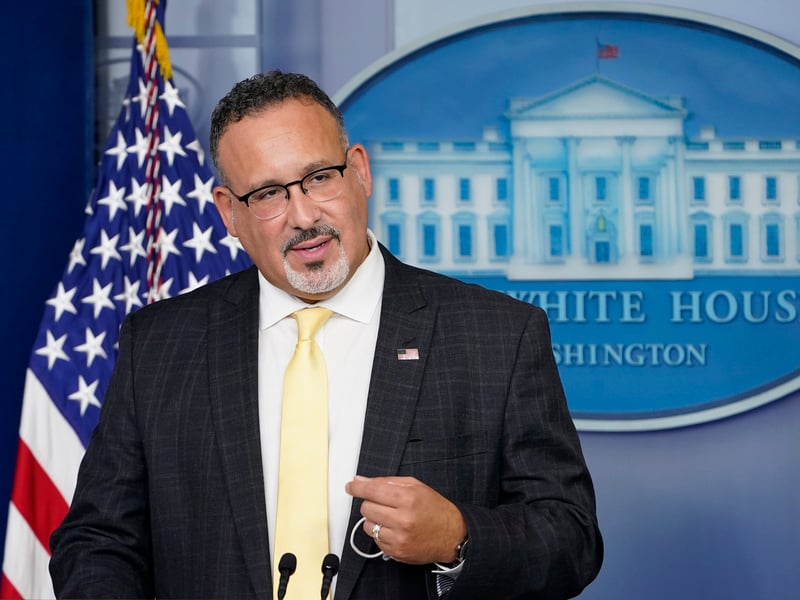
U.S. Secretary of Education Miguel A. Cardona is also named as a defendant. The complaint was initially filed against Betsy DeVos, who served as the Secretary of Education from 2017 to 2021.
 Follow @NikaSchoonover
Subscribe to our free newsletters
Our weekly newsletter Closing Arguments offers the latest about ongoing trials, major litigation and rulings in courthouses around the U.S. and the world, while the monthly Under the Lights dishes the legal dirt from Hollywood, sports, Big Tech and the arts.