Search Articles


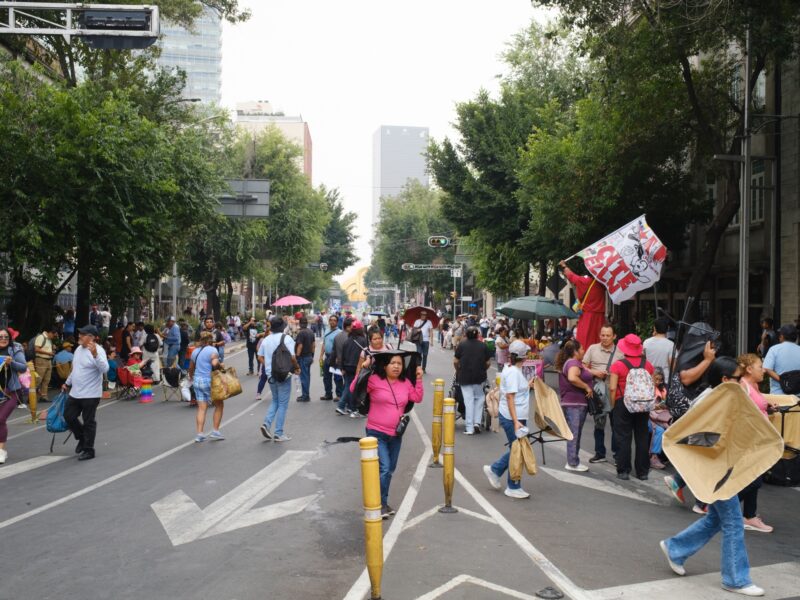
MEXICO CITY (CN) — Hundreds of members of the National Educational Workers Coordination continued to block Bucareli Avenue on Wednesday for the third day with a sit-in outside of the capital’s Secretariat of the Interior building, where they demanded a meeting with Mexican President Claudia Sheinbaum. The demonstrators then marched towards Reforma Avenue, the city’s main boulevard.
Hundreds more striking teachers also set up camp on streets surrounding the Zócalo, Mexico City’s large public square, where a fan fest is planned for the inaugural World Cup match on June 11.
Offices for the Institute for Social Security and Services for State Workers (ISSSTE) and the Secretary of Public Education were also blocked by teacher contingents to pressure the government to concede to their yearslong demands.
“Today’s activity is intended to put pressure on the government because the president of our republic, Claudia Sheinbaum, hasn’t deigned to meet with us; she doesn’t want to face us. She’s throwing all the campaign promises she made back then in the trash. She always justifies herself by saying there’s no budget. There’s no budget for teachers, but there is a budget for the oligarchy,” said Alfredo López, a teacher from Oaxaca, in front of the Secretariat of the Interior building.
“What good is having a supposedly democratic government, a government supposedly of the people, when in reality it turns its back on the people? We are the people. In her campaign, she promised to repeal the disastrous ISSSTE law, and she hasn’t kept that promise,” he said.

The ISSSTE law is the National Educational Workers Coordination’s (CNTE) main grievance with the Mexican government.
The law, passed in 2007 under former President Felipe Calderón’s administration, drastically altered Mexico state workers’ pensions from a collective-based system to an individual one managed by private pension fund managers called AFOREs, which have decreased teacher pensions. The law increased their retirement age and required years of service before retirement.
López argues the current pension system has become a business based on government loans that teachers don’t benefit from.
“A decent pension that can cover basic needs, like food, a house, a home, providing for our wives and even our grandchildren. But that’s not guaranteed with these reforms, which are only enriching the AFOREs, the private companies,” said López. “All we want is a dignified retirement.”
The majority of the striking teachers at Wednesday’s blockade were from Oaxaca, where teachers’ protests have a strong history and have become violent in past years.
“In Oaxaca, it’s a culture of struggle. Because of the strength that the people still have, the culture of community work, the culture of consulting the people, the culture of democracy. That’s what has driven us and kept us at the forefront of this teachers’ struggle at the national level,” López said. “I think all of Mexico is aware of the corruption that exists. Yet, some people are content with the crumbs the government gives them — a political position, a basic food allotment, whatever the government gives them. But the future of the children, the grandchildren, the sons and daughters, is already compromised.”
López said that while only about 20% of the teachers are present in Mexico City, more may be on the way.
“But at a certain point, if there’s more repression, I think the other teachers will come here and block the stadiums or some other more radical action, like blocking the airport, a permanent blockade,” said López.
Consuelo Rios Méndez, a CNTE demonstrator also in front of the Secretariat of the Interior building, said the retirement age needs to be reinstated, not just for teachers’ benefits but also for the students.
“We want to return to retirement based on years of service, not age. Retirement at 28 years for women and 30 years for men,” said Rios Méndez. “Right now, for example, I have 22 years of service, and I’m young. Well, I consider myself young because I’m 43 years old. So, if we were to retire the way the law is now, I would be retiring at 65 years old. So, I would still be working in classrooms at that age, and at that age, we wouldn’t be as effective as we were when we were young — in our twenties, thirties, or forties. At sixty-five, we just wouldn’t be able to teach the students properly.”

On Tuesday, FIFA canceled a face-to-face training for the fan fest workers due to CNTE marches and blockades and instead opted to go virtual.
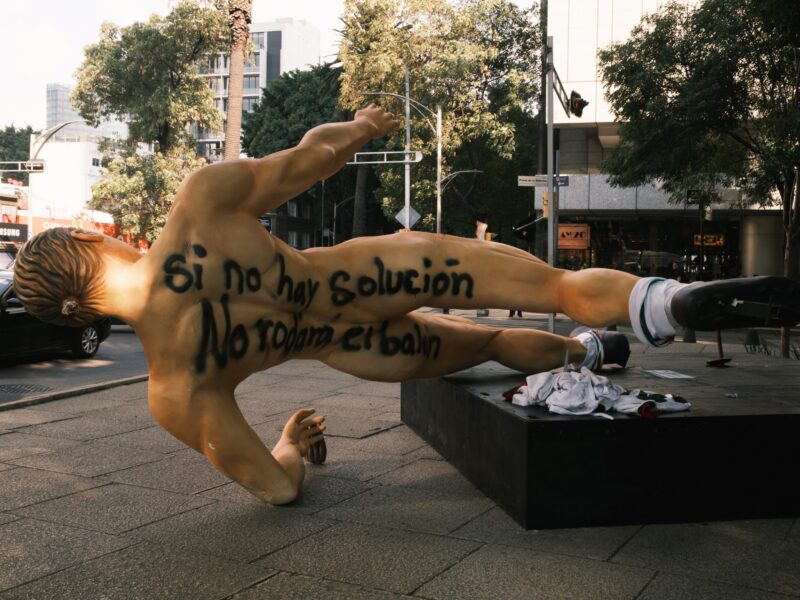
Striking teachers also disrobed and tore down statues of soccer players along Reforma Avenue during one of their demonstrations on Tuesday, leaving them lying on the sidewalk.

On Monday, hundreds of CNTE members clashed with police as they attempted to break through the metal barriers surrounding the Zócalo while workers installed massive screens for the World Cup Fan Fest. The teachers were teargassed, and a handful of injuries were reported.
The largest teachers union in Mexico is the National Educational Workers Union, or the SNTE, founded by the Institutional Revolutionary Party, or PRI, in the 1940s.
“It was a very important instrument of corporativism,” said Jacques Coste, historian and columnist for Expansión Politica. “The way the SNTE worked for years, literally for decades, through all the post-revolutionary regime was that the SNTE was the mediator between the government and the party and the teachers. In exchange for the teachers continuing to work and for a stable political climate, the regime gave the union a lot of privileges, such as allowing them to decide who was in charge of the school board of directors, positions in Congress — particularly in the lower house — and the Secretary of Public Education.”
The SNTE ruptured in the 1970s when many teachers from Rural Normal Schools — rural, public boarding schools that trained young people to become teachers — no longer wanted to be part of a union tied to the ruling party.
“They were Marxist in ideology and were pushing for an independent labor union that was more radical in their demands, for fighting in favor of workers’ rights. The government kind of let them create this dissident union because they were afraid of the teachers becoming guerrilla fighters—the guerrillas were very strong in Mexico at that time,” said Coste, who added they are very powerful because they have the power to stop classes whenever they want.
Coste said the SNTE is more conciliatory in its approach, favoring negotiation, talking to the government and maintaining its political positions.
“For example, right now they have a lot of representatives in the lower house of Congress and in the Secretariat of Public Education,” he said.
The CNTE has a political strategy that they themselves call: mobilization, negotiation, mobilization. They mobilize, take to the streets, seek to negotiate with the government, and then, when the government cedes to their demands, they mobilize again to put pressure on the government.
Coste also noted that both teachers’ unions — the SNTE and the CNTE — had a political pact with the ruling Morena party during the elections.
“So in a way, the Morena party is in debt with both unions. Their political support was not for free and right now they are taking advantage of their previous support. And the government has very little room to maneuver in dealing with these groups because they are such a crucial political and electoral force,” said Coste.
Courthouse News reporter William Savinar is based in Mexico City.
Subscribe to our free newsletters
Our weekly newsletter Closing Arguments offers the latest about ongoing trials, major litigation and rulings in courthouses around the U.S. and the world, while the monthly Under the Lights dishes the legal dirt from Hollywood, sports, Big Tech and the arts.