
 Search Articles


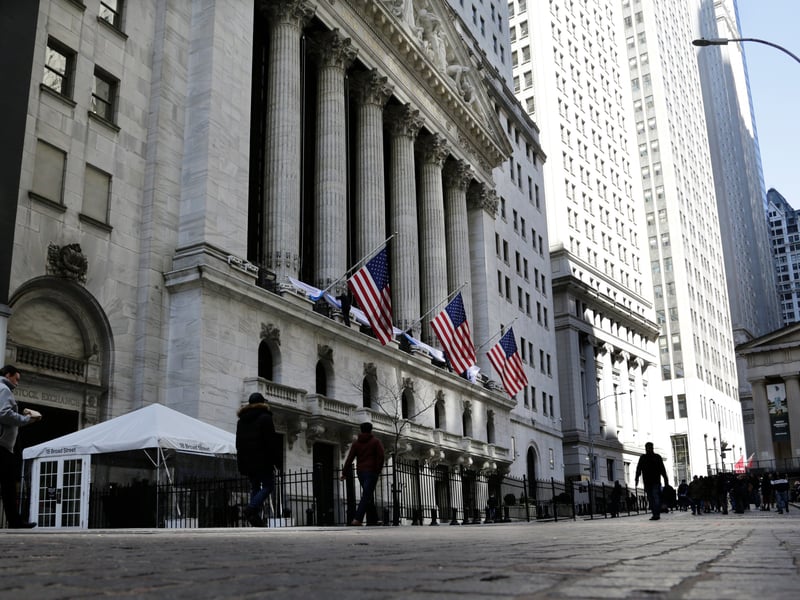
MANHATTAN (CN) — Wall Street has recouped all of its losses for 2025, as investors rallied once the White House announced a potential trade deal with China this week.
To kick off the week, President Donald Trump said he had reached an understanding with China to unwind most of the tariffs between the two countries, though details on the deal — indeed, even whether there was a concrete deal — were scant.
Once again, Trump on Friday ramped up pressure, saying he would ask trading partners to impose new tariff rates on certain countries.
“We’ll be telling people what they’ll be paying to do business in the United States,” Trump said while speaking with business leaders in the United Arab Emirates.
Investors weren’t fazed by the threats, and by the week’s end the Dow Jones Industrial Average had gained 1,405 points for the week. The S&P 500 and Nasdaq also had good weeks, increasing 299 points and a whopping 1,283 points, respectively.
Economic data for the week did not give Wall Street bears any nourishment. Retail sales for April were about what was expected, coming in at 0.1%. However, economists had predicted retail sales excluding automobiles would rise to 0.3%, and the metric missed, echoing the 0.1% retail sales increase.
Many analysts say tariff fears continue to drive retail sales, as consumers — particularly high-income ones — try to get ahead of possible price increases this summer as tariffs take hold. Discretionary spending like eating out at restaurants has not faded, either.
“We believe the April figures are overstated given some of the demand front-loading likely bled into April,” said Lydia Boussour, senior economist at EY-Parthenon. “Looking ahead, consumers will continue to be more selective and cautious with their spending.”
The week’s inflation data offered good news. The consumer price index increased just 0.2% in April, despite decreasing in March.
However, the CPI gained 2.3% year-over-year, the smallest increase seen since early 2021. Gasoline prices led the way, dropping 10% year-over-year, while grocery prices declined 0.1% even as egg prices remain up sharply from a year ago.
The producer price index also showed a 0.5% decrease last month, greater than expected, with prices increasing 2.9% year-over-year. So-called “supercore PPI” — which excludes food, energy and trade services — fell 0.1%, the first decline seen since April 2020.
“While Americans are still smarting from the high prices of the post-pandemic era, the rate of increase has slowed down to a normal pace this spring,” said Bill Adams, chief economist at Comerica Bank, adding that tariff pressures are also likely to ease.
“Inflation looks likely to pick up in the second half of 2025 as businesses pass on the cost of tariffs,” he said, “but after cuts to the tariff rates applied to most imports, the effect will be smaller than it appeared a few weeks ago.”
At least one major U.S. company has already said it would raise prices directly due to tariffs. During a quarterly earnings call this week, Walmart CEO Doug McMillon said “we aren’t able to absorb all the pressure” of tariffs and that “the higher tariffs will result in higher prices.”
Earlier in the week, the National Federation of Independent Business’s monthly small optimism index dropped again, this time by 1.6 points and remaining below the index’s average of 98 for the second consecutive month.
“Uncertainty continues to be a major impediment for small business owners in operating their business in April, affecting everything from hiring plans to investment decisions,” NFIB Chief Economist Bill Dunkelberg said in a statement.
More than one-third of surveyed business owners said they could not fill certain job openings, while labor quality remains the most important problem for small businesses. “While owners are still trying to fill a high number of job openings, their outlook on business conditions is less supportive of future business investments,” Dunkelberg said.
 Follow @NickRummell
Subscribe to our free newsletters
Our weekly newsletter Closing Arguments offers the latest about ongoing trials, major litigation and rulings in courthouses around the U.S. and the world, while the monthly Under the Lights dishes the legal dirt from Hollywood, sports, Big Tech and the arts.