
 Search Articles


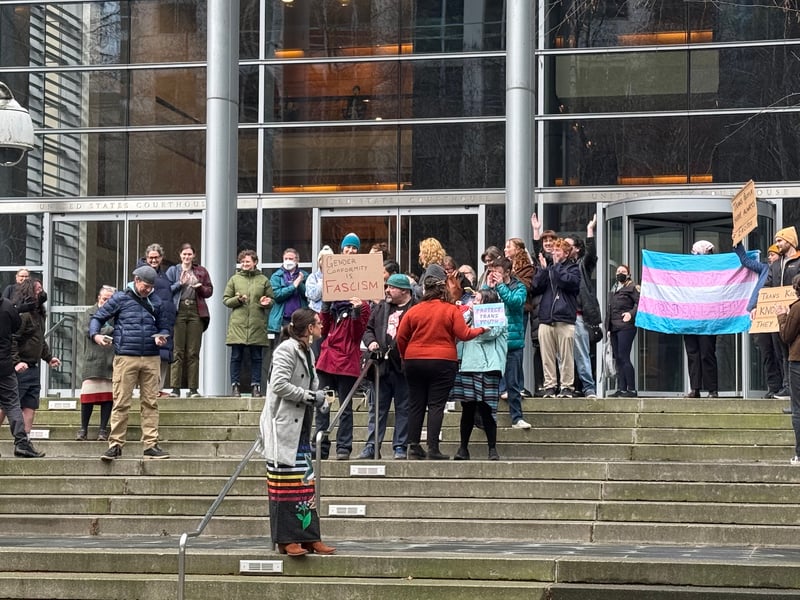
SEATTLE (CN) — A coalition of states and doctors appeared in federal court Friday to ask a judge to continue blocking an executive order directing federal insurance programs to exclude gender-affirming care for minors. In a ruling issued late that evening, U.S. District Judge Lauren King granted most of their motion for a preliminary injunction.
The executive order directs federally run insurance programs to exclude coverage for gender-affirming surgeries or hormone treatments for people under the age of 19 and directs agencies to immediately pull funding from any medical programs or institution like medical schools or hospitals that are providing gender-affirming care to minors.
King granted the plaintiffs’ request for a preliminary injunction of the order, only denying the request with respect to a section the directs the Attorney General to prioritize “enforcement of protections against female genital mutilation.”
“A reasonable reading of the executive order is a broad side attack of gender-affirming care," William McGinty with the Washington state Attorney General’s Office argued before a packed courtroom Friday.
President Donald Trump signed the executive order on Jan. 28, just over a week after his second inauguration.
Washington state, joined by Minnesota, Oregon and three unnamed physicians, sued the Trump administration on Feb. 7, claiming the order will jeopardize vital operations at medical research facilities.
King issued a temporary restraining order on Feb. 14, stating that the executive order is “aimed at the erasure of transgender individuals, and blatantly discriminates against transgender youth.”
King declined to rule from the bench on Friday, instead retreating to her chambers to deliberate after hearing from both sides.
Washington state Attorney General Nick Brown told supporters outside the courthouse following the hearing that he felt confident the states will prevail.
“We have a lot of work ahead, however, no matter what happens today. This is really a continuing saga to ensure that we have justice for people in this state and all across this country, and I’m still thankful for the work here and for the other states that have joined this effort, but we have more work ahead,” Brown said.
Under the order, insurance programs like TRICARE for military families and Medicaid are directed to stop coverage for gender-affirming care. The Department of Justice is also directed to vigorously pursue litigation and promote legislation to allow children who received this type of care and their parents to sue medical professionals.
In their motion for a preliminary injunction, the states argued that the executive order, and another seeking to define sex as only male or female — signed by Trump on his first day in office, and titled “Defending Women from Gender Ideology Extremism and Restoring Biological Truth to the Federal Government" — both unconstitutionally discriminate based on sex and transgender status.
“These orders have unleashed unbridled fear and irreparable harms,” the states wrote in the preliminary injunction motion.
Before King at the Friday afternoon hearing, the states argued that the families impacted by the orders need the court’s protection.
“Families are still afraid to leave the country to get their children the care they need,” McGinty argued. “Not all families have the means to travel internationally to access the life-saving gender-affirming care that their children need. This is literally a matter of life and death."
The states argue that the executive orders not only unconstitutionally discriminate against transgender people, but also violate the separation of powers by forcing federal agencies to cut funding to any institution that recognizes transgender identity or provides gender-affirming care.
“President Trump should know from his failed efforts to defund states and municipalities during his first term that Congress alone holds the ‘power of the purse’ and that he cannot set conditions on appropriated funds that Congress did not authorize,” the states wrote. “But he did it again anyway.”
The executive orders contravene laws banning federal interference and discrimination in medicine and usurp Congress’ powers, the states argued.
The order seeking to define sex used “nonscientific and nonfactual” definitions that describe a “class of literally zero people,” McGinty argued. Plus, the state’s accused the government of not providing any evidence that it would preserve an “immutable biological truth.”
The states also say that the orders intentionally redefine gender affirming care as “mutilation” in an attempt to prohibit it federally under laws banning female genital mutilation.
“These orders follow a decade of President Trump scapegoating transgender people and threatening to criminalize their medical care,” the states argued in the preliminary injunction motion.
In response to the motion for a preliminary injunction, the federal government argued that Trump has the authority as president to direct agencies to implement his agenda. The government also said that the orders further “important governmental interests.”
The order restricting gender-affirming care is intended to protect the well-being of youth and the order defining sex is “similarly based on concerns about the harms stemming from ‘efforts to eradicate the biological reality of sex,’” the government wrote.
King questioned the federal defendants about their understanding of the concepts behind the executive orders, asking Department of Justice attorney Vinita Andrapalliyal about gender dysphoria.
“Your honor, I am not a medical provider,” Andrapalliyal responded.
King pushed further.
“Based on the record, what is it?” King asked the attorney.
“Your honor, that is not defined in the executive order,” Andrapalliyal responded.
The judge followed up asking if gender dysphoria is a medically recognized condition, but the attorney referred again to its lack of presence in the executive order.
Andrapalliyal said the lawsuit is premature and asked the court to limit the scope of the preliminary injunction to only certain portions of the executive order if it chooses to issue one.
Opponents of the executive order gathered outside the federal courthouse carrying signs and flags in support of the transgender community.
“There’s a lot of misinformation that trans kids are getting top and bottom surgery before 18, and that doesn’t happen,” Dr. Kathryn Hightower said. “So if we’re going to consider people to be adults at 18, for being able to go put their bodies on the line and potentially die for our country, they should be able to make decisions about their own bodies.”
The care-restricting order largely mirrors legislation enacted by some 26 states in recent years seeking to restrict or ban gender-affirming medical care for transgender adolescents. Trump described the treatments targeted in the order, which include puberty blockers and hormone therapy, as “junk science.”
“It is the policy of the United States that it will not fund, sponsor, promote, assist, or support the so-called ’transition’ of a child from one sex to another, and it will rigorously enforce all laws that prohibit or limit these destructive and life-altering procedures,” Trump declared in the care-restricting order.
Subscribe to our free newsletters
Our weekly newsletter Closing Arguments offers the latest about ongoing trials, major litigation and rulings in courthouses around the U.S. and the world, while the monthly Under the Lights dishes the legal dirt from Hollywood, sports, Big Tech and the arts.