
 Search Articles


(CN) — Washington, California and 13 other states filed a lawsuit Friday challenging what they called a “fake” energy emergency declared by President Donald Trump in a January executive order.
The suing states claim the order is a pretext for federal agencies to unlawfully bypass or shorten reviews mandated by the Clean Water Act, the Endangered Species Act and the Historic National Preservation Act for energy projects. Those landmark conservation law are imperative to environmental and public health, and there is no energy emergency, the suing states argue.
“The president’s attempt to bypass important environmental protections is illegal and would cause immense harm to Washingtonians," Washington Attorney General Nick Brown, a Democrat, said in a statement. “This won’t lower prices, increase our energy supply, or make our country safer."
In a 61-page complaint filed on Friday, the states asked an Evergreen State federal court to declare the president’s directive illegal and to stop the agencies from issuing emergency permits under the order.
The states also claim that many federal agencies are** currently implementing or are planning to implement the executive order in ways that exceed their statutory authority
“The only ‘emergency’ is that the president disagrees with policies to address climate change in Washington state and elsewhere," Brown added in his statement. “He is illegally using emergency authorities to keep the nation reliant on energy sources like coal, oil, and gas.”
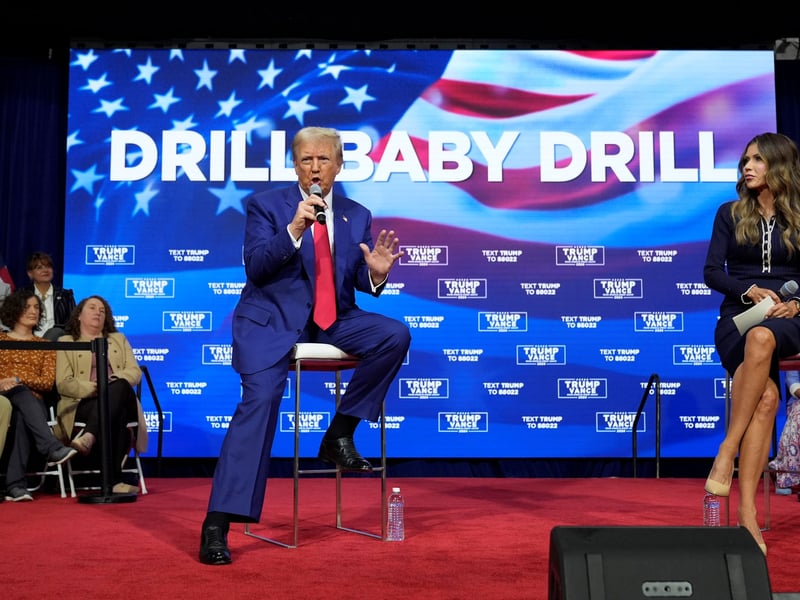
The president has been a vocal supporter of U.S. oil production. On the campaign trail, he notably promised to boost the U.S. oil supply and “drill, baby drill."
On his first day in office, President Donald Trump issued Executive Order 14156. In that order, Trump declared a so-called energy emergency under the National Emergencies Act.
Trump is the first president to declare a national energy emergency, though President Jimmy Carter declared regional energy emergencies in several states in the late 1970s. While signing his emergency declaration, Trump reportedly said that declaring an emergency “means you can do whatever you have to do to get out of that problem.”
Critics of the president’s executive order point out that U.S. energy production is currently at an all-time high. They note that according to the Department of Energy, Trump’s plan to boost exports could actually increase prices for American consumers.
The states also point out that the order** excludes solar and wind production from its definition of energy. They argue that wind and solar power are important to grid reliability, energy security and affordability.
“The end goal is clear: eliminate the competition so his oil and gas donors can keep gouging Washingtonians and polluting the state,” Brown said.
In a statement of his own, California Attorney General Rob Bonta, also a Democrat, argued this was yet another example of President Trump acting unlawfully and exceeding his authority.
“The invocation of the country’s emergency authorities is reserved for actual emergencies," Bonta said — not “because the president feels like it.”
Casey Sixkiller, director of the Washington Department of Ecology, said that the administration’s order could have a significant impact on the environment.
“Environmental regulations exist because we’ve seen what happens when they don’t,” Sixkiller said. “The federal administration is proposing an end-run that ignores the hard lessons of the past. These protections aren’t red tape — they’re guardrails that protect our air, water [and] land and keep our families safe.”
Joining Brown and Democratic California Attorney General Rob Bonta in the lawsuit were the attorneys general of Arizona, Connecticut, Illinois, Maine, Maryland, Massachusetts, Michigan, Minnesota, New Jersey, Oregon, Rhode Island, Vermont and Wisconsin.
This lawsuit was filed in U.S. District Court for the Western District of Washington.
Separately, a coalition of states is also currently suing Trump over a different executive action, which would immediately suspend all federal approvals for wind energy projects. The administration claims it needs to conduct a more thorough review on these projects’ economic and environmental impacts.
Subscribe to our free newsletters
Our weekly newsletter Closing Arguments offers the latest about ongoing trials, major litigation and rulings in courthouses around the U.S. and the world, while the monthly Under the Lights dishes the legal dirt from Hollywood, sports, Big Tech and the arts.