
 Search Articles


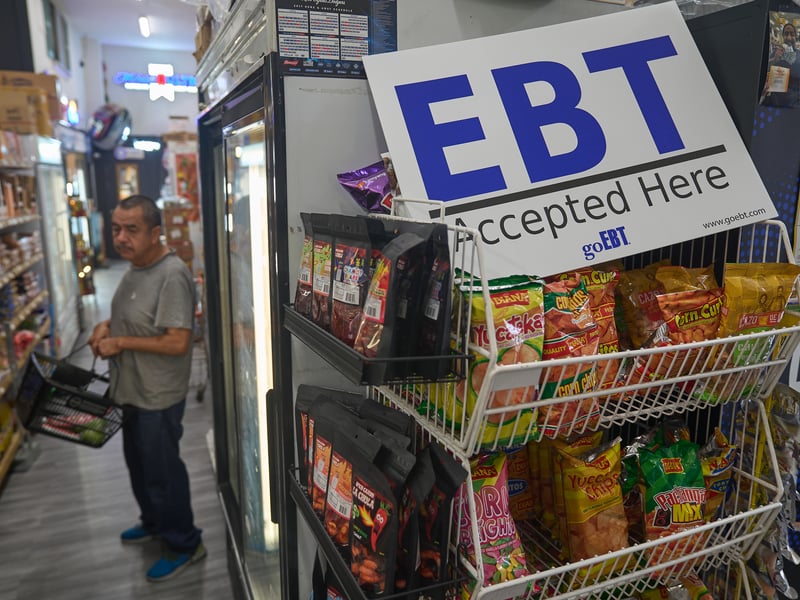
(CN) — The federal government’s refusal to fully fund the Supplemental Nutrition Assistance Program has stoked a “confusing and chaotic” process that could leave many families without any federal food assistance this month, according to Democratic states.
Leaders from more than two dozen states filed an amicus brief on Friday in federal appeals court, pleading with judges to require the Trump administration to distribute SNAP benefits fully amid the ongoing government shutdown.
“Defendants’ decision to issue only partial benefits has sown chaos among the states, and will result in benefit delays of weeks or months in multiple states,” the states wrote in the 23-page filing.
They claim that the administration’s current plan to issue only limited SNAP benefits is further delaying the process, as many states’ distribution systems “require complete reprogramming to accomplish the task.”
In Minnesota, they claim it would take at least six weeks to rewrite the system’s source code, then another six weeks to change the programs back once normal benefits resume. Pennsylvania claims its system would take “a minimum of 9 to 12 business days” to adjust to the government’s altered distribution amount and schedule.
“Oregon reports that it may be able to recode its system in a shorter period, but only by reassigning 570 employees exclusively to the task,” the states claim.
The states are urging the First Circuit Court of Appeals to enforce a lower court’s ruling from Thursday, which required the government to fund SNAP benefits in full, despite the shutdown.
U.S. District Judge John McConnell, a Barack Obama appointee, lambasted the government from the bench after a hearing. He ordered them to use a congressionally approved contingency fund to get money out to recipients as soon as possible.
But the government quickly appealed McConnell’s ruling, calling it a “mockery of the separation of powers.”
“Courts hold neither the power to appropriate nor the power to spend,” the government claims in its Friday appeal. “Courts are charged with enforcing the law, but the law is explicit that SNAP benefits are subject to available appropriations.”
Vice President JD Vance weighed in on the ruling on Thursday, calling it “absurd” because “you have a federal judge effectively telling us what we have to do in the middle of a Democrat government shutdown.” Republican leaders have repeatedly shifted blame for the shutdown to Democrats over the last month.
The government asked the First Circuit for an emergency administrative stay on McConnell’s order, which the appellate court denied Friday evening. The administration is insisting that, despite the multibillion-dollar contingency fund, it does not have the money for SNAP as the shutdown extends deeper into its second month.
But the court declined to grant a stay for now until the court can weigh the merits.
“The request for an administrative stay is denied,” the court ruled in a brief order, penned by First Circuit clerk Anastasia Dubrovsky. “The government’s motion for a stay pending appeal remains pending, and we intend to issue a decision on that motion as quickly as possible.”
It was the shutdown that prompted the Trump administration to previously try to ice SNAP benefits altogether for the month of November, announcing its plan to do so on October 24 — just a week before the funds were set to be shut off.
“Much of this could have been avoided,” the states claim in their Friday filing, “had defendants moved expeditiously to address this crisis on October 1, when the government shutdown began, or even on October 10, when defendants warned the states that the shutdown could cause shortfall funds for the SNAP program.”
It took a ruling from two federal judges for the government to devise its plan to send out partial payments, which is now being scrutinized by both the Democratic states and a batch of Rhode Island churches and nonprofits. Both groups have sued the government over the restrictions to SNAP.
The unprecedented lapse in payments is affecting the roughly one in eight Americans who rely on SNAP to address food insecurity — about 42 million people in total. Children and seniors make up nearly 60% of all recipients and more than 1 million are veterans.
 Follow @Uebey
 Follow @uebey.bsky.social
Subscribe to our free newsletters
Our weekly newsletter Closing Arguments offers the latest about ongoing trials, major litigation and rulings in courthouses around the U.S. and the world, while the monthly Under the Lights dishes the legal dirt from Hollywood, sports, Big Tech and the arts.