
 Search Articles


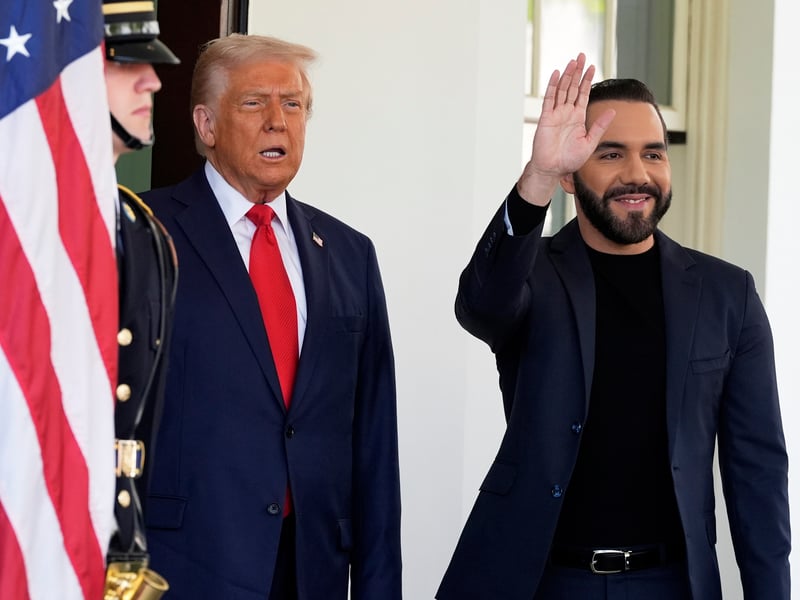
WASHINGTON (CN) — A coalition of immigrant rights groups and criminal defense lawyers sued the State Department Thursday over the government’s agreement with El Salvador’s President Nayib Bukele to indefinitely hold deported migrants at the infamous Terrorism Confinement Center.
Around 238 migrants were abruptly deported to El Salvador’s CECOT mega prison on March 15 after President Trump invoked the Alien Enemies Act and labeled them members of the Tren de Aragua gang without evidence, a designation they have been unable to challenge
According to the lawsuit, the U.S. struck a deal with El Salvador in February allowing it to transfer individuals outside U.S. jurisdiction and pay up to $20,000 per person, amounting to $4.7 million for those deported so far.
The Robert F. Kennedy Human Rights, National Association of Criminal Defense Lawyers, Immigrant Defenders Law Center, Immigration Equality and California Collaborative for Immigrant Justice brought the suit in the U.S. District of Columbia.
“Executive branch leaders have stated that the government plans to continue availing itself of the agreement, sending more people, including potentially U.S. citizens, to indefinite detention in what is an effective black site,” the groups wrote.
The groups asked Chief Judge U.S. James Boasberg, the Barack Obama appointee, who was randomly assigned the case, to set aside the agreement as unlawful.
Skye Perryman, president and CEO of Democracy Forward, said in a statement that the agreement allowed the government to disappear people into “foreign black sites” and decried the acts as un-American.
“It is not immigration policy — it’s an abuse of power typical of autocratic regimes and a direct violation of the U.S. Constitution, federal law and human rights,” Perryman said. “Our lawsuit makes clear: No president — past or present — can buy their way out of the Constitution to disappear people behind a paywall of impunity.”
The groups noted that the State Department had detailed “significant human rights issues” in El Salvador in its 2023 Human Rights Report, finding cruel treatment by security forces, life-threatening prison conditions, arbitrary arrests, “serious problems with the independence of the judiciary,” and forced labor within the country’s prisons.
In certain instances, the State Department found El Salvador had used systemic beatings and electric shocks to torture inmates, including the use of stun guns against wet floors to electrocute all the prisoners in a cell.
The life-threatening conditions arose from: overcrowding; food and water shortages; a lack of medical services; insanitary conditions; and physical attacks.
In one example, a diabetic prisoner received insulin just three times while incarcerated, causing his death. The Department has found reports of widespread tuberculosis and scabies outbreaks in the prisons.
In a declaration for J.G.G. v. Trump , the first lawsuit challenging the deportations, Human Rights Watch cited reports of officers beating detainees for hours, prisoners packed into basement cells with daily abuse, and overcrowding so severe that some were forced to sleep standing.
In one instance, the organizations found that a prisoner who died in custody was buried in a mass grave, without his family’s knowledge.
The Trump administration argues the deported men are dangerous criminals and terrorists who belong in the same prison El Salvador uses to disappear alleged gang members. It has also claimed that judicial review would interfere with the president’s control over immigration and foreign affairs.
Antony Enriquez, vice president of U.S. Advocacy and Litigation at Robert F. Kennedy Human Rights, said in a statement that some of their clients had been deported to El Salvador.
“Ten of our clients were kidnapped from U.S. streets and locked away in one of the world’s most notorious blackhole prisons in a scheme to use U.S. taxpayer dollars for enforced disappearances, incommunicado detention and torture,” Enriquez said.
On Wednesday, Boasberg ordered the Trump administration to facilitate habeas petitions for all 238 men deported to CECOT so they can challenge their removal and their designations as Tren de Aragua members.
In his opinion, Boasberg said the sudden removal of the migrants from a detention center in Texas to a nearby airport without explanation of where they would ultimately end up and for what reason was comparable to Franz Kafka’s plot in “The Trial,” a dystopian tale about a mysterious prosecution that results in the main character’s extrajudicial execution.
 Follow @Ryan_Knappy
Subscribe to our free newsletters
Our weekly newsletter Closing Arguments offers the latest about ongoing trials, major litigation and rulings in courthouses around the U.S. and the world, while the monthly Under the Lights dishes the legal dirt from Hollywood, sports, Big Tech and the arts.