Search Articles


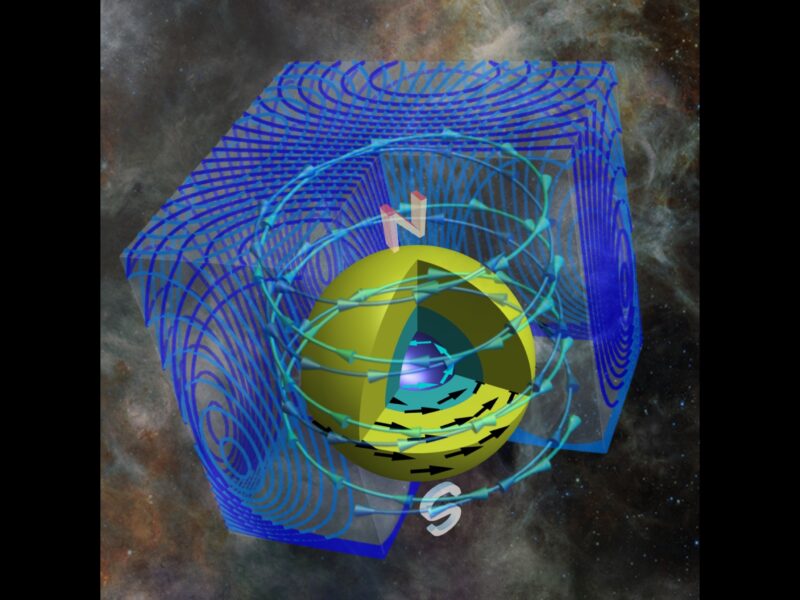
(CN) — For years astronomers have believed stars slow their spin as they age. But new research suggests some may briefly speed up instead just before they die.
Astronomers have long understood that stars tend to spin down over time, often by hundreds or even thousands of times their original rotation rate.
In the case of the sun, that slowdown happens gradually as material escapes in the solar wind, carrying angular momentum with it.
In a study published Monday in The Astrophysical Journal, a team at Kyoto University found magnetic fields deep inside massive stars can sometimes do the opposite, speeding parts of a star up late in life.
The interaction between magnetic fields and flowing plasma has been considered the main driver of that process.
However, observations of other stars have complicated that picture.
Using a technique known as astroseismology, which measures a star’s natural vibrations, scientists have been able to probe the internal rotation rates of stars across the galaxy.
Those measurements suggest current models may not fully explain how dramatically stars slow down as they age.
The researchers set out to explore what might be missing.
“Our co-authors in Australia and the UK have already performed 3D magnetohydrodynamic simulations for massive stars before core-collapse. We suspected that the flow inside the massive star’s convective zone may evolve analogously with the solar convective zone,” said research leader Ryota Shimada in a statement accompanying the study.
The researchers built a 3D simulation of a massive star to examine how convection, rotation and magnetic fields interact beneath the surface. Convection refers to the movement of hot material rising and cooler material sinking, creating turbulent flows inside stars.
The simulation showed those flows are closely tied to both rotation and magnetic fields, and that all three evolve together in a way similar to the solar dynamo — the process that maintains the sun’s magnetic field.
From that, the team developed a model describing how angular momentum moves within a star. In simple terms, that movement can shift spin either outward or inward, changing how fast different regions rotate.
In many cases, that process leads to the expected slowdown. But the researchers also found scenarios where the opposite happens.
“We were surprised to discover that some configurations of the magnetic fields actually spin the core up, suggesting that the final spin rate will be unique to the star’s properties,” said co-author Lucy McNeill in the statement. “Slow rotation might even be forbidden in some classes of massive stars.”
The results suggest the final spin of a star before it dies could vary more widely than previously thought, depending on how its magnetic field is structured.
That matters because a star’s rotation plays a role in what happens at the end of its life, including how it collapses and what kind of remnant it leaves behind.
Researchers also suggest the same physics used to explain rotation in stars like the sun may apply more broadly across different types of stars.
Researchers say the next step is to expand their simulations to follow stars over their full lifetimes, from formation through their final stages, to better understand how rotation evolves over time.
“We were surprised to discover that some configurations of the magnetic fields actually spin the core up, suggesting that the final spin rate will be unique to the star’s properties,” McNeill said.
Subscribe to our free newsletters
Our weekly newsletter Closing Arguments offers the latest about ongoing trials, major litigation and rulings in courthouses around the U.S. and the world, while the monthly Under the Lights dishes the legal dirt from Hollywood, sports, Big Tech and the arts.
Additional Reads

 Early universe light shaped the smallest galaxies April 24, 2026