
 Search Articles


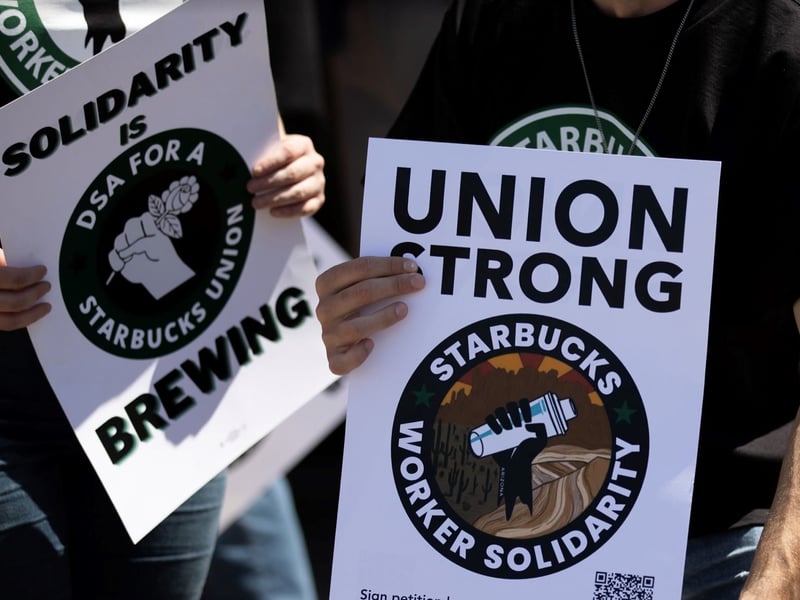
(CN) — Employment practices at the world’s largest coffee company were the focus of a three-judge panel of the Fifth Circuit Court of Appeals on Tuesday, where Starbucks sought to overturn two separate adverse judgments by the National Labor Relations Board.
The first was the result of an incident in the spring of 2022, during a small “collaboration session” with low-level employees in Long Beach, California. There, Starbucks CEO Howard Schultz told a barista who had voiced support of unionizing amid frustration with pay and working conditions that “if you’re not happy at Starbucks, you can go work for another company.”
The National Labor Relations Board later ruled that Schultz’s single remark, made in the context of an ongoing union campaign by Starbucks Workers United, violated a section of the National Labor Relations Act because a reasonable employee would understand it as a veiled threat of discharge for engaging in protected activity.
Representing Starbucks, Attorney Lisa S. Blatt of Williams & Connolly LLP, sought to distance Schultz’s remark from a threat of reprisal, arguing that context, intent and the objective standard are vital considerations. Blatt said the NLRB erred by failing to consider the barista’s reaction and Schultz’s intent because both types of subjective evidence are relevant to how a reasonable employee would understand the statement.
In a follow-up interview, the barista said she did not feel threatened. Blatt also emphasized that under the First Amendment, an employer must have a subjective awareness that a statement is threatening, and recordings of the exchange suggest that Schultz did not.
“A threat requires … the promise of a future retaliatory reprisal,” Blatt said. “In fact, [Schultz] said the opposite. He promised in front of the entire room — managers, employees and on video — that there would be no adverse action taken.”
For the NLRB, attorney Micah Jost said statements like Schultz’s are coercive when made in response to union activity.
“We cite 15 cases in our brief that find statements like this to be unlawful,” he said. “The standard is objective and that neither intent nor actual impressions of employees are relevant.”
“It is ultimately an implicit threat,” he continued. “The idea is you are not welcome here if you support the union; therefore, you are at risk of being fired.”
Both parties referenced the 2023 U.S. Supreme Court case Counterman vs. Colorado, which found that for a statement to be considered a “true threat” unprotected by the First Amendment, the government must prove that the speaker acted with recklessness, meaning they consciously disregarded a substantial risk that their words would be seen as threatening violence.
Blatt contended the Counterman standard should benefit Starbucks, while Jost pushed back, arguing that existing labor law uses an “objective” standard, and the NLRB asserts that precedent does not demand courts probe the subjective intent of the speaker or actual impressions of employees. Instead, it maintains a test based on what a reasonable employee would perceive as a threat.
“It emphasizes that the standard is objective and that neither intent nor actual impressions of employees [are relevant],” he said.
Representing intervenor Starbucks Workers’ United, attorney Dmitri L. Iglitzin of Barnard Iglitzin & Lavitt LLP said the totality of circumstances demonstrates that Schultz knew his comment would have a coercive effect.
Iglitzin characterized Schultz’s approach and the overarching context as calculated to undermine union support, arguing that the setting and Schultz’s prior comments amplify the coercive effect.
“Mr. Schultz is a celebrity, billionaire CEO, and he is an incredibly smooth communicator,” Iglitzin said. “He comes in, he sits in the back. He’s dressed down. He oozes empathy. And it’s easy to watch the video and go, ‘This man has no agenda. He’s just trying to have a sympathetic conversation with the workers.’ But he’s not.”
Iglitzin said later in the same conversation with employees, Schultz recounted a story where a union organizer disrupted a memorial service and, after the conversation, Schultz sent out a mass email to employees calling talk of unionization outrageous and disrespectful.
“There is no reason for [Schultz] to tell that story except to emphasize how intolerable he finds any kind of union activity,” Iglitzen said, urging the panel to uphold the NLRB’s findings.
The second case centered on whether Starbucks committed an unfair labor practice under the NLRA by issuing subpoenas to two pro-union employees amid a 2021 effort at a store in La Quinta, California. An administrative law judge later revoked the subpoenas as overbroad but allowed a narrow renewal, and Starbucks ultimately obtained some evidence that led to the dismissal of the original charges.
The union then filed a new charge, alleging the subpoenas themselves were coercive. In a separate proceeding, an administrative law judge ruled against Starbucks in November 2023, applying a balancing test from the 1995 case National Telephone Directory Corp. to weigh employee confidentiality against employer needs.
Starbucks’ requests were determined to be “inherently coercive,” and the NLRB adopted the ruling in September 2024, ordering the company to stop similar subpoenas and post a remedial notice admitting the violation.
Representing Starbucks, attorney Amy M. Saharia — also of Williams & Connolly LLP — contended that the NLRB applied the wrong legal test, “irrationally convert[ing] every discovery dispute that goes against an employer into an automatic unfair labor practice.” She also urged the court to instead adopt a totality of circumstances test, emphasizing it would consider “far more than simply the substance of each request.”
U.S. Circuit Judge Stephen A. Higginson, a Barack Obama appointee, probed the distinction between a quashed subpoena and an unfair labor practice, questioning if the mere attempt to obtain evidence via subpoena could be prosecuted. Arguing for the NLRB, attorney Jared Odessky defended the established balancing approach.
“The board saw no reason to depart from its seasoned analysis under the balancing test,” Odessky explained. “It essentially said that employees’ strong interests here versus the employer’s minimal need for this information was strongly in favor of employees.”
Attorney Michael Ellement of James & Hoffman PC, for Starbucks Workers United, underscored the board’s position that Starbucks’ subpoenas were overbroad and targeted protected employee communications, warning that “the board has been clear to employers for decades that when they issue requests to employees, they cannot be overbroad. They cannot seek certain information.”
In rebuttal, Saharia pushed back on the idea that its requests were inherently coercive.
“The board has never explained how that is an appropriate test and why it’s appropriate to convert every single revoked subpoena into an automatic unfair labor practice,” she said.
The court’s deliberations focused on whether a more nuanced, circumstance-specific approach was warranted or if the board’s more categorical standard should apply to subpoenas issued in this context.
The panel also included U.S. Circuit Judges Leslie H. Southwick and Dana M. Douglas, appointees of George W. Bush and Joe Biden, respectively. They did not indicate when they would rule but noted Starbucks has three other cases pending before the court.
 Follow @gabetynes
Subscribe to our free newsletters
Our weekly newsletter Closing Arguments offers the latest about ongoing trials, major litigation and rulings in courthouses around the U.S. and the world, while the monthly Under the Lights dishes the legal dirt from Hollywood, sports, Big Tech and the arts.