
 Search Articles


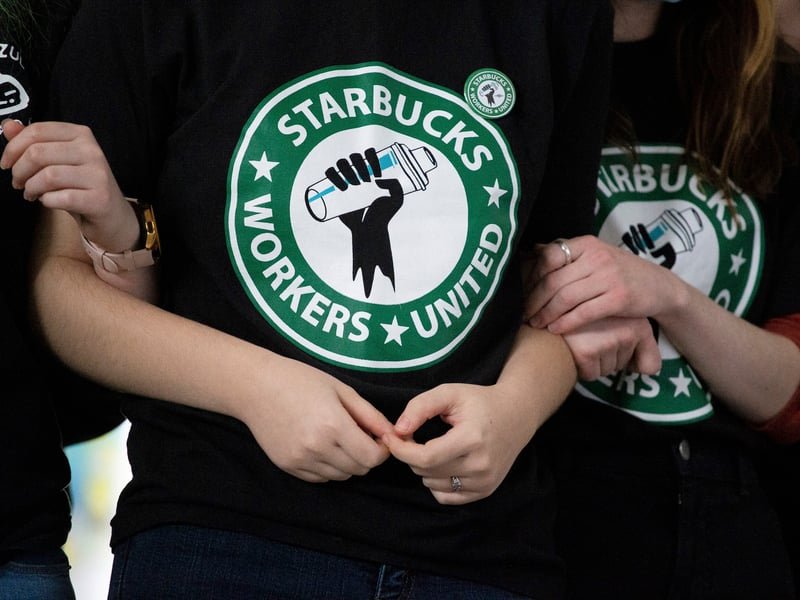
CINCINNATI (CN) — Starbucks’ decision to temporarily close a Memphis coffee shop and fire several workers in the wake of pro-unionization efforts undoubtedly chilled the speech of other employees, an appeals court determined Tuesday.
The National Labor Relations Board filed a lawsuit against the Seattle-based coffee giant, which fired several employees from a Memphis store after they contacted local media and attempted to convince their coworkers to unionize.
Managers closed the coffee shop early when they caught wind of the employees’ scheduled interview with a Memphis news outlet, and Starbucks axed the “Memphis 7” as a disciplinary measure for opening the store and allowing the reporters in anyway.
In the wake of the firings, employees at the store stopped wearing pro-union pins. Workers at neighboring locations testified they were afraid to discuss unionization efforts amongst themselves.
Chief U.S. District Judge Sheryl Lipman, an Obama appointee, granted the labor board’s motion for a preliminary injunction in August 2022 to prevent further retaliation by Starbucks, while also reinstating the Memphis 7 to their previous positions.
Starbucks appealed the decision to the Sixth Circuit and the case was argued in May.
Senior U.S. Circuit Judge Danny Boggs, a Ronald Reagan appointee, made it clear at the outset of his opinion that Starbucks did not challenge whether the terminations of the Memphis 7 violated the National Labor Relations Act, but whether the relief granted by Lipman was necessary to protect the integrity of ongoing labor negotiations.
Boggs emphasized violations of the policies for which the employees were fired were rarely punished and, “on occasion, management appears to have even encouraged them.”
“Under these circumstances,” he continued, “Starbucks’s termination of the Memphis 7 — including six of the seven members of the organizing committee — mere weeks after the media event would almost certainly chill other partners’ exercise of rights protected by the act.”
Testimony from employees at the Memphis store about the immediate removal of pro-union pins following the terminations and a fear of discussing any unionization efforts presented concrete evidence of chilled speech, according to Boggs.
He cited the 2003 Sixth Circuit decision in Ahearn ex rel. NLRB v. Jackson Hosp. Corp. to support the panel’s decision to uphold reinstatement of the employees.
In that case, six hospital employees were fired after their participation in a strike, and a Sixth Circuit panel upheld a federal judge’s decision to reinstate them on the grounds “the union was quite new … [which makes] ‘bargaining units highly susceptible to management misconduct.’”
“Here, as in Ahearn, " Boggs wrote, “the new union faces a critical juncture. Fear of retaliation will exist unless the Memphis 7, apparently terminated for their union support, are reinstated. Likewise, the organizing committee faced a severe encumbrance on its ability to unionize effectively when all but one of its members were terminated.”
Starbucks argued a successful unionization vote following the termination of the Memphis 7 rendered its disciplinary action meaningless and prevented a “return to the status quo,” a claim Boggs likened to “having their cake and eating it too.”
“[Starbucks] could either engage in misconduct and successfully discourage unionization or engage in misconduct and fail to prevent unionization, secure in the knowledge that an election victory would absolve them of their sins,” he said in dismissing the argument.
In a concurring opinion, U.S. Circuit Judge Chad Readler, a Trump appointee, “reluctantly agreed” with Boggs’ lead opinion but opined on the need to adopt the standard “four-factor” test used by federal courts to grant injunctive relief when considering labor relations disputes.
Those factors include the movant’s likelihood of success on the merits, the existence of irreparable harm, the balance of the equities and the public interest — all of which “harmonize our approach to preliminary relief,” according to Readler.
He pointed out an increase in the number of NLRB complaints, which he said often take over a year to resolve, have tipped the scales in favor of the agency and allowed courts to hamper employers’ operations during investigations and litigation.
“Over four decades, we entrenched a body of law far out of line with traditional equity jurisprudence, an approach others have now jettisoned. With two decades of added perspective, our approach to [NLRA] injunctions should be overhauled,” Readler concluded.
Chief U.S. Circuit Judge Jeffrey Sutton, a George W. Bush appointee, rounded out the panel and joined in Boggs’ lead opinion.
The labor board’s general counsel, Jennifer Abruzzo, was understandably pleased with the court’s ruling.
“The Sixth Circuit’s well-reasoned decision upholding the reinstatement of workers known as the ‘Memphis 7’ is critical to ensuring that Starbucks employees in Memphis and beyond can freely exercise their rights to organize and work together to improve their working conditions,” she said. “I’m very proud of all of the NLRB staff who helped bring about this tremendous victory.”
Starbucks did not return a request for comment.
 Follow @kkoeninger44
Subscribe to our free newsletters
Our weekly newsletter Closing Arguments offers the latest about ongoing trials, major litigation and rulings in courthouses around the U.S. and the world, while the monthly Under the Lights dishes the legal dirt from Hollywood, sports, Big Tech and the arts.