
 Search Articles


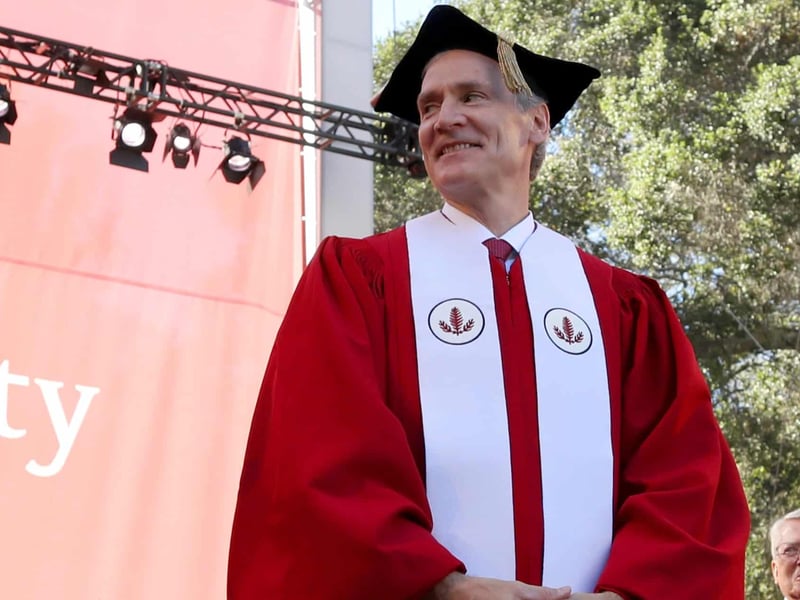
(CN) — Stanford University President Marc Tessier-Lavigne stepped down from his position Wednesday after a special investigation found that he was not robust enough in correcting errors in scientific papers and there were serious flaws in the presentation of research data.
“Although the report clearly refutes the allegations of fraud and misconduct that were made against me, for the good of the university, I have made the decision to step down as president effective August 31,” Tessier-Lavigne wrote in a statement to the community posted on a Stanford website.
“The panel’s report identified some areas where I should have done better, and I accept the report’s conclusions. Specifically, the report discusses steps I took to address issues that arose with some publications. I agree that in some instances I should have been more diligent when seeking corrections, and I regret that I was not,” Tessier-Lavigne wrote.
Tessier-Lavigne built a distinguished career as a scientist. He arrived at Stanford, located in Palo Alto, Calif., in 2016 after serving as president of The Rockefeller University, a premier scientific research institution. In his Stanford biography, the school calls him a “pioneering neuroscientist, biotechnology executive and academic leader.”
There were public allegations of scientific misconduct involving scientific papers where Tessier-Lavigne is a co-author and author.
“The panel’s review also identified instances of manipulation of research data by others in my lab," Tessier-Lavigne wrote in his public statement. “Although I was unaware of these issues, I want to be clear that I take responsibility for the work of my lab members.”
Stanford’s board of trustees, which oversees the president, formed a special committee to check out the allegations. The report was spearheaded by Mark Filip and his colleagues at the law firm Kirkland & Ellis.
“This was a very robust and rigorous process. This was possible in foundational part because of the caliber and commitment to the scientific panel members, some of the foremost experts and leaders in their fields. We encourage members of the Stanford community and broader scientific circles to read it in full,” said Filip, whose assistant read the statement over the phone from Chicago.
Filip engaged a who’s who of experts for the scientific panel, which included Hollis Cline, Dr. Kafui Dzirasa, Dr. Steven E. Hyman, Randy Schekman and Shirley M. Tilghman.
“They were selected for their preeminent academic and scientific backgrounds, as well as their experiences in university leadership, research, and scientific publication,” Filip wrote in his findings.
With help from forensic consultants the panel pored over more than 50,000 documents from journals, institutions and Tessier-Lavigne’s own digital records. The process included more than 50 meetings with individuals possessing knowledge pertaining to the inquiry, including seven with Tessier-Lavigne.
Allegations of research misconduct first emerged from the website PubPeer, a crowd-sourced platform where members of the scientific community can raise concerns over scientific publications, according to Filip.
Twelve papers on which Dr. Tessier-Lavigne was involved with came under the scope of the panel’s review.
Tessier-Lavigne has headed research laboratories for 32 years and has published 74 papers as a principal author, and more than 150 where he is the non-principal author.
The panel concluded that in 2001, the early 2010s, 2015-16, and March 2021, Tessier-Lavigne failed to correct mistakes in the scientific record.
Additionally, the panel observed an “unusual frequency of manipulation of research data and/or substandard scientific practices from different people.”
Jerry Yang, chair of Stanford’s board of trustees, said Tessier-Lavigne accepted the panel’s report and is making corrections and retractions to the scientific record.
The board has appointed Professor Richard Saller to serve as president on an interim basis starting Sept. 1 and continuing until the next president is chosen.
“Stanford is an exceptional and strong institution. The board remains fully committed to Stanford’s mission of excellence in research and education. As always, we stand in service of the best interests of the university we all love,” Yang said in a statement.
“While I will be stepping down as president," Tessier-Lavigne said, “I will remain on the Stanford faculty and look forward to continuing to conduct my scientific research on brain development and neurodegeneration under the auspices of one of the world’s preeminent educational institutions.”
.
Subscribe to our free newsletters
Our weekly newsletter Closing Arguments offers the latest about ongoing trials, major litigation and rulings in courthouses around the U.S. and the world, while the monthly Under the Lights dishes the legal dirt from Hollywood, sports, Big Tech and the arts.