
 Search Articles


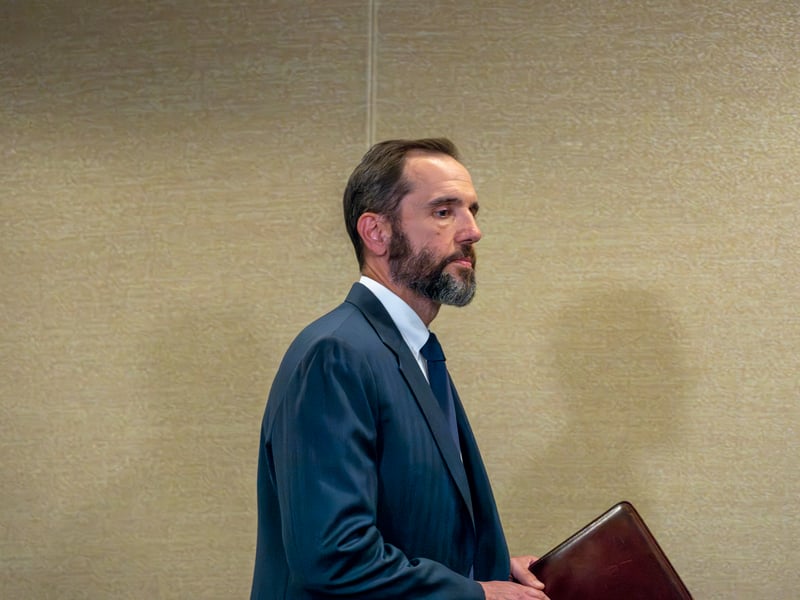
WASHINGTON (CN) — Special counsel Jack Smith asked a federal judge on Monday to dismiss President-elect Donald Trump’s federal election subversion case, bringing the long-delayed prosecution to a close.
“After careful consideration, the department has determined that the Office of Legal Counsel’s prior opinions concerning the Constitution’s prohibition on federal indictment and prosecution of a sitting president apply to this situation and that as a result this prosecution must be dismissed before the defendant is inaugurated,” Smith said.
U.S. District Judge Tanya Chutkan, a Barack Obama appointee, is expected to grant the dismissal motion, ending what had been Trump’s most serious criminal case in an anticlimactic fashion.
As special counsel, Smith is required release a final report consolidating all the evidence he has collected over the course of his investigation into Trump’s expansive scheme to spread false claims of election fraud and upend the peaceful transfer of power on Jan. 6, 2021. He made no mention of a report in the motion.
With Republicans set to take control of both the House and the Senate come January, it is unlikely the report will amount to much in Trump’s second term.
Smith’s decision to abandon the historic prosecution marks the latest victory for Trump in his multiple criminal cases following his electoral victory earlier this month.
On Friday, the judge overseeing Trump’s criminal hush money trial in Manhattan — the only one to go to trial, which resulted in a 34-count conviction — indefinitely suspended the sentencing in the case. Trump was set to face sentencing on Tuesday.
Also on Monday, Smith moved to dismiss his appeal of the charges against Trump in his classified documents case in Florida, where the special counsel was set to argue at the 11th Circuit Court of Appeals that he was not unconstitutionally appointed.
Smith requested the appeal be dropped in part and allow an appeal in the prosecution of two Trump employees who pleaded not guilty to obstruction charges in the case.
Steven Cheung, Trump’s campaign spokesperson and incoming communications director, welcomed Smith’s decision as “another legal victory” in an emailed statement.
“Today’s decision by the DOJ ends the unconstitutional federal cases against President Trump, and is a major victory for the rule of law,” Cheung said. “The American people and President Trump want an immediate end to the political weaponization of our justice system and we look forward to uniting our country.”
In the six-page motion, Smith cited longstanding Justice Department policy that a sitting president cannot be criminally charged but emphasized the gravity of the four charges Trump faced the past 16 months.
He detailed discussion with the Office of Legal Counsel, which issued two relevant opinions in 1973 and 2000, following the Watergate scandal during Richard Nixon’s presidency and the impeachment of Bill Clinton.
In 1973, the office determined that while the Constitution’s impeachment judgment clause did not preclude the prosecution of a sitting president, any criminal prosecution would “violate the separation of powers and ‘unduly interfere in a direct or formal sense with the conduct of the presidency,’” Smith wrote in the motion.
In 2000, after Clinton was impeached and acquitted, the office again found that a prosecution would risk three burdens on his work: the physical burden of imprisonment; the “public stigma and opprobrium” that would weaken the president’s constitutional leadership role; and the mental and physical burdens of preparing a criminal defense.
“Both the 1973 and 2000 OLC opinions recognized the critical national interest in upholding the rule of law, and stated that the president is not above it,” Smith added.
Smith initially brought the four charges — conspiracy to defraud the United States, conspiracy against rights, conspiracy to obstruct an official proceeding and obstruction of an official proceeding — in August 2023.
After the Supreme Court ruled in July that presidents have at least the presumption of immunity, Smith filed a superseding indictment to shield the charges against the high court’s concern that much of Trump’s indicted conduct could fell within the president’s “outer perimeter” of his presidential duties and thus invoked immunity.
Prior to the election, Chutkan was set to weigh either party’s immunity arguments, which would have set up another round of appeals potentially back to the Supreme Court.
However, Trump’s victory leaves the extent of presidential immunity vague and will likely embolden him over the next four years, during which he is expected to fill as many judicial offices as possible, including on the Supreme Court.
 Follow @Ryan_Knappy
Subscribe to our free newsletters
Our weekly newsletter Closing Arguments offers the latest about ongoing trials, major litigation and rulings in courthouses around the U.S. and the world, while the monthly Under the Lights dishes the legal dirt from Hollywood, sports, Big Tech and the arts.