
 Search Articles


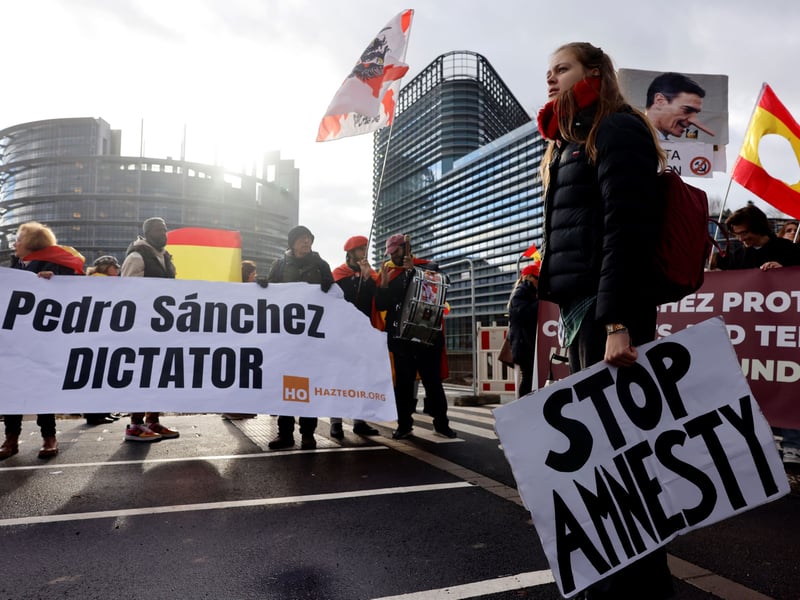
(CN) — The unresolved and polarizing question of Catalonia’s independence is once again plunging Spanish politics into crisis and paralysis.
The fragile government of Spanish Prime Minister Pedro Sánchez faces a major debacle after it was unable to pass a contested amnesty law for Catalan secessionists on Tuesday afternoon.
The bill was defeated in the Congress of Deputies, the powerful lower chamber, and sent back to the drawing board after seven deputies with the hard-line Together for Catalonia party voted against the legislation. They worried it did not protect Carles Puigdemont, the party’s self-exiled leader, and others from charges of terrorism and treason.
The parliamentary defeat was a major embarrassment for Sánchez, whose Socialists cobbled together a coalition government with the left-wing Sumar party only after winning support from Catalan and Basque separatists.
The problem is that his government’s survival hinges on passing an amnesty law for hundreds of Catalan politicians, public officials, police officers and activists who were prosecuted or face prosecution for their involvement in the Catalan independence drive.
But Sánchez says the amnesty law faces getting overturned by Spanish and European Union courts if the bill shields people accused of terrorism and treason.
Although the bill was amended to include language saying amnesty would apply to people accused of terrorism who did not knowingly violate human rights, Puigdemont’s party insisted it will only support the bill if it covers those crimes without conditions.
This impasse is linked to two Spanish judges who are pursuing terrorism and treason investigations against Puigdemont and others.
Since last November, Manuel García-Castellón, a national court judge, has pushed to charge Puigdemont and other Catalan leaders with terrorism for their involvement with Democratic Tsunami, a secretive group that organized demonstrations and actions — including the occupation of Barcelona’s El Prat airport in October 2019 — to protest the prosecution of Catalan independence leaders.
Meanwhile, Joaquín Aguirre, a Barcelona judge who has investigated political corruption, on Monday extended for six months a probe into accusations that Puigdemont sought the help of Russian officials to carry out his plans for Catalonian independence. In this case, Puigdemont faces accusations of high treason, a crime that would exclude him from the proposed amnesty.
Puigdemont is accused of meeting with a Russian official with close ties to the Kremlin at the height of the independence drive in October 2017. Media reports suggest Russia offered to help Puigdemont by sending 10,000 troops to Catalonia and turning Barcelona into a hub for cryptocurrency trading.
Following a failed and illegal independence referendum in 2017, Puigdemont fled to Belgium out of fear of prosecution. At the time, he was the president of Catalonia’s regional government. He remains in Brussels, where he is a member of the European Parliament. Meanwhile, several Catalan politicians and activists who stayed in Spain were charged with crimes and convicted, though Sánchez pardoned them in 2021.
After Tuesday’s vote, Puigdemont said his party voted against the law because it did not offer a “comprehensive amnesty” and left too “many loopholes.”
He accused the judges pursuing terrorism and treason cases against him of being politically motivated. He described Spain’s judicial system as one “where judges, prosecutors, police, journalists conspire to subvert democracy while the attorney general always looks the other way.”
“And they want us to trust that these conspiring judges and prosecutors will deliver us justice?” Puigdemont said on social media.
For many on the left, García-Castellón and Aguirre are viewed as partisans of the conservative opposition, which is vehemently against the Catalan independence drive.
Alberto Núñez Feijóo, the opposition leader of the center-right Popular Party, is attacking Sánchez for allying with Catalan secessionists and defended the judges in an interview on Spanish television.
“Terrorism is terror and in Catalonia there were days of absolute terror,” Feijóo told Antena3, a Spanish broadcaster.
He called the 2019 demonstrations that disrupted roadways, the airport and railways “pure fascism.”
His fierce criticism of Sánchez and the Catalan movement reflects widespread anger in Spain over the amnesty bill. The Popular Party and the far-right Vox party have been leading protests for weeks against the proposed legislation. Another large rally against the bill took place on Sunday.
Tuesday’s defeat highlighted how difficult it will be for Sánchez to govern. Without an amnesty bill, he cannot rely on the support of the Catalan parties to pass legislation — for example, a new budget.
A Justice Commission at the Parliament will have another month to discuss amendments to the amnesty bill before it is brought before the Congress of Deputies for a second vote.
But even if an amnesty bill passes, it faces numerous hurdles, with the opposition vowing to fight it at every step and slow its progress through the Senate, which is in the hands of the Popular Party. Any amnesty law will also face legal challenges.
Courthouse News reporter Cain Burdeau is based in the European Union.
 Follow @cainburdeau
Subscribe to our free newsletters
Our weekly newsletter Closing Arguments offers the latest about ongoing trials, major litigation and rulings in courthouses around the U.S. and the world, while the monthly Under the Lights dishes the legal dirt from Hollywood, sports, Big Tech and the arts.