
 Search Articles


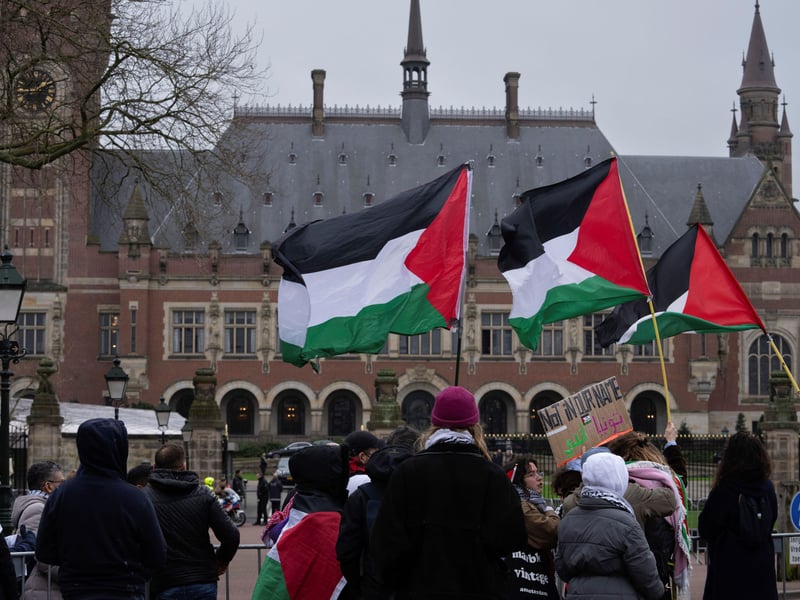
MADRID (AFP) — Spain said Thursday it would join South Africa’s case at the U.N.’s top court in which Pretoria has accused Israel of “genocide” in the Gaza Strip.
His statement came a week after Spain, along with Ireland and Norway, recognized the state of Palestine, sparking fury from Israel.
“Our sole goal is to put an end to the war and to advance on the road of applying the two-state solution,” Foreign Minister Jose Manuel Albares told journalists.
South Africa brought the case before the International Court of Justice last year. It claims that Israel’s Gaza offensive, launched in retaliation for an unprecedented Hamas attack on Israel, breached the 1948 U.N. Genocide Convention.
Israel has strongly denied the accusation.
Albares, asked if he felt Israel’s actions in Gaza amounted to genocide, said it was up to the court to decide.
“At the moment we see a large-scale war that does not distinguish between civilian and military targets in Gaza, as well as the enormous risk of regional spillover,” he added.
Several Latin American nations, including Colombia and Mexico, have already joined South Africa’s proceedings before the court.
Until now, however, no European country had taken that step. Ireland has also indicated it plans to join the case.
‘Right side of history’
Set up after World War II, the Hague-based court rules in disputes between states.
The court on Friday ordered Israel to ensure “unimpeded access” to U.N.-mandated investigators to look into allegations of genocide.
In a ruling on Jan. 26, the court also ordered Israel to do everything it could to prevent acts of genocide during its military operation in Gaza.
But South Africa has since returned several times to the court, arguing that the dire humanitarian situation in the territory compels the court to issue further fresh emergency measures.
On May 24, the court ordered Israel to “immediately” halt its military offensive in the city of Rafah and keep open the key border crossing there for “unhindered” humanitarian aid.
It also called for the “unconditional” release of hostages taken by Palestinian militant group Hamas during its Oct. 7 assault that sparked the war.
“It is urgent that we all support the court so that precautionary measures aimed at stopping any military operation are respected,” Spanish Prime Minister Pedro Sanchez said at an economic forum.
“And it is essential that we all strengthen the United Nations, supporting the role of the court as the highest judicial organ of a rules-based international system.
“Have no doubt: Spain will stand on the right side of history.”
Binding, but unenforceable
While ICJ rulings are legally binding, the court has no concrete means to enforce them. For example, it ordered Russia to halt its invasion of Ukraine, to no avail.
Spain is one of the European countries that has been most critical of Israel over the war in Gaza.
The war was sparked by Hamas’s Oct. 7 attack on Israel, which resulted in the deaths of 1,194 people, mostly civilians, according to an AFP tally based on Israeli official figures.
Israel’s retaliatory military offensive has killed at least 36,654 people in Gaza, also mostly civilians, according to the Hamas-run territory’s health ministry.
—
By Agence France-Presse
Subscribe to our free newsletters
Our weekly newsletter Closing Arguments offers the latest about ongoing trials, major litigation and rulings in courthouses around the U.S. and the world, while the monthly Under the Lights dishes the legal dirt from Hollywood, sports, Big Tech and the arts.