
 Search Articles


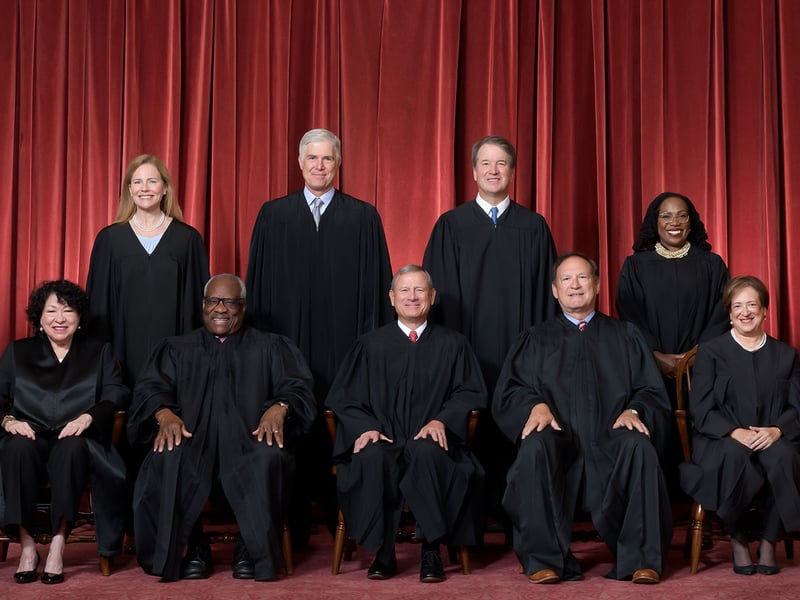
(CN) — The Supreme Court granted only one petition for review Monday, spurring a dissent from two justices who scorned the court over not applying “equal justice under law.”
While the justices vacated the conviction and death sentence of James Skinner’s co-defendant in 2016, based on suppressed evidence, they denied his petition seeking similar relief.
Although Skinner’s trial relied on the same evidence used against Michael Wearry when they were both tried over the 1998 murder of Eric Walber, Louisiana courts refused to apply the high court’s findings to Skinner’s case, leaving him incarcerated while Wearry was freed.
“Equal justice under law, the phrase engraved on the front of this court’s building, requires that two co-defendants, convicted of the same crime, who raised essentially the same constitutional claims, receive the same answer from the courts,” Justice Sonia Sotomayor wrote in the dissenting opinion.
“Here, because the Louisiana courts refused to apply this court’s Bradyprecedents, including a decision by this court involving the very same evidence, Skinner risks spending the rest of his life in prison while Wearry walks free. Because the court refuses to enforce its own precedents, I respectfully dissent from the denial of certiorari,” the Barack Obama appointee added.
Skinner’s trial was plagued by piles of suppressed evidence that his counsel easily could have used to further undermine an already weak case against him, wrote Sotomayor, who was joined by the Joe Biden-appointed Justice Ketanji Brown Jackson.
Like with Wearry, no physical evidence connected Skinner to the murder. In both cases, prosecutors relied on the same two eyewitness accounts.
One witness, Sam Scott, gave investigators many significantly different accounts of Walber’s murder. Prosecutors then suppressed evidence indicating Scott had coached people to lie about Walber’s murder to get out of jail, and that Scott was testifying “to settle a personal score” against Wearry.
Scott’s story was also likely physically impossible, as he said a man named Randy Hutchinson hauled Walber in and out of a vehicle and beat him, despite medical records revealing Hutchinson had just undergone major knee surgery.
Eric Brown was the only other eyewitness. Undisclosed evidence belied the state’s assertions at trial that he sought no favors for his testimony, when Brown was in fact motivated by the “possibility of a reduced sentence on an existing conviction.”
According to Skinner’s petition, his counsel was able to conduct a renewed investigation that unearthed additional withheld evidence that further weakened the case against him. He cited police records indicating police fed Scott information to shape his story, and Brown admitting to fellow prisoners he participated in the carjacking that led to Walber’s murder, but wanted to pin the crime on Wearry.
Additional records also showed Brown identified another man as Walber’s killer, who had purportedly boasted about the murder while he was prosecuted for a similar carjacking one month later.
There is also significant evidence of other possible suspects, even beyond the man Brown identified in the photo array, Sotomayor noted. One possible suspect repeatedly confessed, according to three independent sources. Another was seen covered in blood the night of the murder, reportedly confessed, and asked the police if he was a suspect.
It is “illogical” to deny Skinner’s claims, Sotomayor wrote, given there is substantially more undisclosed evidence at issue now than there was when the court found prosecutors had “beyond doubt” violated its constitutional obligations for his co-defendant.
Unlike in Wearry’s case, Skinner’s first trial ended with a hung jury, and his second trial ended with a nonunanimous verdict, which would be unconstitutional under modern precedent, set in 2020.
“Because Skinner was subject to the same constitutional violations that Wearry was (and more), he is entitled to the same relief that Wearry received. The Louisiana courts denied him that relief,” Sotomayor wrote.
“Rather than leaving that injustice in place, the court should have granted certiorari to uphold its obligations to ensure the supremacy of its own decisions and to treat like defendants alike,” she added.
While Skinner’s petition and many others were denied Monday, the justices agreed to decide whether defendants can circumvent the pleading requirements of the Federal Rules of Civil Procedure.
Jasmine Younge’s petition comes after a judge determined she was excluded from pursuing a pregnancy discrimination claim against the Fulton County District Attorney’s Office in Atlanta because her job duties made her a member of the personal staff of an elected official.
She argues that the 11th Circuit erred in allowing Fulton County to assert this unpled affirmative defense in a summary judgment motion that was filed almost exactly a year after the expired scheduling order deadline for any pleading amendments.
The case presents a multifaceted circuit conflict about when a pleading may be amended and if a defendant can ever base a summary judgment motion on an unpled affirmative defense.
 Follow @Megwiththenews
Subscribe to our free newsletters
Our weekly newsletter Closing Arguments offers the latest about ongoing trials, major litigation and rulings in courthouses around the U.S. and the world, while the monthly Under the Lights dishes the legal dirt from Hollywood, sports, Big Tech and the arts.