
 Search Articles


(CN) — The European Union is in a breakthrough moment: It’s begun churning out more electricity from solar panels and wind turbines than power plants fed by coal and natural gas.
The EU hit this important milestone last year for the first time, according to a January report from Ember, a London-based energy think tank. Ember is credited with providing the most up-to-date global figures on renewable energy.
A surge in solar generation across the EU’s 27 member states drove the momentum. Solar production jumped last year by 20% compared to 2024, generating more than 13% of the EU’s total power for the year, an all-time high, Ember said.
“In solar, we see exponential growth in all European countries except the very northern parts of the Nordics,” said Leonhard Gandhi, an expert on electricity generation at the Fraunhofer Institute for Solar Energy Systems in Germany.
In all likelihood, experts said last year marked the first of what may become a normal year in Europe when wind, sun and water are the primary sources for electricity.
“It is clearly a crucial turning point,” said Robert Pietzcker, an expert on renewable energy at the Potsdam Institute for Climate Impact Research in Germany.
Rina Bohle Zeller, an energy policy expert at Agora Energiewende, a Berlin-based climate think tank, said: “We are definitely going to see an increase because renewable electricity is going to expand.”
The EU’s landmark year was part of a global trend with renewable energy, especially thanks to solar panels, showing impressive gains in many countries.
Last October, Ember reported that globally renewable power generation outpaced coal in the first half of 2025 for the first time. Ember has not yet issued data for the second half of last year.
In a nod to that feat, Science magazine made the global growth in renewable energy its “Breakthrough of the Year” for 2025, and linked an “unstoppable growth of renewable energy” to China’s massive increase in the production of solar cells, wind turbines and lithium batteries that have driven down prices. China produces about 80% of the world’s solar panels, 70% of its wind turbines and 70% of its lithium batteries.
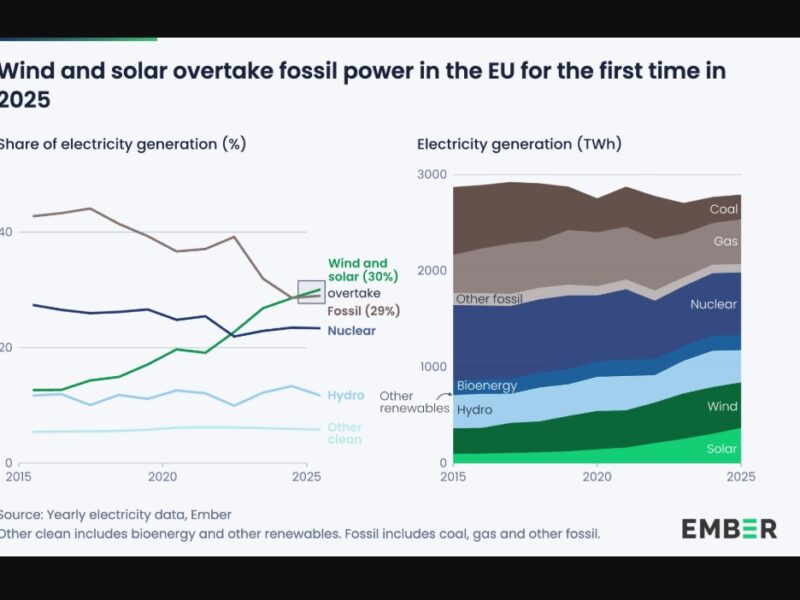
In the EU last year, wind and solar accounted for 30.1% of the electricity produced while fossil fuels (mostly natural gas, some coal and a bit of petroleum and waste) generated 29%, Ember reported.
Wind production dipped a bit last year due to weather conditions, but it still accounted for 16.9% of the EU’s electricity, Ember said. Nuclear power and hydro-electric dams provided most of the rest — 23.4% and 11.7% respectively.
Besides the rollout of a huge number of solar panels across rooftops and fields in Europe, last year’s milestone can be traced to EU climate policy driving countries away from coal and toward green energy.
The EU has set a legally binding target of reaching “net zero” by 2050, a scenario where its 450 million people and $22 trillion economy are no longer adding to the greenhouse gas load in the atmosphere.
To reach that goal, getting rid of coal is a must.
Last year, coal hit a new low, with only 9.2% of the EU’s electricity coming from coal-fired plants, Ember found. A decade ago, coal accounted for nearly a quarter of the EU’s power generation. It’s expected to be a thing of the past as a power source by 2040.
In the past two decades, coal plants across the EU have closed or turned to burning gas, largely as a result of Brussels imposing hefty prices for every ton of carbon emitted, making coal uneconomical and green energy much cheaper.
“Countries are adding more and more renewables,” Bohle Zeller said. “Economically, it makes sense.”
Coal burning is mostly confined to Poland and Germany, though it’s still powering former communist countries such as Bulgaria, Romania, Czechia and Slovenia.
Another factor behind the spread of renewable energy was Russia’s invasion of Ukraine and a subsequent spike in energy costs.
“After the energy price crisis in 2022, everybody started building huge amounts of wind and solar, which then came on line in 2023 and 2024,” Pietzcker said.
Since the Ukraine war and rising global tensions, Europe sees investment in green energy as a security benefit because it lessens the leverage fossil fuel producers — such as Russia, Saudi Arabia and even the United States — can exert with price hikes and shutoffs.
Beatrice Petrovich, an Ember analyst, said Brussels wants “to reduce vulnerability to energy blackmail from fossil exporters.”
Europe’s next challenges
Besides continuing to install more solar panels and wind turbines, the EU’s next big challenges lie in expanding electrical grid systems and building places to store all the green energy created when the sun is shining and the wind blowing — periods that don’t necessarily match with demand for power.
“The problem is you have an hour with lots of wind somewhere and then you don’t get that wind [power] away from there,” Pietzcker said. “When you don’t have enough grid or storage, that electricity is simply curtailed, thrown away.”
To make the most of renewable energy, he said work to expand and improve transmission lines and install more batteries is taking place across the EU.
“Every large EU member state has thousands of kilometers of grid improvement on their to-do list,” Pietzcker said. “And that grid expansion is happening slowly, painfully slowly.”
Ben McWilliams, an energy and climate analyst at Bruegel, a Brussels-based economic think tank, also pointed to the storage difficulty.
“The challenge increasingly becomes not just building more and more solar and wind, but increasingly how do you ensure that you have that solar and wind that can be used, first of all, across the 24-hour period,” he said.
All this work is very expensive and complicated by regulations and the need to obtain permits, especially when it comes to lines that cross through inhabited areas and involve multiple jurisdictions. Turbines and solar farms often are constructed in remote places, making it necessary to build new lines to bring that energy into the larger electrical grid.
“Our systems were built 80 years ago to bring electrons from coal plants and gas plants into cities, and then to use them there,” McWilliams said.
Today, green energy is most often being produced far from cities. “It is not necessarily smart to put your wind farm where your coal plant was,” McWilliams said. “You want to put your wind farm where it’s windy.”
Bohle Zeller said critical work to connect grids across EU borders also was happening.
“The further you integrate the European market, the better you can integrate resources, and the less backup capacities you are going to need,” she said.
Last year, then, showed the EU is largely on track when it comes to the power sector in meeting its goal of becoming net zero by 2050.

“On the actual implementation, I would say the EU is doing reasonably well,” Pietzcker said. “It will be the first regional superpower to reach an almost carbon-free power supply, I’m convinced of that.”
But the picture is much less clear when it comes to how well the EU is shifting other sectors away from fossil fuels, Gandhi said.
“Electrification of transportation, electrification of heating and electrification of industrial processes is much too slow in many of the European countries,” he said.
Carbon emissions have been on a downward trajectory in the EU since 2008, coinciding with the Great Recession. Since 1990, its emissions have fallen by 36%, but the bloc’s 27 nations still pump a lot of pollutants into the sky. In 2024, the EU added about 3.3 billion tons of carbon dioxide into the atmosphere, according to Eurostat.
Courthouse News reporter Cain Burdeau is based in the European Union.
 Follow @cainburdeau
Subscribe to our free newsletters
Our weekly newsletter Closing Arguments offers the latest about ongoing trials, major litigation and rulings in courthouses around the U.S. and the world, while the monthly Under the Lights dishes the legal dirt from Hollywood, sports, Big Tech and the arts.
Additional Reads


 Judge dismisses foster kids' suit against Alaska March 31, 2026